
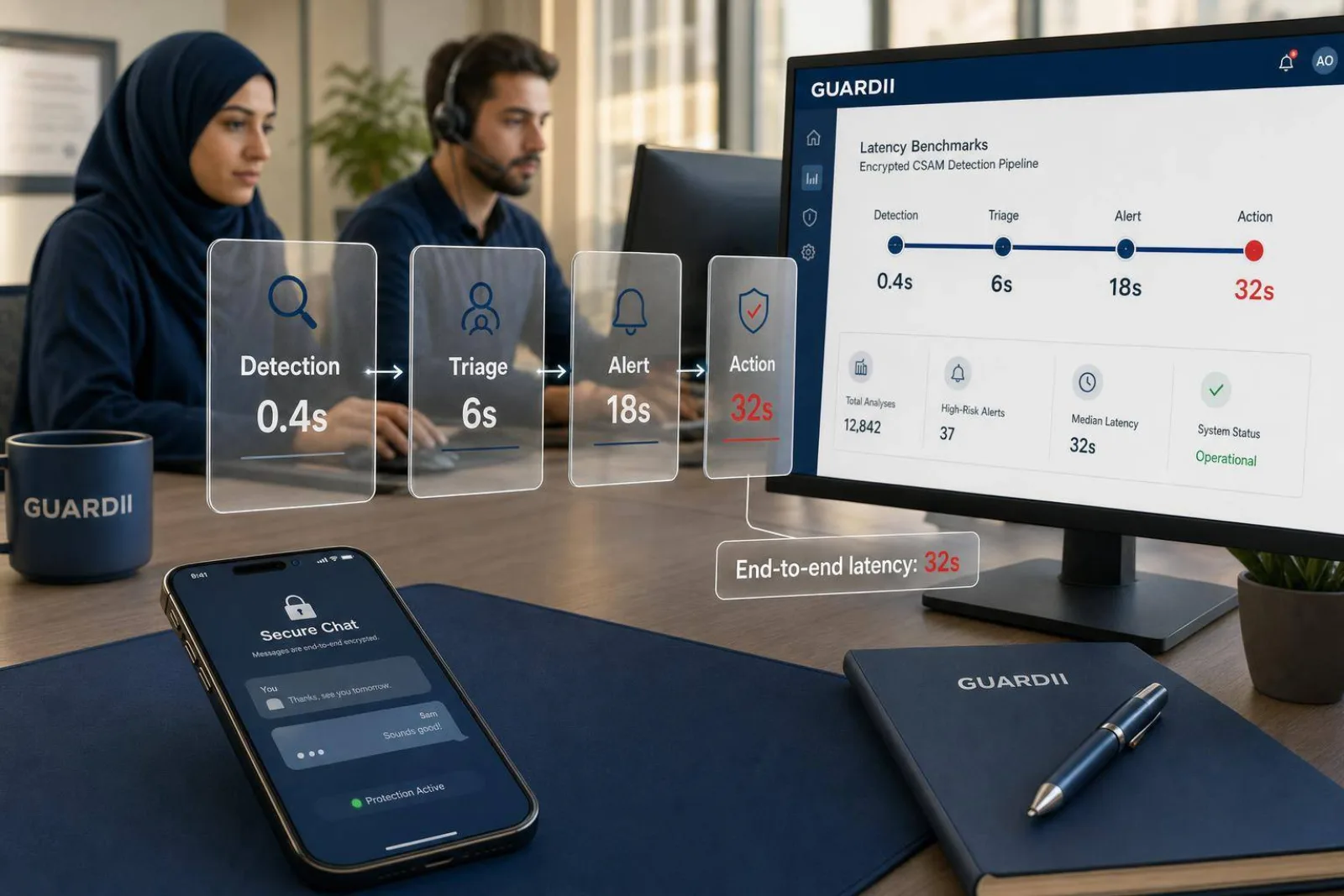
Latency Benchmarks for Encrypted CSAM Detection Systems
If abuse sits in comments or DMs for hours, the damage is already done. I’d frame the target like this: hide or triage high-risk content fast, get threat cases into evidence packs within 15 minutes, and cut player exposure time without blocking normal fan talk.
Here’s the short version:
- Instagram comments: I’d use auto-hide first, not delete first, when the goal is lower public harm with less engagement risk. Delete has a place, but it can create review mistakes, fan backlash, and sponsor questions if used too broadly.
- DM threats: For clubs, agents, and creator managers, the working goal is simple: detect, review, preserve, and escalate in 15 minutes or less for threats, doxxing, sexual abuse, and extortion-style messages.
- False positives on tour: Rivalry slang changes by market. I’d use allow-lists plus local reviewer routing for Hindi, Urdu, Tamil, Arabic, and mixed-script abuse so normal banter stays visible while direct abuse is removed.
- Women athletes and creators: Sexualized DM harassment and cyberflashing need a separate path with low exposure workflows, evidence preservation, legal logging, and account-level repeat-offender tracking.
- Sponsor-safe match days: Safety teams should treat match day like an incident window: tighter rules, on-call coverage, watchlists, and live reporting for brand partners.
- Proof matters: If a club may report threats to law enforcement, leagues, sponsors, or platform teams, I’d keep chain-of-custody records, timestamps, screenshots, handle history, and action logs from the start.
- Success metrics: Don’t judge moderation by volume alone. Track precision, recall, false positives, time-to-hide, time-to-escalate, reviewer exposure minutes, and repeat-offender hit rate every week.
A simple way to think about it: this is not just “content moderation.” It’s player safety, sponsor protection, legal recordkeeping, and fan experience rolled into one system.
How can technology detect CSAM and respect privacy in an End-To-End Encryption environment?
sbb-itb-47c24b3
Quick comparison
| Topic | What I’d optimize for | Main KPI |
|---|---|---|
| Comment moderation | Lower public visibility of abuse fast | Time-to-hide |
| DM threat handling | Actionable case file in under 15 minutes | Time-to-evidence-pack |
| Rivalry slang tuning | Fewer false positives during tours | FP rate by language |
| Women athlete safety | Lower exposure to sexual abuse | Reviewer and talent exposure minutes |
| Sponsor-safe moderation | Clean branded surfaces on match day | Brand-risk incidents per event |
| Evidence and audit | Defensible records for reports and disputes | Chain-of-custody completion rate |
| Repeat-offender tracking | Catch abuse across many handles | Watchlist match rate |
| Team performance | Better moderation without silencing fans | Precision/recall by queue |
If I were turning the source article into a sports-and-creator safety piece, I’d keep the same core idea: speed only matters if it leads to timely action. For this topic, that means moving from abuse detection to hide, review, evidence, and escalation before the situation spreads.
Why latency matters in encrypted CSAM detection
Latency is a safety metric. When detection slows down, the odds of stepping in on time drop. Every extra second in the detection-to-action chain shrinks the window before a situation gets worse. A predator may pull personal information from a child, move the chat to another platform, or shift to threats. That’s why the right benchmark is the full detection-to-action chain, not just model speed.
End-to-end latency: from message creation to intervention
A lot of benchmark talk zooms in on one thing: model inference speed, or how fast an AI scores a single message. But that’s only one slice of the story. What matters in practice is end-to-end latency: the total delay across the whole pipeline, from the moment a message is sent to the moment a protective action happens.
In encrypted messaging systems, most of that time is lost in three main stages:
- Detection - behavioral scoring of message content and grooming patterns: < 200ms [2]
- Escalation - routing an alert to a designated human authority: < 4s median [2]
Mean latency can make a system look better than it is. The tail matters more. P95 and P99 are the numbers to watch, especially during traffic spikes and active abuse, which is exactly when delays are hardest to accept.
In encrypted systems, each stage also has to run under tighter device and privacy limits.
How encryption changes detection architecture
End-to-end encryption (E2EE) makes server-side content scanning not viable. That pushes detection toward three options: client-side analysis on the user’s device, metadata-based signals such as timing, frequency, and contact patterns, or privacy-preserving hybrid approaches that mix both.
Each path comes with trade-offs. Client-side analysis adds compute and battery load. Metadata signals are less precise. Hybrid approaches may perform well, but they’re harder to verify. And all three face tighter latency and compute limits than server-side scanning. That changes what a realistic latency target looks like.
Those architectural limits also make speed and early warning two different benchmarks.
Two types of latency: per-message speed and warning latency
Per-message latency is the wall-clock time needed to score one message - the < 200ms figure above. Warning latency is measured in conversation turns: how many messages into a grooming sequence the system takes before it sends its first alert.
Per-message speed tells you whether the system can keep up with heavy message volume without building a backlog. Warning latency tells you whether it can spot an escalating pattern early enough - before personal information is exposed.
The next question is how to measure these latencies in real deployments.
What current studies show about acceptable latency ranges
Per-message benchmarks from security and moderation systems
Once you separate scoring speed from warning speed, the picture gets a lot clearer.
Current evidence supports sub-200 ms automated flagging and median escalation to human review under 4 seconds [2][3]. The available sources do not back a blanket sub-100 ms target for every encrypted messaging setup. That kind of claim sounds neat on paper, but the research here doesn’t go that far.
What the evidence does point to is a simpler standard: per-message latency has to stay low enough to keep pace with live conversations, even when message volume climbs.
Warning latency benchmarks from grooming detection research
In this area, warning latency matters more than raw scoring speed. A model can score a message fast, but if the warning arrives too late, that speed doesn’t help much.
That matters because 30% of victims face demands within 24 hours of initial contact, which means alerts need to trigger early in a conversation [1]. Guardii's threat research also points to the need for early warning, though it does not set a turn-by-turn threshold.
A practical benchmark based on current evidence
A cautious benchmark, based on current evidence, looks like this:
| Metric | Supported Target |
|---|---|
| Per-message detection latency | < 200 ms |
| Escalation to human review | < 4 s median |
These targets support near-real-time scoring and escalation within seconds. They do not support a universal sub-100 ms standard.
One more thing: report these targets with the full latency budget, not just inference time. That means measuring the whole pipeline in conditions that match actual deployment, because these targets only mean anything if the system can hit them in practice.
How to measure latency in encrypted messaging systems
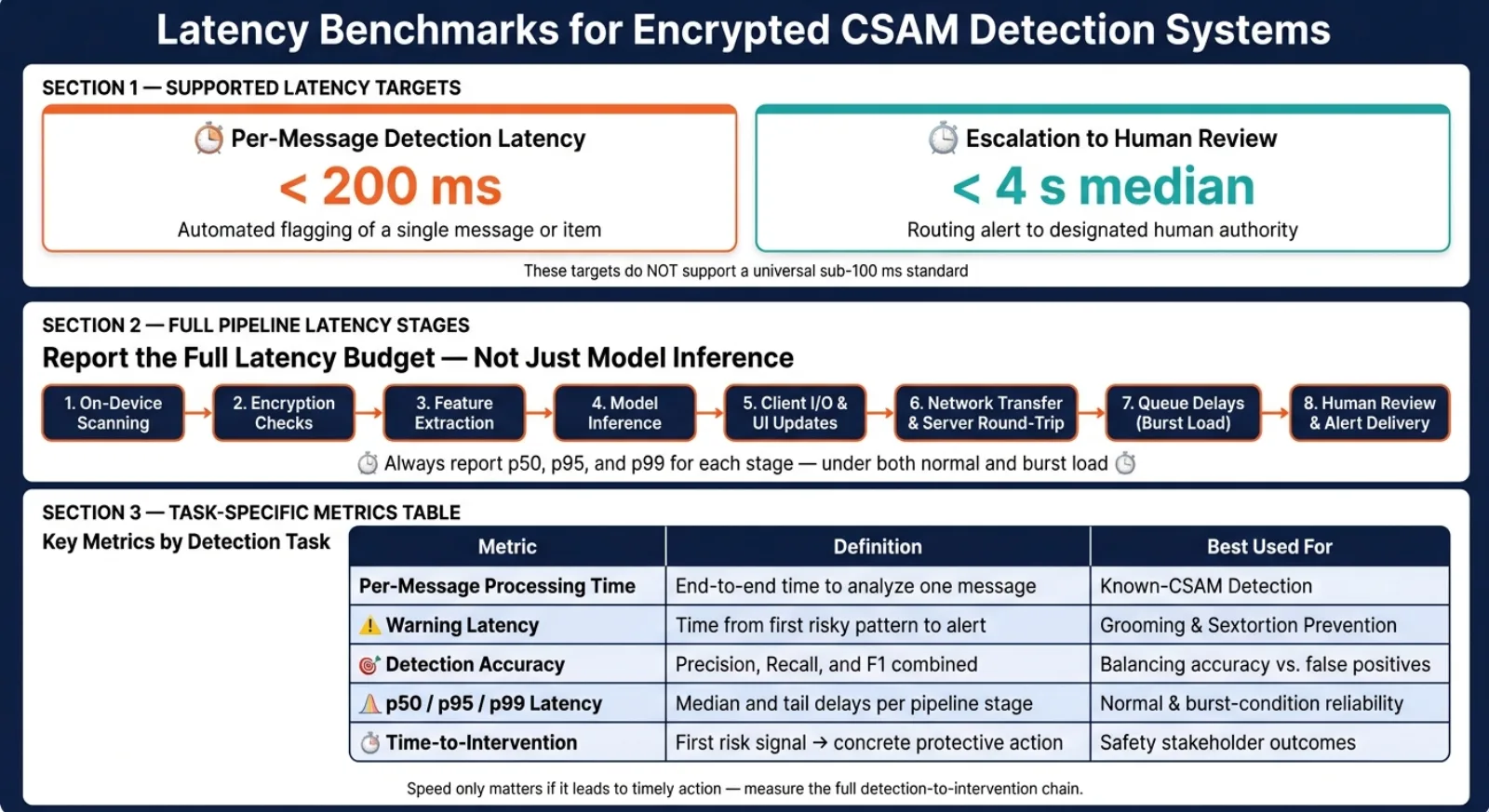
Encrypted CSAM Detection: Latency Benchmarks & Pipeline Metrics
With the benchmark in place, the next step is to measure it the same way every time.
Report the full latency budget, not just model inference
Don’t stop at a single end-to-end number. It sounds neat, but it hides where the slowdowns actually happen.
Instead, report each stage of the pipeline on its own. At a minimum, studies and vendor evaluations should break latency into:
- on-device scanning
- encryption-related checks
- feature extraction
- model inference
- client I/O and UI updates
- network transfer and server round-trip
- queue delays under burst load
- human review
- alert delivery
Any one of these can be the main source of delay, depending on the setup. If you squash them into one number, comparing systems becomes messy and finding the problem becomes even messier.
A staged pipeline makes this easier to read: ingestion, detection, packaging, and escalation. If a system flags a message fast but then takes much longer to build an alert package that someone can use, that “fast detection” number doesn’t tell the whole story.
Always publish p50, p95, and p99 for each stage, not just the median, and do it under both normal load and burst load.
Once the pipeline is split up, the next issue is whether the metric actually fits the safety job.
Use task-specific metrics for CSAM and grooming risk
Measure known-CSAM detection and grooming prevention as separate tasks. In encrypted messaging, item detection and conversation escalation don’t run on the same clock.
For known-CSAM detection, per-item processing time is the main unit to track. Pair it with precision, recall, F1, and false-positive rate. Speed alone isn’t enough. A fast system that throws off too many false positives creates a different kind of harm: it floods reviewers with noise and slows the people who need to respond to real cases.
For grooming and sextortion detection, warning latency is the metric that ties speed to what happens next. The point isn’t only how fast the model runs. The point is how fast the system can escalate a risky conversation before it moves further.
| Metric | Definition | Relevance |
|---|---|---|
| Per-message processing time | End-to-end time to analyze one message or item | Core throughput measure for known-CSAM detection |
| Warning latency | Time from first risky pattern to alert or escalation | Best measure for grooming and sextortion prevention |
| Detection accuracy | Precision, recall, and F1 together | Balances detection accuracy against false positives |
| p50 / p95 / p99 latency | Median and tail delays at each pipeline stage | Shows normal and burst-condition reliability |
| Time-to-intervention | Time from first risk signal to a concrete action | Most outcome-linked measure for safety stakeholders |
Those figures don’t say much unless they still hold up on actual devices and under actual traffic.
Test on realistic devices, traffic, and intervention workflows
Test client-side and hybrid systems on low-end school-managed devices, mid-range consumer smartphones, and high-end phones. Include battery drain and thermal throttling scenarios. A device that looks fine in a clean lab test can behave very differently after sustained use.
Network conditions matter too. Simulate congested Wi-Fi, 4G with jitter, and packet loss, since network transfer can be a major source of delay in cloud or hybrid setups.
A system that looks fine under normal load but falls apart at peak volume isn’t meeting the benchmark in practice. Measure whether it can produce an actionable alert package fast enough for human action. Latency only matters if there’s still enough time for a person to step in.
Design and policy considerations
Architectures most likely to meet low-latency targets
Those latency targets rule out a lot of architecture choices pretty fast. In practice, speed pushes teams toward staged triage instead of heavy one-pass models.
Here’s the basic idea: run a fast behavioral classifier first, then send only the higher-risk cases to deeper analysis. That setup makes sense when every second matters. It also fits well with metadata-assisted triage, where the system scores timing patterns, escalation frequency, and other behavioral signals before it looks at message content. The upside is pretty clear: lower latency and less privacy exposure.
What decision-makers should ask about benchmark claims
Benchmark claims sound good on paper, but they only matter if they match the conditions of actual deployment. That means decision-makers should ask for the exact hardware, device class, operating system or app context, and whether the test ran on-device, on a server, or in some hybrid setup. A server-side lab result doesn’t tell you much about managed-device performance under live traffic.
The next issue is just as important: vendors need to separate automated detection latency from human-review latency. If a system flags something fast but then leaves it sitting in a review queue, it hasn’t met a real-time intervention benchmark in any practical sense.
A few metrics matter more than headline numbers:
- Ask for p50, p95, and p99 results, not just the median.
- Ask whether those numbers still hold under burst load, multilingual traffic, and other realistic deployment conditions.
- Ask for false-positive and false-negative rates at the reported latency setting.
That last point matters a lot. A lower-latency threshold may look good in a sales deck, but if it over-flags or misses too much, it creates a different kind of problem.
Conclusion: the benchmark that emerges from current research
Taken together, the research points to a clear procurement standard: fast first-pass screening, deeper staged analysis only when needed, and separate measurement of the time it takes to deliver an actionable alert to a safeguarding lead, parent, moderator, or authority. That clock should start the moment risky behavior first appears and stop the moment someone is actually able to act.
FAQs
Why isn’t model speed alone enough?
Model speed on its own doesn’t solve the problem. Predatory behavior often plays out through subtle, slow escalation, and that’s exactly what keyword filters or one-off message checks tend to miss.
To catch it, safety systems need to read the pattern over time. That means spotting things like grooming arcs, attempts to move a conversation off-platform, and offers of money, gifts, or other incentives. It also means helping teams review far more conversations than human moderators could reasonably keep up with on their own.
What’s the difference between per-message latency and warning latency?
Per-message latency is the time the system needs to process a single incoming message through its detection engine.
Warning latency is the gap between spotting a threat and sending an alert to a parent or other authority.
In real-time safeguarding, both delays need to stay low. Why? Because exploitation can escalate fast, and even a short lag can matter.
How should encrypted CSAM systems be tested in real-world conditions?
Research points to testing that goes past static keyword filters and leans into behavioral analysis.
That shift matters. Grooming and sextortion threats are now more often driven by AI agents that can change tactics on the fly. A simple keyword check won’t catch much if the language keeps shifting. Testing needs to mirror what these systems are up against: high-volume, polished interaction patterns that look convincing at scale.
A strong system should be judged on a few core things:
- Whether it spots escalation arcs instead of isolated messages
- Whether it triages threats with a high level of accuracy
- Whether it puts together tamper-evident, prosecution-ready evidence with a clear chain of custody
In plain terms, the test isn’t just “Did it flag a bad word?” It’s “Did it follow the pattern, rank the risk, and preserve the record in a way that can hold up later?”