

AI CSAM Detection: Integration Challenges and Solutions
If abuse reports sit in screenshots, email threads, and messy spreadsheets, your safety process is already too slow. I’d fix three things first: route abusive comments and DMs into one queue, turn each incident into an evidence pack within 15 minutes, and cut false positives with language-specific allow-lists before match day.
Here’s the short version:
- Instagram comments need different actions: auto-hide, unhide, and delete each carry different engagement, risk, and sponsor tradeoffs.
- DM threats need a set path: detect, review, preserve, label risk, and send legal-ready evidence fast.
- False positives drop when slang is tuned locally: that matters on subcontinent tours across 40+ languages and mixed-language chat.
- Women athletes and creators face a different abuse mix: sexualized DMs, cyberflashing, and repeat contact need tighter handling rules.
- Sponsor risk is often a moderation problem: brand activations can be damaged by visible abuse left live on match day.
- Evidence quality matters as much as detection: timestamps, account IDs, URLs, action logs, and reviewer notes need to stay together.
- Player wellbeing improves when exposure time drops: the goal is fewer abuse-viewing minutes, not shutting down normal fan talk.
- Success should be measured weekly: I’d track precision, recall, review time, repeat offenders, and time-to-escalation.
3News Investigates: Combating the spread of CSAM and the problems created by AI
sbb-itb-47c24b3
Quick Comparison
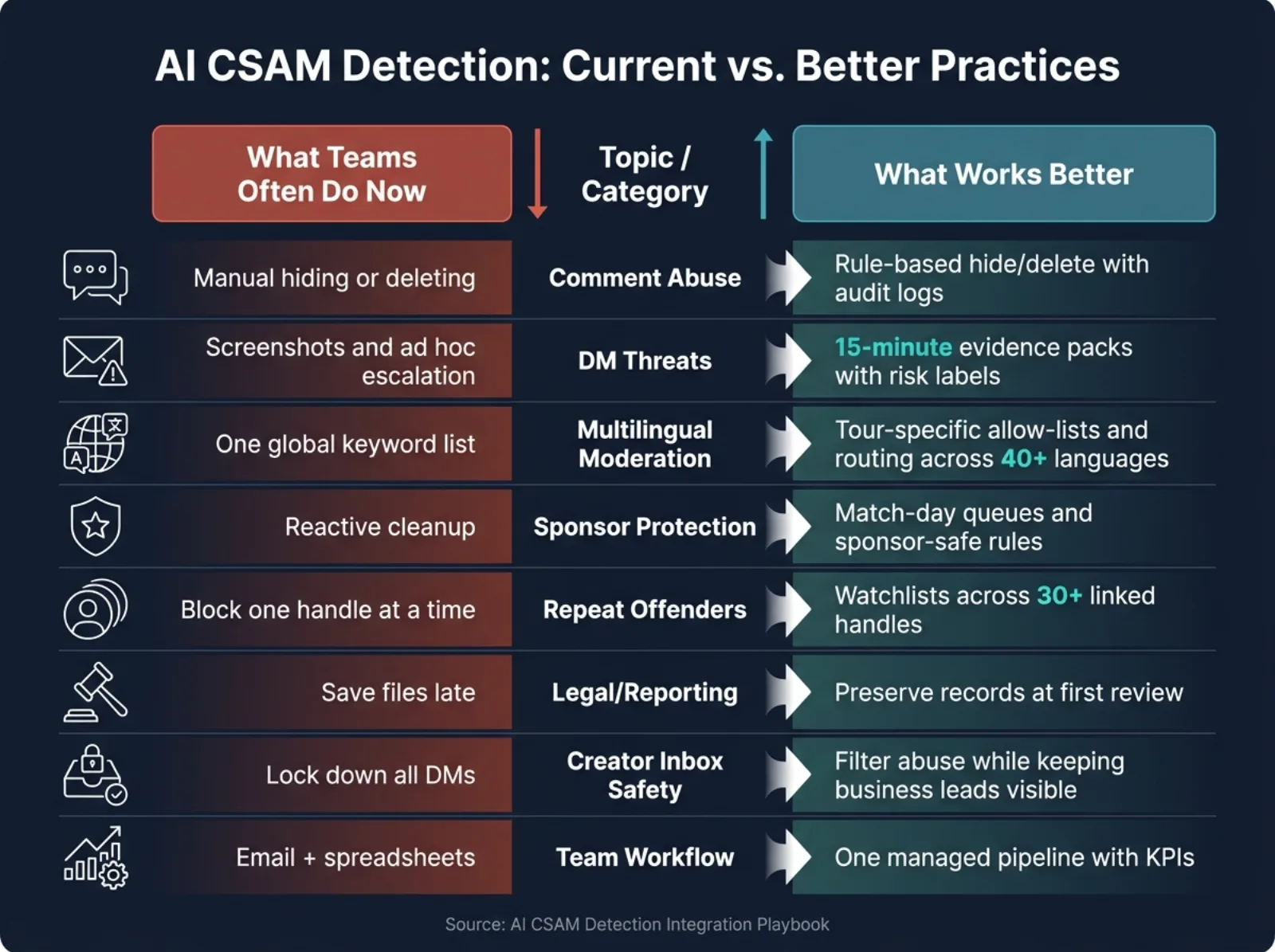
AI CSAM Detection: Current vs. Better Practices for Platforms
| Topic | What teams often do now | What works better |
|---|---|---|
| Comment abuse | Manual hiding or deleting | Rule-based hide/delete with audit logs |
| DM threats | Screenshots and ad hoc escalation | 15-minute evidence packs with risk labels |
| Multilingual moderation | One global keyword list | Tour-specific multilingual moderation and routing |
| Sponsor protection | Reactive cleanup | Match-day queues and sponsor-safe rules |
| Repeat offenders | Block one handle at a time | Watchlists across 30+ linked handles |
| Legal/reporting | Save files late | Preserve records at first review to ensure legal integrity |
| Creator inbox safety | Lock down all DMs | Filter abuse while keeping business leads visible |
| Team workflow | Email + spreadsheets | One managed pipeline with KPIs |
If I were building this playbook, I’d keep it simple: protect the person, keep fan conversation open where possible, and make every action traceable. That’s the line between basic moderation and a system your legal, partnerships, and player-care teams can all use.
The Main Integration Problems Between Detection Tools and Law Enforcement Systems
The biggest breakdown happens at the handoff from model output to investigation systems. Finding CSAM signals is only part of the job. The harder part is turning those signals into case inputs that investigators can use - and defend. In practice, the problems land in three areas: data mismatch, weak report quality, and too much operational noise. The pattern usually starts with data structure, moves into report quality, and then snowballs into review volume.
Fragmented Data Formats, Scores, and APIs
Hash matching gives a simple yes/no hit. AI classifiers, by contrast, produce confidence scores. Many case systems don’t handle either type of signal in a clean, consistent way [1][6]. And that’s only part of the mess. Platforms still package those signals in different formats, with different field names, score logic, and API behavior.
Without a shared schema, investigators often have to normalize reports by hand before they can do anything with them. That slows triage and piles more work onto teams that are already stretched thin.
Even when a signal is technically sound, it still isn’t enough on its own. Investigators need context before they can act on it.
Poor Report Quality and Missing Context
AI can flag a suspicious image. But a flag alone doesn’t give investigators much to work with. They still need behavioral data and victim-risk indicators to decide what comes next. If a report leaves out behavioral signals, investigators may get an alert with no clear path forward.
That turns a detection event into a dead end. The system says, “look here,” but it doesn’t explain why the case matters now, how the people involved may be connected, or what kind of risk may be unfolding.
Once reports reach investigators, the next bottleneck is preservation and provenance.
Privacy, Chain of Custody, and Alert Fatigue
Privacy rules, chain-of-custody standards, and lawful collection requirements add another layer of difficulty. If those pieces aren’t handled well, even a strong lead can become harder to use.
There’s also a newer problem: AI-generated content can contaminate victim-identification databases and slow the separation of real and synthetic material. That creates friction at exactly the point where speed and accuracy matter most.
Then volume hits. High-volume, low-quality tips force analysts to clean out noise before triage can even begin. That drags investigations down and eats up staff capacity. In plain terms, alert fatigue doesn’t just annoy reviewers - it slows triage across the entire pipeline.
Practical Solutions for Better Integration
The fix is to treat integration like a pipeline issue: standardize the evidence, sort it by urgency, and keep context intact across cross-jurisdictional frameworks from start to finish.
Standardize Evidence Objects and Risk Signals
One practical way to cut manual normalization work is to use one shared report schema from the very beginning. Every detection event should include the content type, confidence score, timestamps, account identifiers, and lawful device or session metadata. It should also keep the original files, hashes, platform logs, and reviewer actions in one record that an investigator can actually use.
The difference often comes down to one thing: build these evidence packages with investigators, not off to the side. That’s what turns a report into something that opens a case instead of sitting in limbo.
Once the evidence object is standardized, the next step is simple: route it based on urgency.
Build Reporting Pipelines Around Investigative Triage
Standardized evidence only helps if the pipeline separates active harm from lower-priority history. Active grooming, ongoing contact, and imminent risk need immediate escalation. Older possession cases and lower-confidence detections should go into a separate queue with different handling rules.
Clear urgency labels help CyberTipline triage move faster and cut the noise that slows investigators down.
Use Explainable Behavioral Detection in Private Messaging
There’s still the earliest stage of abuse to deal with: the point where no image exists yet. Behavioral detection should look at escalation patterns across DMs, surface a risk score with a plain-English explanation, and record a plain-English rationale. That explainability is what makes the output court-defensible, not just another alert.
Platforms like Guardii focus on this layer. They turn behavioral signals into structured, explainable evidence that investigators can act on.
Hash matching works best for known material. Visual AI helps with new content. Behavioral detection can catch grooming and coercion before an image exists. Put all three into the same evidence pipeline, and investigators get the context they need at each stage of a case.
Governance, Compliance, and Cross-Border Design
Once detection turns into evidence, the conversation changes fast. It’s no longer just about finding risky content. It’s about whether the pipeline can stand up to legal review, privacy rules, and cross-border limits. How you store evidence, who gets to review it, and where the data lives all shape whether the system is defensible and compliant.
U.S. Legal Duties and Evidentiary Standards
The 2024 REPORT Act expanded mandatory reporting to include planned or imminent abuse and child sex trafficking, while also requiring longer evidence preservation [4]. In plain terms, detection pipelines need to keep the forensic record intact. That includes EXIF data, image metadata, and provenance signals that help separate camera-captured media from synthetic media for later review [2][3].
Audit logs and reviewer traceability matter just as much. State attorneys general are using consumer protection and child safety statutes more aggressively to hold platforms accountable [1][5]. So defensible logs and reviewer traceability aren’t nice extras. They’re the paper trail that shows your duty of care was met, with a clean split between automated scoring and human escalation decisions.
That legal burden also puts limits on reviewer access. If people can see sensitive content, that access needs to be narrow, justified, and logged.
Encryption, Privacy, and Human-in-the-Loop Oversight
Private messaging creates a hard tradeoff. Detection needs access to content or behavior signals. Privacy law puts limits on that access. The practical answer is role-based access that gives reviewers only the minimum evidence needed for escalation, with immutable logs recorded at each stage.
Explainable outputs also matter here. If a system shows a risk score plus a plain-English reason, human reviewers have something they can assess. A black-box flag, by contrast, gives them almost nothing. And that’s how alert fatigue starts to creep in.
These controls get even tighter in systems that need local hosting, continuous monitoring, and faster intervention.
Designing for UAE and MENA Regulatory Requirements
The U.S. model is reporting-first: detect, review internally, report to NCMEC where required, then hand off to law enforcement. The UAE’s federal child digital-safety law, effective January 2027, requires proactive AI detection. That shifts the sequence. Intervention may need to happen before reporting, or at the same time, not afterward.
For organizations working across both jurisdictions, that gap drives different architecture choices. In MENA markets, teams may need sovereign deployment, local data residency, and continuous auditability. In the U.S., the focus leans more toward preservation-focused, audit-ready pipelines.
Conclusion: What a Future-Proof Integration Model Looks Like
Detection is only half the job. The weak spot comes after a flag is raised: how evidence gets packaged, how reports reach investigators, and whether prosecutors and investigators can use the output without extra cleanup. The answer isn’t more alerts. It’s a better digital evidence management pipeline.
A model built to last starts with a simple rule: every signal needs to turn into usable evidence. That means standardizing evidence, routing it by risk, and keeping context intact from start to finish. No single model can do all of this on its own. What does hold up is one evidence pipeline that works across all signal types - hash matching, visual detection, and behavioral analysis - and turns them into structured, explainable outputs that investigators can act on without reformatting or guesswork.
This is a shared systems problem. Platforms, reviewers, and law enforcement all rely on the same thing: evidence quality.
Systems built now also need to fit jurisdiction-specific rules, including U.S. evidentiary standards and the UAE's proactive detection mandate taking effect in January 2027. Local data residency and auditable controls aren’t edge cases. For organizations working across both markets, they’re core design requirements. That’s the bar for systems built to last.
Key Takeaways for Platforms and Law Enforcement Partners
There are four priorities here:
- Normalize outputs so risk scores and evidence objects can move into downstream systems without manual conversion.
- Preserve provenance by default by capturing metadata and manipulation signals at the moment of detection, not later.
- Triage by urgency so high-confidence, high-risk material reaches investigators first instead of getting buried under low-quality tips.
- Keep human review in the loop with role-based access and auditable escalation decisions that meet jurisdiction-specific compliance rules.
Integration breaks when detection ends at the alert. It works when evidence is ready for action.
FAQs
What makes a CSAM report usable for investigators?
A usable CSAM report needs more than a piece of flagged content. It needs to give law enforcement enough context to sort the case and decide what to act on first. That includes whether the report points to a viral meme, re-shared older material, or ongoing hands-on abuse.
The report should also include clear metadata, confidence scores, and explainable signs of intent or behavior getting worse over time. That extra context helps investigators judge urgency, link related reports, and focus on the highest-risk cases.
How can teams reduce false positives without missing real risk?
Teams should use a layered approach that mixes automation with human review. If you lean on automated alerts alone, you often end up with a pile of low-value tips. A better setup pairs hash matching for known material with AI classifiers that assign confidence scores to new, altered, or synthetic content.
That way, high-confidence detections can move to the front of the line, while borderline cases go to human reviewers who can add context and judgment. Just as important, feedback from investigators should feed back into the system so the models keep getting better over time.
How should AI detection work across U.S. and MENA rules?
AI detection needs to line up with local legal rules while still giving law enforcement something they can act on.
In the U.S., integration is shaped by the NCMEC CyberTipline framework and Fourth Amendment limits. That means systems should help with triage first, using methods like hash matching and AI-based visual risk scoring.
In MENA, including the UAE, rules are moving toward more active AI detection. Across both regions, tools need to be explainable, ready for day-to-day use, and able to spot behavioral escalation patterns.