

Ultimate Guide to Multi-Modal CSAM Detection
If abuse hits comments, DMs, and fake accounts at the same time, comment filters alone are not enough. I’d treat this as a full safety workflow problem: detect abuse fast, cut reviewer exposure, keep sponsor-facing posts clean, save court-ready evidence, and keep business DMs open.
Here’s the short version:
- Auto-hide beats delete for many Instagram comments because it lowers public harm while keeping a record for review, audit, and sponsor checks.
- DM threat response should move in under 15 minutes from flag to evidence pack, with timestamps, screenshots, account links, and action logs.
- Allow-lists matter on tour. Rivalry slang in Hindi, Urdu, Tamil, and Arabic can trigger false positives if your rules are only built for U.S. English.
- Women athletes and creators face a different abuse mix: sexualized DMs, cyberflashing, doxxing threats, and repeat account evasion.
- Repeat-offender tracking across 30+ handles helps clubs and agents spot the same person coming back under new usernames.
- Good moderation protects both people and revenue. Cleaner match-day feeds can lower sponsor risk, while better routing keeps sales and partnership DMs visible.
- Success should be measured every week with precision, recall, review time, exposure minutes, false-positive rate, and action-by-channel.
Generative AI Principles to Prevent Child Sexual Abuse
sbb-itb-47c24b3
Quick comparison
| Topic | What I’d focus on | Why it matters |
|---|---|---|
| Instagram comments | Auto-hide vs delete rules | Public visibility, fan friction, sponsor risk |
| DM threats | 15-minute response flow | Faster triage and cleaner evidence |
| Multilingual AI moderation | Allow-lists and route-by-language | Fewer false positives on tour |
| Women athletes/creators | Sexualized abuse and cyberflashing workflow | Higher harm, different legal and care needs |
| Sponsor-safe social | Match-day escalation rules | Brand safety during peak traffic |
| Evidence and audit | Chain of custody and templates | Legal review, reporting, and case history |
| Meta-compliant actions | Hide, unhide, delete rules | Platform-safe enforcement |
| Repeat offenders | Cross-handle watchlists | Abuse often comes back under new names |
| Player wellbeing | Exposure-minute reduction | Less reviewer and athlete harm |
| Creator managers | Keep good DMs visible | Protect revenue while filtering abuse |
| Data retention | Short, role-based storage | Safety and legal teams need different windows |
| Tool comparison | Comments-only vs comments + DMs + evidence | Full coverage vs partial coverage |
Put simply: the best setup is not the one that blocks the most. It’s the one that cuts harm fast, keeps evidence clean, and avoids hiding normal fan talk.
Core Detection Methods: Hashing, AI Classification, and Signal Fusion
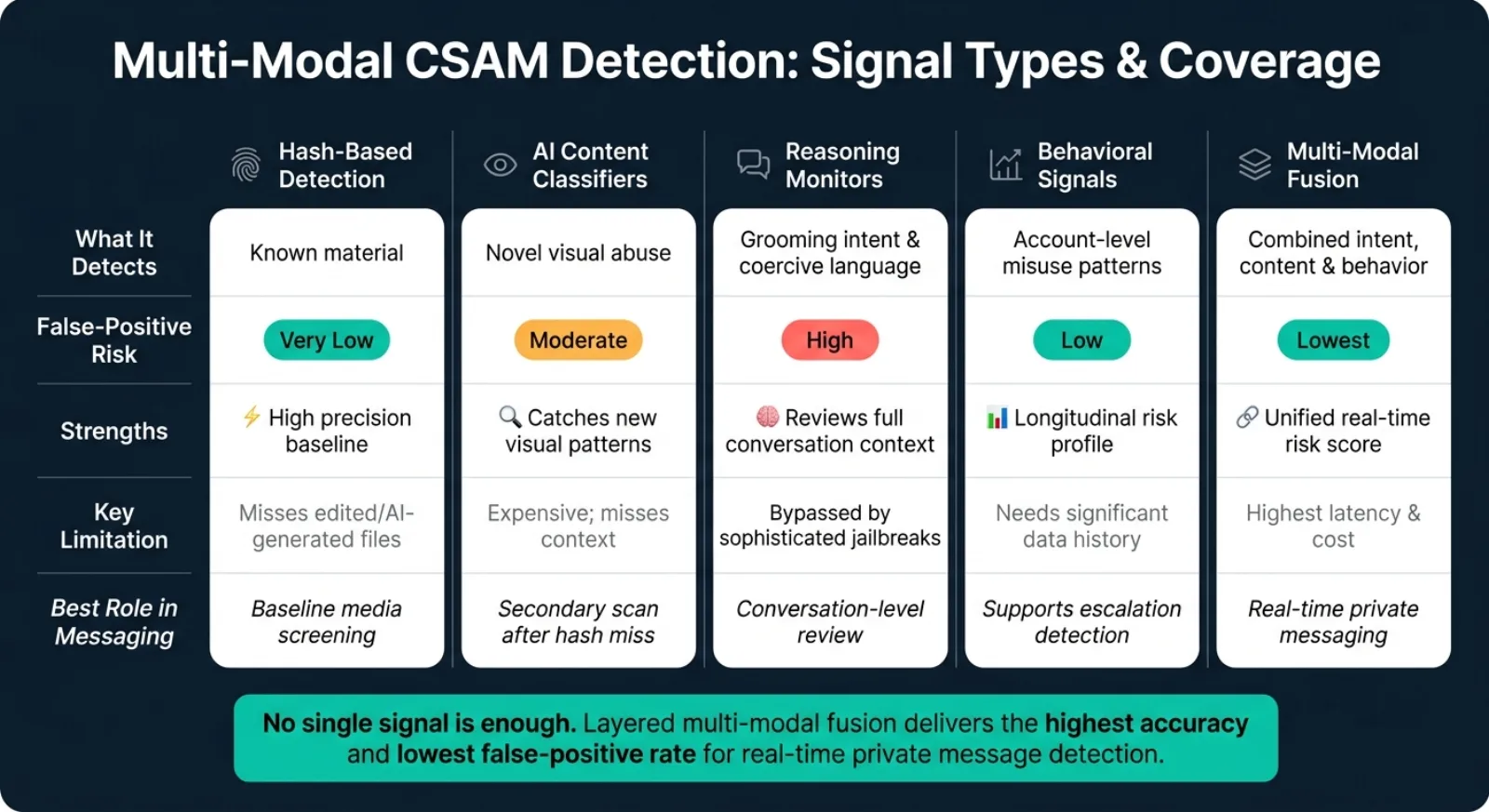
Multi-Modal CSAM Detection Methods: Single-Signal vs. Layered Fusion
Hash Matching for Known CSAM
Hash matching is the fastest way to catch known CSAM. If a file matches something already cataloged, the system can spot it fast and with high precision.
But there's a catch. Small changes can throw off an exact match. If a file is edited, compressed, re-recorded, or generated from scratch, plain hash matching may miss it.
That’s why hash matching is the right place to start, not the whole answer.
Visual, Language, and Behavioral Models for Novel Abuse
CSAM detection breaks down when media and conversation are treated like two separate lanes. In private messaging, abuse rarely stays in one box. A file, a chat thread, and a pattern of account activity can all matter at the same time.
When hashes miss, the system has to look at media, language, and behavior together.
AI classifiers help fill that gap. Image and video models can flag novel or AI-generated or computer-edited CSAM. But they come with tradeoffs. Running them in real time across every image and video is expensive, and they can produce false positives around medical or artistic content.[1]
Text models take a different path. Instead of judging one message by itself, they look across conversation threads for grooming patterns and coercive language patterns. Reasoning monitors go a step further by reviewing the full conversation, not just one flagged line, to spot likely harm.
Behavioral signals add account-level context. They connect separate messages, uploads, and sessions into one risk picture, which matters when no single event looks alarming on its own.
Single-Signal Tools vs. Multi-Modal Fusion: Comparison Table
No single signal can do this job on its own. In private messaging, abuse can show up in files, text, or behavior, so detection has to be layered. The table below shows where each method helps and where it falls short.
| Detection Type | What It Detects | Strengths | Limitations | False-Positive Risk | Best Role in Messaging |
|---|---|---|---|---|---|
| Hash-based detection | Known material | High precision for baseline threats | Misses edited, cropped, compressed, re-recorded, novel, or AI-generated material | Very low | Baseline screening of media |
| AI content classifiers | Novel visual abuse material | Catches new visual abuse patterns | Computationally expensive; may miss context | Moderate (medical, artistic content) | Secondary scan after hash miss |
| Reasoning monitors | Grooming intent, secrecy requests, coercive language patterns | Reviews context rather than isolated flags | Can be bypassed by sophisticated jailbreaks | High; may flag benign but sensitive discussions | Conversation-level review |
| Behavioral signals | Account-level misuse patterns | Adds longitudinal context | Requires significant data history to establish a risk profile | Low; usually needs multiple signals to trigger | Supports escalation detection |
| Multi-modal fusion | Combined intent, content, and behavior | Produces a unified, real-time risk score | Highest latency and cost per request | Lowest | Real-time private messaging detection |
Put simply, single-signal tools are good at one slice of the problem. Multi-modal fusion tries to connect the dots.
Layered safeguards - combining hash matching, content classifiers, reasoning monitors, and behavioral signals - give more redundancy and accuracy than any one method alone.[1] The next issue is deployment: how to score risk in real time without exposing more data than needed.
System Design: Privacy, Risk Scoring, and Real-Time Response
Deployment Models: Client-Side, Server-Side, Metadata-Only, and Privacy-Preserving
Where detection runs matters just as much as how it works. The setup you choose shapes privacy, accuracy, and day-to-day overhead.
| Deployment Model | Privacy Impact | Latency | Detection Coverage | Best Use Case |
|---|---|---|---|---|
| Client-side (on-device) | Lowest data exposure; processing stays local | Low | Limited by device compute and available context | Privacy-first deployments |
| Server-side inspection | Higher exposure because the platform processes content directly | Low to medium | Broad multi-modal coverage | Platforms that need the fullest signal set |
| Metadata-only behavioral monitoring | Minimal content access | Very low | Behavioral signals only; no message or media inspection | Early-stage triage or narrow-risk monitoring |
| Privacy-preserving (ZDR) | Queries and data are automatically purged after processing [2] | Low to medium | Full server-side coverage | Regulated markets and private messaging |
Zero Data Retention (ZDR) means the system processes content, scores it, and then deletes it. In plain English, the system looks, decides, and clears the data. Many modern systems use ZDR to support compliance and user privacy [2].
Once the deployment model is in place, the next step is figuring out how to score escalation without exposing more content than needed.
Behavioral Risk Scoring and Grooming Arc Detection
What matters most isn't one message on its own. It's the pattern across messages and how the conversation shifts over time.
Strong behavioral risk scoring looks for escalation arcs such as information extraction ("where do you go to school?"), incentive-offering ("I'll send you a gift card"), requests for secrecy ("don't tell your parents"), platform migration ("let's move to Snapchat"), and then coercion or threats tied to offline harm. Seen together, those signals form a pattern that's hard to ignore.
Keyword filtering usually misses that pattern because it treats each message like a separate event.
| Feature | Keyword Filtering | Behavioral Risk Scoring |
|---|---|---|
| Context awareness | Low - flags isolated words | High - tracks multi-message escalation arcs |
| Explainability | Binary (word present or absent) | Uses conversation-level monitors to explain harm potential [1] |
| Adaptability | Requires manual list updates | Rapidly updated via test-time reasoning [1] |
| False-positive risk | High - misses context and over-flags benign content | Lower - calibrated to intent and conversation trajectory |
| Privacy compatibility | Often requires more logging | Can be ZDR-compatible via programmatic tool calling [1] [2] |
As OpenAI has noted in its own safeguard design:
"Effective safeguards account for the context and likely consequences of a request, preserving legitimate defensive work while applying stronger controls where the evidence indicates a serious risk of harm." [1]
That logic maps cleanly to grooming detection. The system has to weigh the full arc, not just the last message in the thread.
The end result should be a score a reviewer can act on right away, without digging through a long chain to guess what went wrong.
Guardii as a Real-Time Private-Message Detection Example
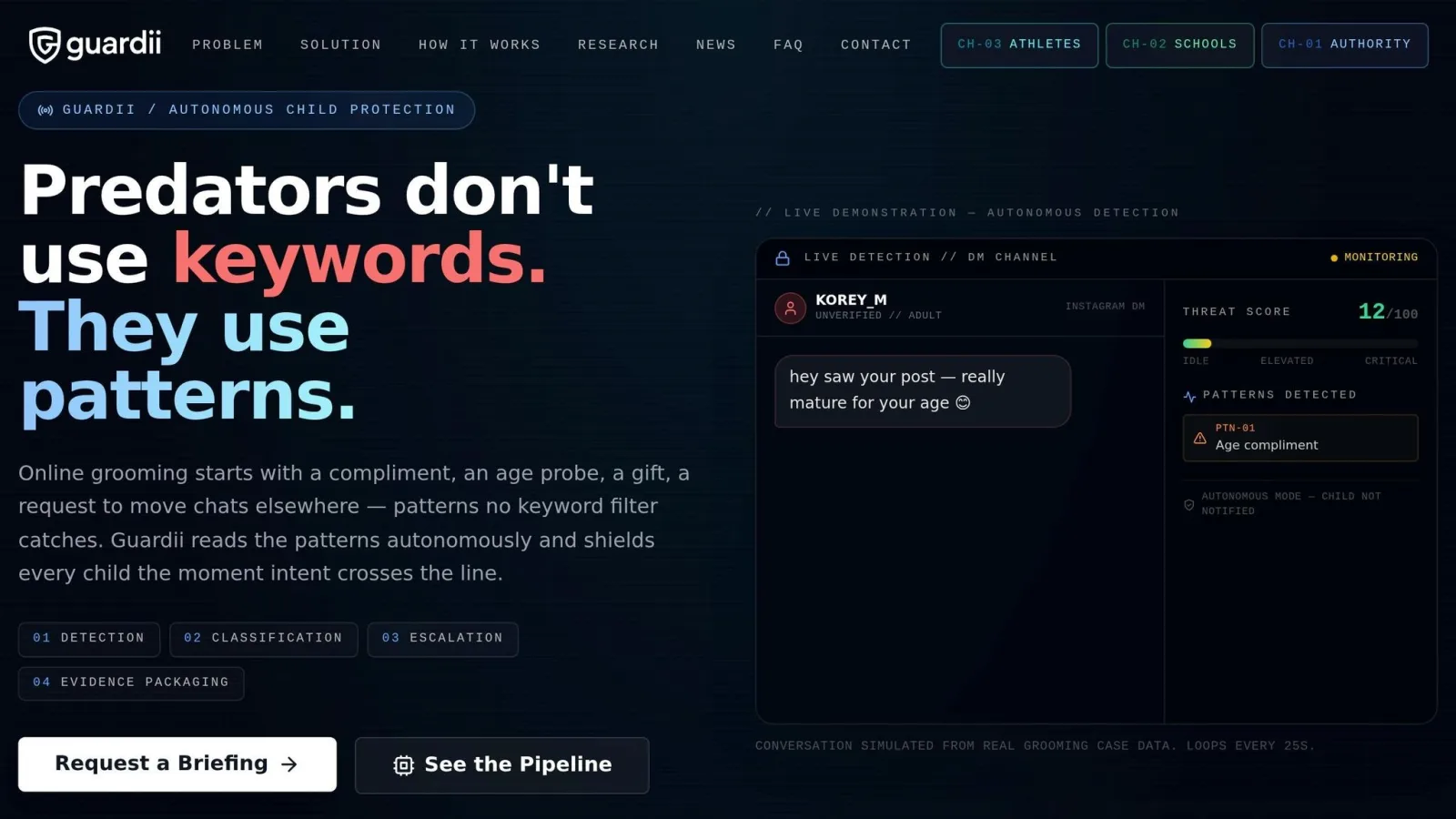
Guardii works inside direct messages, spots escalation arcs in real time, and shows a live risk score with short reason codes so a human reviewer can see, fast, why a conversation was flagged. That score only matters if it creates a clean triage trail for review and reporting.
Deployment and Operations: Triage, Evidence, and Sector Use Cases
Human-in-the-Loop Triage, Evidence Packs, and Chain of Custody
Once a live risk score fires, the job moves from detection to triage and evidence handling. At that point, an alert can go into a priority review queue for immediate action or a hold queue for later review. In high-volume queues, a reasoning monitor can check the conversation in context and judge the potential for harm, which cuts down the load on human reviewers [1].
Each evidence packet should include the flagged thread, timestamps, the risk score, plain-English reason codes, access logs, and supporting hashes or account metadata. The best way to keep this clean is to auto-generate the packet from structured API output, so records stay consistent from case to case.
Access control is what closes the evidence chain. Limit evidence access to verified personnel only, and use restricted-access controls with hardware-backed passkey authentication [1].
U.S. Reporting Obligations and Cross-Border Regulatory Pressure
After triage, retention and reporting rules decide what stays and what gets purged. Keep only what internal review and reporting require. For cross-border deployments - including markets such as the UAE, where proactive AI detection inside private messaging becomes mandatory in January 2027 - teams should use privacy-by-design controls, least-privilege access, defined retention windows, and explainable outputs. Transient data should be processed in memory and purged after scoring [1][2].
Sector Deployments: Law Enforcement, Schools, and Athlete Protection
Operational priorities change by sector. The same detection stack may sit underneath each setup, but the workflow looks different depending on who is using it.
| Sector | Primary Threat | Key Operational Need |
|---|---|---|
| Law Enforcement | CSAM, grooming networks | Sovereign data residency, digital evidence for cross-jurisdictional frameworks |
| Schools/Districts | Student grooming | Fast internal escalation, counselor-ready alerts |
| Athletes/Clubs | Sextortion, harassment, targeted abuse | Repeat-offender tracking, safeguarding documentation |
Law enforcement teams need sovereign deployment, fast triage, evidence enrichment, and human-reviewed case routing.
Schools and districts need to spot grooming behavior inside institutional messaging networks and escalate fast to school leadership or counselors.
Athletes and public figures often deal with direct-message harassment, sextortion, and targeted abuse. Repeat-offender watchlists help safeguarding teams track persistent bad actors over time, even when those people come back under new accounts.
Evaluation and Conclusion: Measuring What Works
Testing Scenarios, Benchmarks, and Adversarial Robustness
Once a system is live, the job isn’t done. You have to test whether it catches abuse and whether it holds up when someone tries to slip past it. That means running red teams, automated tests, multimodal benchmarks, long-thread checks, and benign-use reviews [1].
| Scenario | Goal | Metrics | Takeaway |
|---|---|---|---|
| Adversarial Red Teaming | Surface jailbreaks and evasion tactics | Block rate; bypass rate; test coverage | Automated probing finds weak points that human reviewers may miss |
| Mixed-Content Abuse Detection | Detect novel abuse in combined text and image content | Benchmark accuracy | Higher scores correlate with stronger context awareness across signal types |
| Thread-Span Escalation Detection | Catch grooming arcs across extended conversations | Thread-level recall | Tests whether models retain context across many messages to detect escalation |
| Benign Conversation Protection | Minimize false positives | Friction rate; retry rate; benign block rate | Measures disruption to legitimate users |
Those tests matter only if they map to steady operating targets. A benchmark score by itself doesn’t help much if the live system creates too much friction or misses clear abuse.
What Good Performance Looks Like in Production
Good production performance is pretty simple on paper, even if it’s hard to pull off: high recall on serious abuse, low false positives, and low friction for legitimate users. Teams should also watch time to decision, review steps, and retry rate.
That gives you a clearer read on what users and reviewers are dealing with day to day. If detection is slow, review takes too many handoffs, or users keep retrying after blocks, something is off.
Conclusion: A Framework for Multi-Modal CSAM Detection
Multi-modal fusion is the only approach that lasts. Hash matching catches known material. Text, visual, and behavioral models help cover new abuse and grooming patterns that hashes can’t see on their own.
Privacy, ZDR compatibility, and role-based access need to be built in from the start, not bolted on later. And the strongest systems don’t stay static. They get better through red teaming, monitoring, and live abuse signals. As noted:
"Findings from researchers, monitoring, and real-world misuse will feed into new evaluations and stronger safeguards on an ongoing basis." [1]
The practical standard is simple: detect fast, review cleanly, and retain only what the case requires.
FAQs
How does multi-modal detection reduce false positives?
Multi-modal detection cuts down false positives by looking past simple keyword filters and reading the bigger picture of a conversation.
Instead of flagging a chat just because it contains certain words, it looks at context and behavior patterns across the exchange. That includes emotional tone, message timing and frequency, and how the interaction changes over time.
This gives the system a better shot at telling the difference between harmless peer-to-peer conversation and manipulative predatory behavior. The result is more precise triage and fewer harmless exchanges getting swept up in the process.
When should teams use client-side versus server-side detection?
Choose based on privacy needs, setup effort, and whether you can keep message threads connected over time.
Client-side detection keeps more data on the user’s device, which can help limit data sharing. Server-side and overlay setups make it easier to run deeper analysis with more context across apps and sessions. That matters because predators often move between platforms, use encrypted channels, and rely on disappearing messages. To spot slow, subtle escalation, the system needs to keep thread continuity secure over time.
What should an evidence pack include for legal review?
An evidence pack for legal review should include documentation that supports a secure chain of custody and full auditability. It should be put together as a tamper-evident record that keeps the full context of the interaction intact.
It should also include securely stored content that preserves thread continuity, along with a clear way to sort events by severity, evidentiary value, and jurisdictional fit for formal legal scrutiny.