
Q&A: AI Governance for Child Safety Platforms
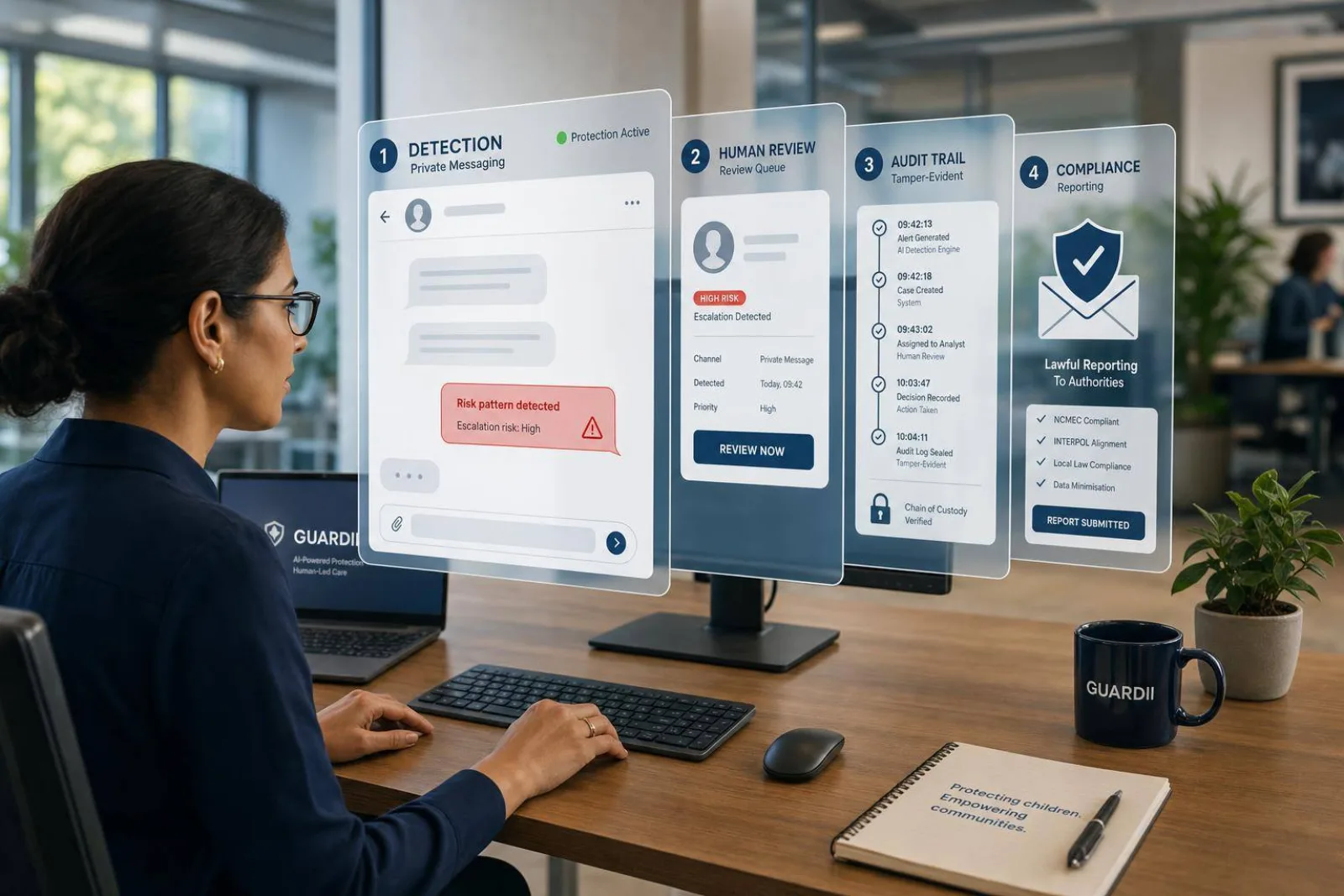
If you run child-safety AI in private messages, your job is simple to state: detect harm, get a human involved fast, keep clean records, and report when the law says you must.
From what I see in this piece, the article comes down to four things:
- Set rules before launch: define what the AI can do, what it cannot do, who owns decisions, and when humans step in.
- Keep records that hold up later: plain-English alert reasons, timestamps, reviewer actions, and tamper-evident logs.
- Match each alert to a legal path: CSAM, grooming, and sextortion do not follow the same workflow.
- Build for high-risk settings: schools, law enforcement, and youth-facing platforms need tight access, short review times, and clear retention rules.
A few numbers show why this matters:
- $375 million: civil penalties imposed by a New Mexico jury against Meta in March 2026
- 48 hours: takedown window under the TAKE IT DOWN Act
- 1,325%: increase in NCMEC CSAM reports involving generative AI in 2024
- January 1, 2027: date when the UAE law requires AI-based detection and reporting systems to be live
If I boil the article down even further, the message is this: AI governance for child safety is not a policy memo. It is a working review and reporting system for grooming, sextortion, CSAM, evidence handling, and cross-border compliance.
That matters for the same teams dealing with athlete, creator, and influencer abuse too. The playbook is similar: decide when to hide vs. delete, cut review time, lower false positives across many languages, preserve evidence, protect sponsors, and reduce how long people are exposed to abuse without blocking normal fan interaction.
Here’s the short version of what a governed system should deliver:
- Comment controls with clear rules for hide, unhide, and delete
- DM threat handling that moves from detection to evidence packs in 15 minutes or less
- Repeat-offender tracking across many accounts and handles
- Rivalry slang tuning to cut false positives in Hindi, Urdu, Tamil, Arabic, and other tour languages
- Women athlete and creator protection for sexualized abuse, cyberflashing, and threat review
- Sponsor-safe match-day workflows that protect brand campaigns without over-blocking fans
- Chain-of-custody records for comments and DMs
- Weekly KPI tracking for precision, recall, review time, and escalation rate
- Retention and data-location rules that legal and safety teams can defend
- Crisis statements and reporting paths for clubs, leagues, agents, and creator managers
In other words: if an alert can affect a child, a player, or a public figure, you need clear thresholds, fast human review, and records you can trust.
The rest of the article explains how to put those rules into daily use.
AI and the Rights of Children | IASEAI '26
sbb-itb-47c24b3
Core Governance Controls for Child Protection AI
Before deployment, define the system’s purpose, boundaries, owners, and controls. In plain terms, governance needs to be set before the first message is analyzed.
Safety-by-Design, Privacy Controls, and Human Oversight
The use-case register should spell out permitted uses, banned behavior, escalation thresholds, and review owners. [1]
Privacy controls need to cover COPPA-compliant data minimization, retention limits, and PII redaction before storage or training. [1][4] Media should be processed in memory only and not stored by default, which lines up with data minimization principles. [3]
Every model update and incident response decision should have a named owner and a clear responsibility matrix. [1] Human reviewers must stay in the loop for high-risk escalations. [1]
Use privacy-first child protection tools with age-appropriate UX, data minimization, high-privacy defaults, plain-English alert reasons, and human review for high-risk escalations. [1][4][6]
Pre-deployment testing should include adversarial red-teaming that simulates worst-case scenarios, such as multi-turn coaxing and attempts to bypass safety policies. [1][3] After launch, safety monitoring should run like an SRE function, with live dashboards that track refusal rates, classifier hits, and escalation counts, plus drift detection after any model update. [1]
Explainability and Auditability in Private-Message Detection
When a DM flag can trigger review or escalation, show the triggering behaviors, the risk reason, and the reviewer action in plain English. [1][3]
Audit logs should be tamper-evident and record each input, score, reviewer action, and timestamp. [5] Those logs create the evidence base for escalation, reporting, and later review. They also support the reporting and escalation duties covered next.
Compliance Requirements in the U.S. and Other Regulated Markets
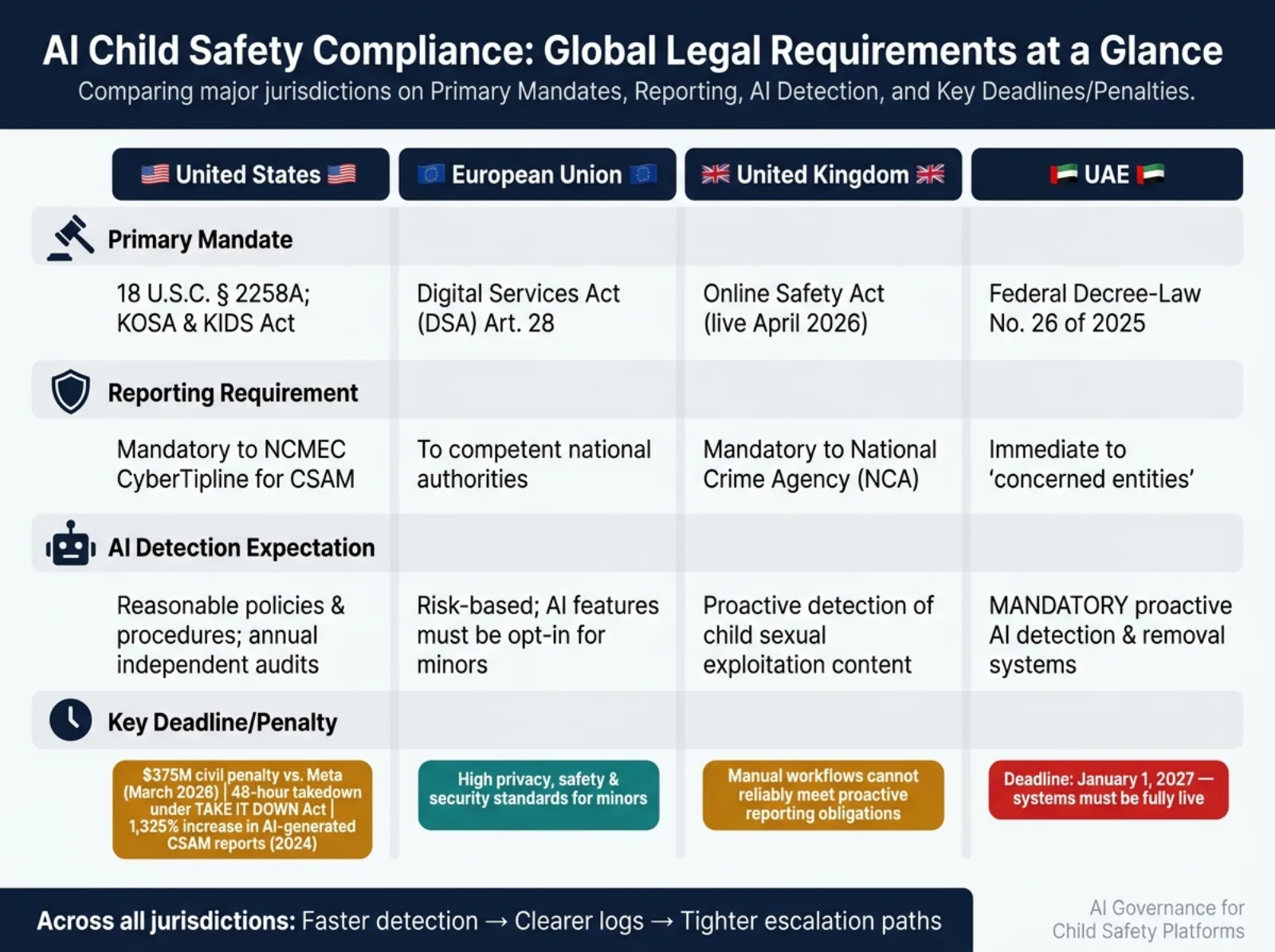
AI Child Safety Compliance: Global Legal Requirements at a Glance
Once governance controls are in place, compliance decides how those controls need to work in each market.
U.S. Legal Duties for CSAM, Exploitation, Monitoring, and Reporting
18 U.S.C. § 2258A requires platforms to detect apparent child sexual abuse material (CSAM) and report it to the NCMEC CyberTipline as soon as they become aware of it. In plain terms, that means teams need fast escalation paths and logs that are ready to support a report right away. [3]
KOSA and the KIDS Act would require reasonable measures against sexual exploitation and abuse, along with annual independent audits of safeguards. It helps to treat KOSA as a child-safety compliance bill, not as some separate policy lane. [3]
The TAKE IT DOWN Act, enacted in May 2025, requires removal of non-consensual intimate imagery, including AI deepfakes, within 48 hours of notice. The compliance deadline is May 2026. At the same time, the NCMEC CyberTipline recorded a 1,325% increase in CSAM reports involving generative AI in 2024. [3]
Civil risk is climbing too. A New Mexico jury imposed $375 million in civil penalties against Meta in March 2026 for failures to protect children under state consumer protection statutes. Updated FTC COPPA rules, effective April 22, 2026, add more pressure around data minimization and transparency for AI interactions with minors. [3][4]
International Frameworks and Emerging Proactive Detection Mandates
Outside the U.S., the pattern looks much the same, though some places are moving faster. The UAE's Federal Decree-Law No. 26 of 2025 took effect January 1, 2026, with a one-year grace period ending January 1, 2027. By that date, platforms must have proactive AI monitoring and reporting systems up and running. [6]
The EU Digital Services Act (DSA) uses a risk-based model. It requires a high level of privacy, safety, and security for minors, and it pushes AI features to be opt-in rather than default for younger users. The UK Online Safety Act requires platforms to report detected child sexual exploitation content directly to the National Crime Agency (NCA). Both systems are moving away from simple takedown models and toward proactive detection. On the ground, that means documented thresholds, fast escalation, and reporting paths that match each jurisdiction. [2][3]
The details vary, but the pressure points are familiar: faster detection, clearer logs, and tighter escalation.
| Jurisdiction | Primary Mandate | Reporting Requirement | AI Detection Expectation |
|---|---|---|---|
| United States | 18 U.S.C. § 2258A; KOSA and KIDS Act (proposed) | Mandatory to NCMEC for CSAM [3] | Reasonable policies, practices, and procedures; annual audits [3] |
| European Union | Digital Services Act (DSA) Art. 28 | To competent authorities [2] | Risk-based; AI features opt-in for minors [2] |
| United Kingdom | Online Safety Act | Mandatory to National Crime Agency (NCA) [3] | Proactive detection of child sexual exploitation content [3] |
| UAE | Child Digital Safety Law | Immediate to "concerned entities" [6] | Mandatory proactive AI detection/removal by January 1, 2027 [6] |
For child-safety teams, the job is simple to describe but hard to do well: turn each legal duty into a specific detection, review, and reporting step. Map each duty to a control, owner, log, and reporting path. Then tie each jurisdiction's rule to a matching alert, review, and reporting workflow. [3][1]
Governance for Incident Escalation, Evidence, and Response
Once an alert is flagged, governance has to answer three simple but high-stakes questions: Who reviews it? Who escalates it? What gets preserved? Detection is only the first step. The harder part comes next, when a flagged conversation moves from an AI alert to a human reviewer, and then, if needed, to law enforcement or a mandatory report. That chain matters because the alert, the reviewer action, and the final report become the compliance record.
From Detection to Triage to Mandatory Escalation
Not every alert needs the same response. A conversation that shows early grooming patterns is not handled the same way as a CSAM finding or an active sextortion threat. That’s why governance needs clear severity tiers. Teams should route cases either to urgent human review or isolated review based on the system’s risk score and the harm category detected. The hard part is doing that without losing speed, privacy, or legal footing.
The escalation matrix should spell out exactly who gets notified at each tier. For CSAM, the path is immediate: under 18 U.S.C. § 2258A, CSAM discovery triggers immediate reporting to NCMEC. There’s no room to stall while people debate it internally. The incident playbook needs a direct, documented path to the NCMEC CyberTipline that staff can use without delay. [3] For grooming or sextortion, the path usually runs through an internal child safety lead and legal counsel before law enforcement gets involved, but that timeline still needs to be written down.
Triage access should stay tight. Reviewers should see only the minimum material needed to route the case. A RACI matrix makes this concrete by showing who can authorize escalation, who can view sensitive material, and who signs off on outside reports. Reviewers also need documented training on grooming tactics, sextortion, and CSAM response criteria so decisions stay consistent and legally defensible.
Evidence Handling, Chain of Custody, and Audit Trails
Once a case is escalated, preserve only the evidence needed for reporting, review, and audit. But that evidence also has to stand up later. In practice, that means keeping full message threads, timestamps, model outputs, and reporting records in a tamper-evident format. [5]
For CSAM, volatile-memory-only processing - handling files entirely in volatile memory without writing them to disk - can help meet data minimization duties while keeping detection in place. [3] For other incident types, encrypted storage with strict least-privilege access helps limit how many staff members ever see the raw material.
The table below maps common incident types to their escalation paths, reporting entities, and evidence handling standards:
| Incident Type | Statutory Reference (U.S.) | Escalation Path | Reporting Entity | Evidence Handling |
|---|---|---|---|---|
| CSAM / AI-Generated CSAM | 18 U.S.C. §§ 2251, 2252, 2252A, 2256 | Immediate isolated review → Safety Lead → Legal → NCMEC report | NCMEC CyberTipline; Law Enforcement | Volatile-memory-only processing; hash/metadata preserved; tamper-evident logs [3][5] |
| Grooming / Enticement | 18 U.S.C. § 2422 | Urgent human review → Safety Lead → Legal Counsel → Law Enforcement | Law Enforcement; Internal Legal | Full message thread; timestamps; user ID and IP logs [1][3] |
| Sextortion | 18 U.S.C. §§ 2251, 2422 | Immediate triage → crisis resources and Take It Down info → Law Enforcement | NCMEC; Local Law Enforcement | Preserve original threat messages and timestamps; redact PII in secondary logs [1][3] |
These rules turn governance from a policy document into something teams can actually use under pressure.
Use fail-closed design: if the safety controls go offline for any reason, the system should halt rather than continue without protection. [5]
Applying the Framework in Schools, Law Enforcement, and Vulnerable-User Protection
Once escalation and evidence rules are set, the next move is to fit them to the setting where they'll be used.
Deployment Requirements for Schools, Districts, and Child-Protection Teams
Schools carry a higher duty of care than most platforms, and that changes how governance should be set up. Start with restricted student mode, staff dashboards, and role-based access as the default. Before launch, set retention rules in plain terms: how long flagged data stays stored, who can see it, and when it gets deleted. Those rules need to hold up against both privacy duties and evidence-preservation needs. After-hours escalation also needs to be defined before deployment, not figured out in the middle of an incident.
Track governance metrics every month. The table below shows the main control focus and key metric for each operating environment:
| Deployment Context | Primary Control Focus | Key Metric |
|---|---|---|
| Schools & Districts | Restricted student mode, staff dashboards, role-based access | Review time & staff escalation rate |
| Law Enforcement | Evidence packs, chain of custody, prosecutor-ready formatting | Reporting timeliness & audit accuracy |
| Vulnerable Users (Athletes, Public Figures) | Targeted abuse detection, PII redaction, post-update behavior drift monitoring | Precision/recall & false-positive rate |
In justice workflows, the main priority shifts from user support to evidentiary integrity. That means detection outputs must be formatted for reporting and prosecution. It also means reporting pipelines need to be automated and auditable, not handled by hand. The UK Online Safety Act's reporting duties, which went live in April 2026, require in-scope services to report detected child sexual exploitation content directly to the National Crime Agency (NCA) - a proactive obligation that manual workflows cannot reliably meet. [3]
Outside schools, many of the same controls still matter, but the threat mix changes. For student athletes, women public figures, and youth-facing communities, a single workflow should detect crossover abuse patterns. In practice, that means context-aware detection that follows escalation across grooming, sextortion, and harassment. It also means regular scenario testing, so teams can catch post-update behavior drift when model changes alter protective behavior.
What a Governed Child Safety Platform Should Deliver
Those deployment rules matter only if the platform can carry them out when pressure is high.
A platform that meets the governance standard described throughout this article must detect threats inside private messaging, surface explainable alerts in plain English, support human-in-the-loop review, generate automated evidence packs with tamper-evident audit logs, and enforce defensible retention policies. These aren't add-ons. They're the core product.
The standard is simple: child-centered, compliant, privacy-respecting, and usable under incident pressure.