

US, UAE, EU Child Safety Laws: Analysis
If you run one platform across the U.S., UAE, and EU, you can’t use one child-safety setup everywhere. I’d treat this as a product, legal, and moderation split across four pressure points: private messages, content rules, CSAM reporting, and AI detection.
Here’s the short version:
- The U.S. is still mostly reactive. There’s no general federal duty to scan private messages, but there are takedown and reporting duties for certain harms.
- The UAE is the strictest on product design. It requires AI-based detection, age checks, message-safety controls, and local audit records, with enforcement starting January 1, 2027.
- The EU already enforces the DSA, which focuses on risk systems and user safeguards. But its proposed CSAR could change private-message scanning rules in a big way.
- The biggest conflict is encryption. The U.S. leans toward protecting it, the UAE’s model puts pressure on it, and the EU is still arguing over it.
For me, the article points to one bottom line: this is not just a policy issue. It’s an architecture issue.
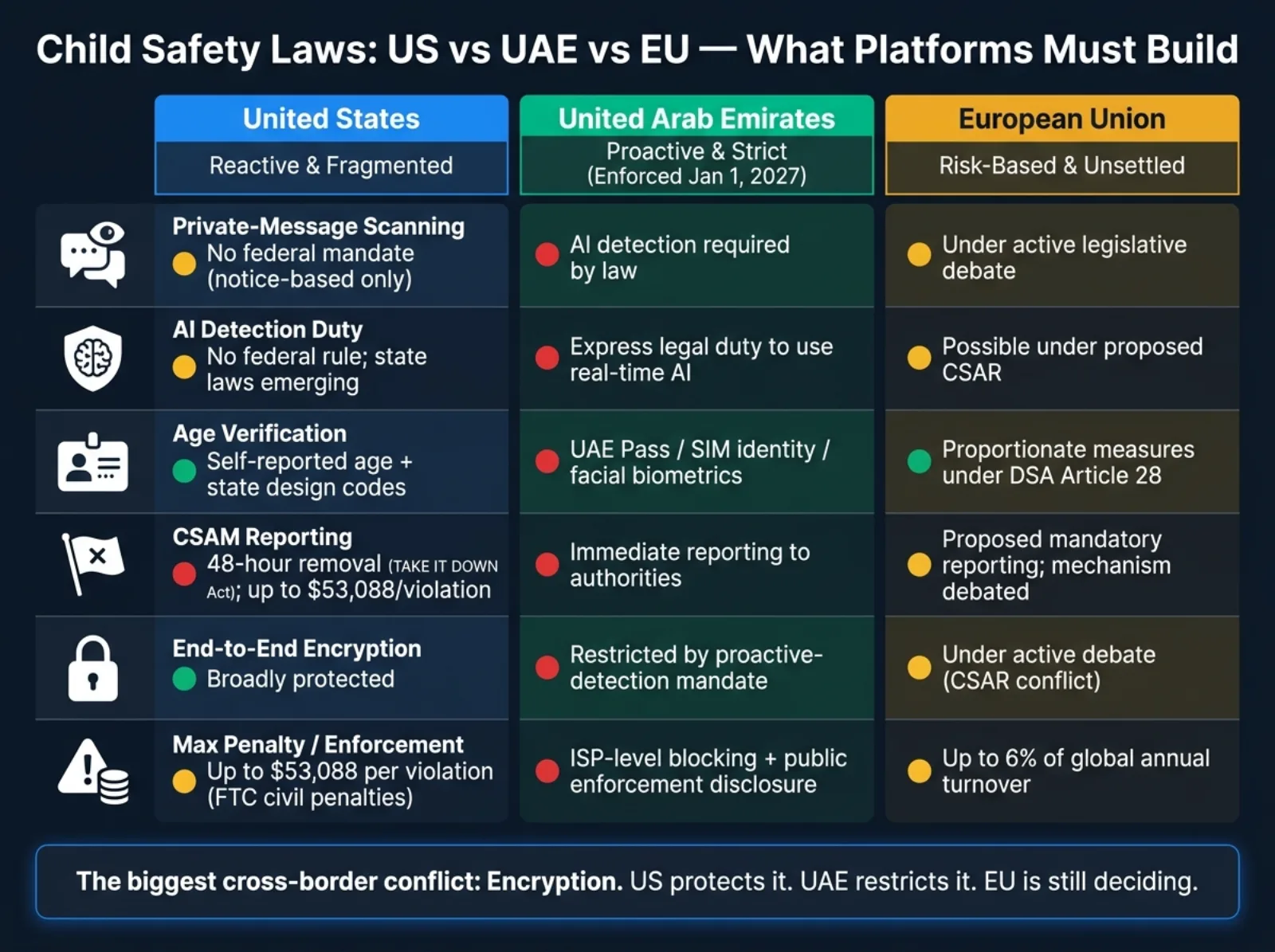
US vs UAE vs EU Child Safety Laws: Platform Compliance Comparison
Quick comparison
| Issue | United States | United Arab Emirates | European Union |
|---|---|---|---|
| Main legal approach | Patchwork federal/state rules | Single child-safety law with direct duties | DSA live; CSAR still under debate |
| Private-message scanning | No general federal mandate | AI detection required | Still being debated |
| Content standard | Focus on specific illegal harms | Broad harmful-content rules | Illegal content + risk controls for lawful but harmful material |
| CSAM / escalation | Notice, takedown, reporting duties | Immediate reporting to authorities | DSA duties now; CSAR may add more |
| AI detection duty | No general federal rule | Express duty to use it | Possible under CSAR |
| Main compliance strain | State-by-state drift | Product design, identity, and logs | Legal uncertainty around scanning and E2EE |
A few numbers stand out:
- 48 hours: federal removal window in the U.S. for flagged non-consensual intimate imagery under the article’s summary of the TAKE IT DOWN Act
- January 1, 2027: UAE enforcement start date
- 6% of global annual turnover: top-end DSA fine level mentioned for the EU
If I were planning rollout today, I’d lock down message rules, region-based escalation, and auditable AI decisions first. That’s where cross-market conflict shows up fastest.
sbb-itb-47c24b3
1. United States Child Online Safety Framework
The U.S. model is fragmented. Federal law tends to target specific harms, while states have moved faster on product design and youth protections.
Private-Message Scanning
U.S. law is still mostly notice-based, not proactive. In plain English, platforms are generally expected to act when they know about illegal content, not to go looking for it ahead of time. First Amendment and privacy concerns have helped stop efforts to impose broad scanning duties. Some platforms do voluntarily scan unencrypted messages for CSAM, but there is no federal rule that makes this mandatory. [5]
That reactive approach sets the tone for the rest of U.S. moderation law.
Content Moderation Scope
Section 230 still protects platforms from liability for third-party content, but recent rulings suggest that recommendation systems may sit outside that shield. [4] At the federal level, lawmakers have usually leaned toward design-based safeguards like default privacy settings and data minimization instead of direct content takedowns, partly to avoid First Amendment fights. States have taken a tougher line. California, Maryland, Nebraska, and Vermont have passed Age-Appropriate Design Codes that extend protections to minors and regulate product architecture more directly. [1][4][6]
For platform operators, that means a reactive federal baseline paired with a growing patchwork of state design rules.
When content falls outside Section 230's shield, reporting and takedown duties become the main compliance risk.
CSAM Reporting Duties
The TAKE IT DOWN Act is the main federal tool here. It makes the publication of non-consensual intimate imagery a crime, including AI-generated deepfakes, and it requires platforms to remove flagged material within 48 hours after receiving a valid notice. The FTC can issue civil penalties of up to $53,088 per violation for non-compliance. [4]
The FTC's amended COPPA rule, which takes effect in 2025 and becomes fully enforceable in 2026, broadens personal information to include biometric identifiers and tightens consent rules for children under 13. The FTC and DOJ also sued TikTok in August 2024 over alleged COPPA violations, seeking penalties of up to $51,744 per violation per day. [4]
AI Detection Mandates
At the federal level, there is no mandate requiring platforms to use AI or other automated tools for real-time detection of grooming, sextortion, or CSAM. The Kids Online Safety Act (KOSA), which would create a duty of care aimed at preventing harms to minors, was still pending in the House as of May 2026. [4]
States, though, are moving faster. Wyoming and South Dakota have passed laws that impose criminal liability for AI-generated harmful content involving minors, and Maryland has banned behavioral advertising aimed at users under 18. [6] For platform operators, the federal floor remains reactive while state rules keep drifting apart.
That reactive U.S. baseline stands in contrast to the UAE's explicit proactive detection duty.
2. United Arab Emirates Child Digital Safety Framework
The UAE framework is strict and specific. It calls for proactive detection, verified age checks, and fast enforcement. In plain terms, UAE compliance is a design-and-verification issue, not just a moderation issue.
Proactive AI Detection
The law goes past a basic notice-and-takedown model. It requires real-time AI detection and removal before harmful content reaches child users, including CSAM, violence, and threats to moral or psychological harm [2].
That means platforms need systems that can spot and act on risk in real time. Those systems also need to be auditable, since regulators can inspect how detection and enforcement work in practice [2].
Harmful-Contact Prevention
The law also requires technical controls that stop unwanted contact from unknown adults and detect grooming behavior in private messages [2].
This matters because it shifts private-message safety into the core compliance stack. It’s not just a nice extra for trust and safety teams. It’s part of the legal duty [2].
Age Verification Standards
A simple self-reported age field isn’t enough under this law. Platforms need identity signals that can be verified [2].
Accepted signals include:
- UAE Pass
- Telco-backed SIM identity
- Facial biometric verification [2]
Enforcement Teeth
If a platform fails to comply, the result can be ISP-level blocking [2].
That changes the stakes. It also sets up a clear contrast with the EU model, which leans more on systemic risk analysis than on explicit identity-backed access control.
3. European Union Child Online Safety Framework
The EU sits somewhere between the U.S. model, which often moves after harm happens, and the UAE model, which leans more on upfront duties. In the EU, the DSA focuses on systemic risk management. At the same time, the pending CSAR could bring more direct scanning duties. That split shows up first in how the DSA handles illegal content versus lawful but harmful content.
Content Moderation Scope
The Digital Services Act (DSA) draws a firm line between illegal content and harmful-but-legal content. Illegal content, such as CSAM, triggers mandatory removal and reporting duties. Harmful-but-legal content is treated differently: the focus shifts to systemic risk management instead.
Article 28 says platforms that minors can access must take proportionate steps to protect privacy, safety, and security at the same time. That includes default privacy settings that stop children from being discoverable by strangers [1].
Private-Message Scanning
The temporary legal basis that let platforms voluntarily scan unencrypted messages for CSAM expired on April 3, 2026 [5]. Even so, several major platforms are reportedly still scanning on a voluntary basis while talks over a permanent replacement continue [5].
That replacement proposal, widely known as Chat Control 2.0 and formally called the Child Sexual Abuse Regulation (CSAR), is still under negotiation [5]. The flashpoint is client-side scanning (CSS). Under that model, AI software checks content on a user's device before encryption and before the message is sent.
Why does that matter so much? Because the scan happens before encryption does its job. Security researchers have warned that client-side scanning can weaken encryption and security more broadly [5]. Those fights over scanning don't stay abstract for long. They connect straight to reporting duties when platforms receive detection orders.
CSAM Reporting Duties
Under the proposed CSAR, a platform that receives a detection order would have to automatically report flagged material to law enforcement [5]. That's one of the main pressure points in the debate.
The proposal is still heavily disputed. The Council's Legal Service has questioned whether it fits with fundamental rights, while Parliament has argued for targeted, judicially authorized scanning instead of generalized monitoring [5].
AI Detection Mandates
The original 2022 Commission proposal would require AI detection of known CSAM, unknown CSAM, and real-time grooming behavior [5]. The Council's current position reshapes that approach as risk mitigation for high-risk providers, not as a direct scanning mandate [5].
Still, the practical effect remains disputed [5]. Even with the Council using the language of risk mitigation, the proposal would continue to push high-risk providers toward AI-based detection of CSAM and grooming [5].
So the core tension here isn't the DSA's risk model by itself. It's how far the final CSAR goes on scanning, encryption, and mandatory detection.
Where the Frameworks Diverge in Practice
These frameworks split most sharply on private-message scanning, CSAM reporting, AI detection, and encryption. For product and trust-and-safety teams, that’s not a small policy detail. It shapes what a platform has to build, what it has to log, and what it has to tell users in each region. The next issue is how those rules push product design in different directions across markets.
| Criterion | United States | United Arab Emirates | European Union |
|---|---|---|---|
| Private-Message Scanning | No federal mandate; KOSA pending | Required - proactive AI detection | Under legislative debate |
| Platform Responsibility: Illegal Content | 48-hour takedown for NCII under TAKE IT DOWN Act | Immediate reporting to UAE authorities | Systemic risk focus; proposed CSAM rules under debate |
| Platform Responsibility: Harmful Content | Pending KOSA; no unified federal standard | Proactive AI detection and removal required | Systemic risk assessment and mitigation under DSA |
| CSAM Reporting Trigger | NCMEC reporting for qualifying CSAM | Immediate reporting required | Proposed mandatory reporting; mechanism under debate |
| End-to-end encryption | Generally protected | Restricted by proactive-detection mandate | Under active debate |
| Audit Trails | Fragmented by state | Required - logs stored in UAE infrastructure | Required for DSA/GDPR compliance |
| Explainability of AI Decisions | Under debate | Required for auditable systems | Required - user-facing reasons for moderation decisions |
End-to-end encryption is the clearest point of conflict. The UAE’s proactive-detection mandate for messaging apps clashes with end-to-end encryption, because detection has to happen before encryption or after decryption. The EU is still debating whether encrypted messages should be scanned. The US, by contrast, treats E2EE as broadly protected. That clash around encryption creates the biggest day-to-day split across the three regimes.
Recordkeeping rules split too. The UAE requires local storage of identity and audit records. The EU leans on GDPR- and DSA-based recordkeeping. The US takes a patchwork approach, with rules that vary by state.
Under the DSA, users can challenge content moderation decisions, which means automated systems must give user-facing reasons for those decisions [1]. The UAE puts more weight on regulator-facing auditability. The EU, meanwhile, puts user-facing explanations front and center.
These differences create market-specific tradeoffs, often requiring privacy-first AI tools to balance compliance with user trust.
Pros and Cons by Market for Platform Operators
For operators, the key issue isn’t the wording of each law. It’s the product architecture each one pushes you toward.
That matters most in four areas for multi-market rollout: private-message scanning, CSAM reporting, AI detection, and encryption. The U.S. is the easiest place to launch, but the hardest place to standardize. The UAE gives you the clearest rulebook, but it also asks the most from your stack. The EU gives you reach across 27 member states, yet the toughest questions, especially around encryption, are still unsettled.
| Jurisdiction | Operator Advantages | Operator Burdens | Key Compliance Risk |
|---|---|---|---|
| United States | Lower baseline liability for third-party content; First Amendment challenges often delay restrictive state laws [4] | State age-verification laws; 48-hour federal removal mandate for non-consensual intimate imagery [4] | Civil penalties up to $53,088 per violation; growing exposure as algorithmic recommendation systems begin to lose Section 230 protection [4] |
| United Arab Emirates | Centralized UAE Pass standard reduces the need to build interoperable age-verification infrastructure [2] | Mandatory proactive AI scanning; UAE-hosted data residency for audit logs; continuous identity re-validation during each session [2] | ISP-level blocking and public enforcement disclosure for non-compliance [2] |
| European Union | Single market framework across 27 member states; platform-wide risk management instead of post-by-post liability [1] | Annual risk assessments; transparency reporting; unresolved conflict between proposed CSAM scanning and end-to-end encryption [1] [5] | Fines up to 6% of global annual turnover; potential technical incompatibility between scanning mandates and E2EE architecture [5] |
The next issue is simple: which market forces the most expensive redesign?
In the U.S., the risk profile is mostly about money and lawsuits. That can snowball fast. Recent enforcement shows how quickly COPPA and AI compliance exposure can pile up [4].
In the UAE, the risk sits much deeper in operations and system design. The CDS Law works at the code layer. Compliance is not based on one-time onboarding. It starts with continuous UAE Pass re-validation during each session, and that check ties straight into private-message safety, not just identity management. Full enforcement begins on January 1, 2027 [2] [3].
The EU carries the most legal uncertainty. The main conflict still isn’t settled: mass scanning and end-to-end encryption do not fit neatly together. For platforms built around encrypted messaging, that tension is the main cross-border fault line [5].
Conclusion
The U.S. focuses on reporting and liability. The UAE puts more weight on early detection. The EU leans toward systemic-risk governance, while rules around private-message scanning are still unsettled.
Those differences shape how products need to be built. For platform teams, this isn’t just a legal gap. It’s an architecture problem.
That leads to three launch decisions. Before launch, lock down three controls: private-message monitoring rules, jurisdiction-specific CSAM escalation, and auditable AI decisions.
Build configurable, jurisdiction-aware safety controls with auditable logs and localized escalation workflows from the start.
FAQs
Which market requires the biggest product redesign?
The UAE calls for the biggest product rethink.
Its Child Digital Safety Law sets a much higher bar for age checks. Companies can’t lean on self-reported boxes or a one-time check during signup. Instead, age verification needs to connect to the country’s official digital identity system.
The law also requires proactive AI-driven detection of harmful content and abuse, with full compliance due by January 1, 2027.
That’s where Guardii fits. It supports real-time detection of predatory behavior in private messaging, which lines up closely with what the law asks platforms to do.
How does end-to-end encryption affect compliance?
End-to-end encryption puts two goals into direct conflict: user privacy and child-safety duties.
You can see that clearly in the EU debate over message scanning. Privacy advocates argue that automated detection can threaten fundamental rights. Safety experts push back, saying that if scanning is off the table, abuse becomes much harder to detect.
Even though the EU's temporary scanning measures have expired, platforms aren't off the hook. They still have duties under the Digital Services Act.
That’s why many platforms are shifting toward safety-by-design and more proactive detection that works within those technical limits.
What should platforms prioritize first for rollout?
Start with safety by design. That means building child protections into the product from day one, not adding them later.
In practice, this includes data minimization, age-appropriate settings and age verification, and clear workflows for reporting issues and responding when something goes wrong.
Then back that up with strong compliance measures so enforcement can work at scale. This approach lines up with Europe and the U.S. It also fits the UAE’s focus on filtering and blocking, parental controls, proactive AI-enabled detection, removal and reporting, and prompt reporting to authorities.