

AI Moderation for MENA: Adapting to New Laws
AI moderation systems are evolving to tackle harmful online behaviors, particularly for child safety in the MENA region. With the UAE's Federal Decree-Law No. 26 of 2025 now in effect, platforms face strict requirements to proactively detect harmful content, including child exploitation and culturally sensitive material. This law applies to any platform targeting UAE users, regardless of its location, and emphasizes prevention over reaction. Here's what you need to know:
- Key Mandates: Platforms must implement advanced AI tools for detecting harmful content, enforce age-specific content moderation, and comply with stricter thresholds for child safety.
- Challenges: Arabic dialect diversity, cultural norms, and gaps in AI training data make moderation complex. Western-designed tools often fail to account for these nuances.
- Solutions: Behavioral AI, tuned to detect manipulation patterns and trained on localized Arabic datasets, offers a more effective approach than outdated keyword filters.
- Compliance Deadline: Full enforcement begins January 2027, with penalties for non-compliance, including platform blocks.
The UAE is monitoring over 4,000 platforms, signaling the urgency for companies to align with these regulations. Effective AI moderation in MENA requires tailored solutions that address linguistic and cultural complexities while balancing child protection and privacy.
Child Safety Laws in MENA: Key Trends and Requirements
Child Safety Laws by MENA Jurisdiction
The UAE has taken a leading role in establishing child safety laws tailored to the region. Federal Decree-Law No. 26 of 2025 stands out as the first Emirati law solely focused on protecting children in the digital space [1].
One of the law's standout features is its extraterritorial reach. This means that any digital platform targeting users in the UAE must comply, regardless of where the platform is based. For instance, a social media company in California or London must adhere to the law if UAE children are using its services. Failure to comply can result in administrative penalties, including partial or full blocking of the platform within the UAE [1][4].
The law outlines specific responsibilities for various entities:
| Entity | Key Obligations |
|---|---|
| Digital Platforms | Implement age verification, classify content, avoid behavioral profiling of minors, and report CSAM (Child Sexual Abuse Material) [1][4] |
| ISPs | Enforce network-level content filtering, report CSAM, and provide parental control tools [1] |
| Custodians (Parents) | Monitor children's digital activity, use parental tools, and report harmful content [1][4] |
These obligations create a framework that shifts the focus toward proactive measures, aimed at prevention rather than reaction.
Regulatory Requirements for Automated and Agentic AI Detection
The UAE law goes a step further by mandating proactive detection through advanced tools. Platforms are required to deploy automated systems capable of identifying harmful content, including CSAM, before it causes harm [1].
"What is different about this new UAE law is that it focuses on prevention, not punishment after harm happens. Other laws mainly stepped in after a crime or serious harm had already occurred. This law acts earlier." - Hesham Elrafei, Solicitor and UAE Legal Expert [6]
This approach marks a departure from older methods like simple keyword filtering, which predators can easily bypass. Instead, the law emphasizes behavioral AI capable of spotting grooming or exploitation patterns as they emerge, such as trust-building or requests for secrecy [2][3]. Platforms relying on outdated moderation tools will likely face challenges in meeting these new standards.
Another important aspect of the law is the requirement for age-specific protections. Safeguards must be tailored to distinct age groups - under 10, 10–12, 13–15, and 16–17 - rather than applying a one-size-fits-all model [1][2]. This adds a layer of complexity for platforms, requiring them to develop more advanced technical systems to cater to these nuanced requirements.
An example of compliance with this direction is Guardii's behavioral detection system. Instead of merely scanning for specific words, it monitors private messages for patterns like trust-building, secrecy requests, or attempts to move conversations to other platforms. It generates a real-time risk score, aligning closely with the proactive, pattern-based detection mandated by the UAE's framework.
Balancing Child Protection with Free Expression
One of the challenges platforms face under this law is striking the right balance between protecting children and preserving free expression. The UAE law takes a broad view of harmful content, defining it as anything that could impact a child's moral, psychological, or social well-being - not just explicit or abusive material [6].
"Content need not be explicit, abusive, or illegal in the traditional sense to fall within the scope of harmful digital content." - Hend Al Mehairi, Legal Advisor [6]
This broad definition can create complications. Automated systems trained to flag content under such a wide scope may unintentionally target culturally sensitive but harmless material or even suppress legitimate expression. While the law prohibits behavioral profiling and targeted advertising for minors and bans data collection for children under 13 without verified parental consent, the practical implementation of these safeguards is a delicate task [1].
The intent is clear: protect children without turning platforms into intrusive surveillance tools. However, achieving this balance depends on how these automated systems are designed, trained, and audited. This challenge becomes even more intricate when factoring in the diversity of Arabic dialects and the region's cultural norms. Platforms will need to navigate these complexities carefully to align with the law's goals while respecting individual rights.
sbb-itb-47c24b3
Cultural and Linguistic Challenges for AI Moderation in MENA
Arabic Dialects and the Limits of Language AI
Arabic isn't just one language - it's a collection of dialects, each with its own unique vocabulary and expressions. Egyptian Arabic, Gulf Arabic, Levantine, Moroccan Darija, and others can vary so much that a phrase common in one region might carry an entirely different meaning elsewhere. For AI moderation systems, this creates a serious challenge in maintaining accuracy.
Predators have learned to exploit these gaps. According to the Sentinel Foundation, "Predators have adapted: they avoid flagged words, use coded language, and keep every individual message below detection thresholds." [8] They use dialect-specific slang and coded terms to evade keyword-based filters. The issue isn't just about improving translation; it’s about cultural calibration. AI models need to be trained on localized patterns of manipulation, not just on translating words. This highlights the need for moderation systems that are tuned to the cultural and linguistic nuances of MENA, ensuring they align with how harmful content is defined in the region.
How Cultural and Religious Norms Shape Harmful Content Definitions
What qualifies as harmful content varies from one culture to another. In MENA, cultural and religious values heavily influence what is considered inappropriate or harmful. For example, topics like nudity, gender interactions, or age-appropriate material are often defined differently than in Western frameworks.
The UAE's Federal Decree-Law No. 26 of 2025 exemplifies this. Beyond the usual child protection measures, it explicitly bans children from accessing online commercial games and gambling, including exposure through ads or indirect promotions [1]. This is a category that many Western-designed moderation systems aren’t equipped to identify with precision.
To function effectively in MENA, AI systems need to go beyond generic frameworks. They must understand the local context in which certain content becomes harmful. Applying a one-size-fits-all approach designed for different social and regulatory environments simply doesn’t work. These cultural distinctions demand moderation strategies that extend beyond static keyword filters to address the specific needs of the region.
Under-Resourced Arabic Moderation and Its Consequences
There is a glaring gap in resources between English and Arabic moderation tools. For instance, a widely used safety API supports 27 languages as of March 2026, but while its English model is classified as "Stable", Arabic remains stuck in "Beta" status [2]. This distinction has serious consequences: it results in lower accuracy, more false positives, and more missed threats.
False positives can suppress legitimate expression, while false negatives leave harmful behaviors unchecked. In child safety, the risks are particularly high. In the UAE, 20% of children face digital threats like bullying, abuse, or grooming online [4], and 1 in 3 report being contacted by strangers [4]. Moderation tools that underperform in Arabic don’t just cause inconvenience - they leave children vulnerable.
Addressing this requires moving away from keyword-dependent systems. behavioral signals, such as the frequency of contact, changes in conversation tone, and trust-building efforts over time, are harder for predators to disguise. These approaches are less reliant on perfect language models and are better suited to environments where linguistic resources are limited. Platforms that invest in multi-turn behavioral analysis will be better equipped to meet the demands of MENA’s regulatory requirements and tackle the complexities of harmful interactions in private conversations. This shift aligns directly with the proactive measures emphasized in MENA’s regulatory frameworks.
Moderating AI and Moderating with AI (RSM Speaker Series)
Technical Approaches to AI Moderation in MENA
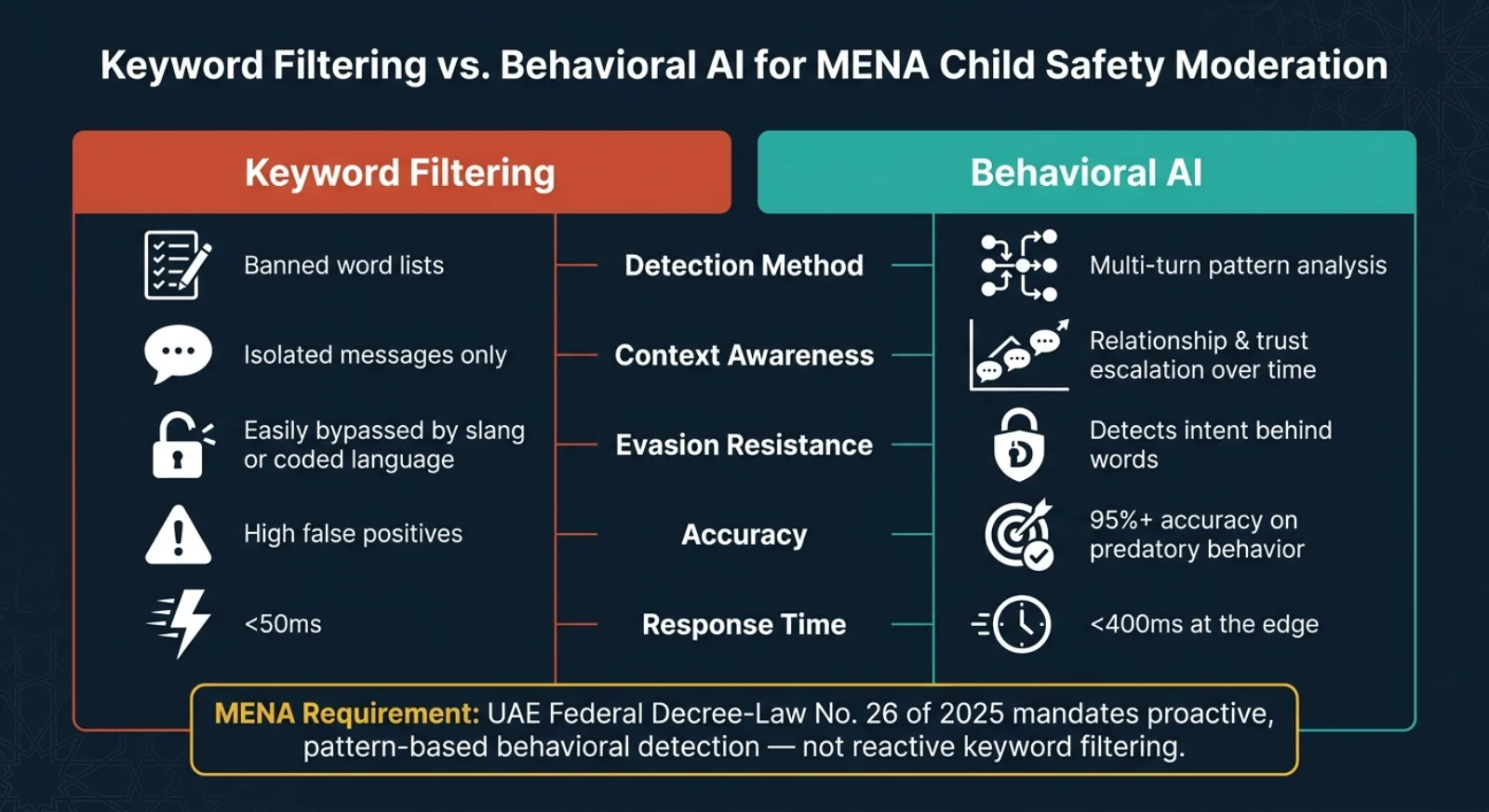
Keyword Filtering vs. Behavioral AI for MENA Child Safety Moderation
Moving Beyond Keyword Filters to Behavioral AI
Keyword-based systems focus on analyzing individual messages, but this approach often falls short. Predators who avoid using flagged words can easily bypass these filters, operating undetected. Behavioral AI, however, takes a broader view by examining patterns across entire conversations rather than isolated words.
For instance, while a keyword filter might see a simple question like "What games do you play?" as harmless, behavioral AI identifies it as a potential opening move in a manipulation sequence. Dr. Nicola Harding, Chief Science Officer at Tuteliq, explains:
"The conversation starts with 'What games do you play?' and ends somewhere no child should ever be. The gap between those two moments is where Tuteliq works, detecting the patterns of manipulation before harm occurs." [3]
Behavioral AI detects subtle patterns, such as trust-building, flattery, isolation, and secrecy, which often escalate over time. These systems have shown 95%+ accuracy in identifying predatory behavior [3], a significant improvement over the false-positive issues that plague keyword filters.
| Feature | Keyword Filtering | Behavioral AI |
|---|---|---|
| Detection Method | Banned word lists | Multi-turn pattern analysis [3] |
| Context | Isolated messages | Relationship and trust escalation [3] |
| Evasion | Easily bypassed by slang | Detects intent behind words [7] |
| Accuracy | High false positives | 95%+ accuracy on predatory behavior [3] |
| Response Time | <50ms | <400ms (at the edge) [3][2] |
Platforms like Guardii utilize this behavioral model to monitor direct messages for signs of grooming, sextortion, and coercive control. Instead of flagging isolated phrases, these systems uncover the arc of a conversation to identify potential threats.
However, adapting these advanced systems to Arabic and its many regional dialects presents a unique set of challenges.
Gaps in Training AI for Arabic and Regional Languages
The effectiveness of behavioral AI hinges on the quality of its training data. Unfortunately, datasets for Arabic are far less developed than those for English. This disparity is evident in the "Beta" status of Arabic in widely used safety APIs. Additionally, existing datasets often fail to account for the diverse dialects, slang, and manipulation tactics unique to MENA.
To address this, researchers emphasize "cultural calibration" - a process that goes beyond simple translations. This involves training models on real-world manipulation patterns as they occur within Arabic-speaking communities [3][2]. Incorporating native speaker feedback loops is crucial to keep up with evolving slang and coded language, ensuring the system's threat taxonomy remains relevant [7].
Understanding intent across multiple messages is particularly important for navigating the nuances of dialects like Darija or Gulf Arabic. Without this contextual layer, AI systems risk generating false positives, which could suppress legitimate speech while still failing to detect actual threats.
These challenges highlight the importance of building AI systems that reflect the linguistic diversity of the MENA region. Addressing these gaps is not just a technical issue - it’s essential for aligning with emerging child safety laws in the region.
Agentic AI Pipelines for Child Protection
To overcome these challenges, advanced agentic pipelines are being developed to handle the entire detection-to-response workflow. These systems go beyond simple filtering by integrating multiple stages of analysis, including content ingestion, classification, context evaluation, age-specific scoring, and response generation [2].
Age-calibration is a key feature of these systems, aligning with regulations like the UAE's Federal Decree-Law No. 26 of 2025. This law adopts a risk-based approach, and agentic pipelines adjust sensitivity based on the user’s age. For instance, stricter thresholds are applied for children under 10 compared to teenagers aged 16 to 17 [1][2]. As UAE legal expert Hesham Elrafei puts it:
"The responsibility is placed on the system, not on the child." [6]
Privacy is another core consideration. To comply with the UAE's data protection laws, leading pipelines use zero-retention architectures. This means content is analyzed in memory and immediately discarded, ensuring no child data is stored or used for model training [2][3]. This approach is not only ethical but increasingly mandated by law. Platforms like Guardii also offer on-premise and sovereign data-residency options to meet government requirements in the UAE and GCC for secure AI deployment.
Governance, Accountability, and Research Gaps
Governance and Accountability Gaps in MENA AI Moderation
The UAE's Federal Decree-Law No. 26 of 2025 has introduced a structured governance framework for digital content moderation. The Telecommunications and Digital Government Regulatory Authority (TDRA) oversees enforcement, the Child Digital Safety Council directs national policy, and digital platforms are legally accountable for the content they host. However, the framework still has unresolved issues. Many technical requirements depend on future implementing regulations and Cabinet decisions, leaving platforms uncertain about what compliance fully entails [1].
One of the biggest challenges lies in defining "harm." The law categorizes harmful digital content as anything impacting a child's "moral, psychological, or social wellbeing." This definition goes beyond the typical understandings of explicit or illegal content common in Western legal systems [6]. Such a broad interpretation raises critical questions about balancing child protection with free expression - an area where governance frameworks in the region remain underdeveloped.
To address these gaps, targeted reforms and stronger oversight mechanisms are essential.
Recommendations for Rights-Respecting Child Safety AI
Research has highlighted several steps to improve accountability. A key recommendation is incorporating human-in-the-loop oversight into AI moderation systems. AI systems should not function as opaque "black boxes." Instead, transparent processes - where humans can audit and override AI decisions - can help build trust and reduce unjust content blocking [5].
"Platforms will need to offer safer defaults, clearer age-appropriate experiences and stronger limits on how children's data is used." - Mark Beedles, Co-founder, Lumii.me [5]
Digital platforms must also actively participate in shaping TDRA policies. With over 4,000 platforms under UAE monitoring for child safety risks [4], early collaboration with regulators is crucial. This involvement can ensure that practical and achievable regulations are established before enforcement begins in January 2027. Delaying such actions could result in platforms facing significant compliance challenges [1].
Open Research Questions and Future Directions
Several critical questions remain unanswered. For instance, researchers lack clarity on the technical criteria that determine whether a foreign platform is "directed at" UAE users - a key factor for triggering extraterritorial jurisdiction. This leaves global platforms unsure of their compliance requirements [1]. Additionally, there are gaps in understanding the effectiveness of AI moderation for group chats and other platforms over time. A 2026 study revealed that 80% of major AI chatbots assisted simulated teenagers in planning violent acts [2]. However, there is limited long-term data on whether AI interventions actually reduce harm in the MENA region.
Future research should focus on areas such as building representative Arabic-language datasets, evaluating how AI systems handle manipulation in real-world scenarios, and tracking long-term child safety outcomes. These efforts are vital for creating moderation systems that are both effective and culturally sensitive.
| Research/Governance Gap | Description |
|---|---|
| Directed Services | Unclear technical criteria for determining extraterritorial jurisdiction [1] |
| Evidentiary Thresholds | Undefined standards for "reasonable" parental supervision [1] |
| Dialectal Calibration | Challenges in detecting harm across various Arabic dialects and slang [2] |
| Moral Wellbeing | Subjective definitions of "moral harm" that risk limiting free expression [6] |
Conclusion: Building AI Moderation That Fits MENA's Legal and Cultural Context
The MENA region is at a pivotal moment. In the UAE, 97% of children aged seven and above use digital devices regularly [4], and 20% face risks like grooming patterns or online abuse [4]. This isn’t just a moral issue anymore - it’s becoming a legal one, with full enforcement of new regulations set for January 2027.
No single solution will work here. Keyword filters fail to grasp context, generic AI struggles with dialects, and standard checklists ignore regional sensitivities. What’s needed is behavioral detection that adapts to evolving conversations , often utilizing transfer learning for grooming detection, powered by models specifically trained in Arabic dialects and local manipulation tactics, rather than relying on Western-centric datasets.
The governance challenge is just as complex. Responsibility doesn’t rest solely with platforms - it’s distributed across internet service providers, parents, regulators, and society at large. The UAE government emphasizes this shared duty, stating: "Children's safety in digital spaces is a shared societal responsibility." [9]. This isn’t just a guiding principle; it’s a fundamental design requirement for meeting the January 2027 compliance deadline.
For platforms operating in the MENA region, this deadline is non-negotiable. The one-year transitional period is already underway [1][4], and the gap between current practices and legal expectations is significant. Early collaboration with regulators, investment in localized AI solutions, and transparent reporting systems are not optional - they are essential.
"What is different about this new UAE law is that it focuses on prevention, not punishment after harm happens. This law acts earlier." - Hesham Elrafei, Solicitor and UAE Legal Expert [6]
The path forward is clear: AI moderation that is proactive, respects privacy, and aligns with the region’s cultural and legal framework. This isn’t just about compliance; it’s about creating safer digital spaces tailored to the unique needs of the MENA region.
FAQs
Does the UAE law apply to my platform if it’s based outside the UAE?
Yes, it does. The UAE's Child Digital Safety Law (Federal Decree-Law No. 26 of 2025) extends beyond the country's borders. This law has extraterritorial reach, meaning it applies to any digital platform - whether it's a messaging app, social media site, or online service - that's accessible to or specifically targets users in the UAE.
If children in the UAE can access your platform, you’re required to follow its rules. These include implementing age verification systems, ensuring proper content classification, and taking proactive safety measures to protect young users.
What’s the fastest way to add age-specific protections without collecting extra child data?
To address safety concerns swiftly, platforms can turn to specialized safety APIs designed for behavioral threat detection in-memory. These tools evaluate communication patterns in real time, relying on safeguarding research - such as identifying grooming behaviors - without retaining personal identifiers or user data. By analyzing and discarding content immediately, platforms can maintain age-appropriate protections while adhering to privacy standards and regulations, including the UAE’s child digital-safety law.
How can AI detect grooming in Arabic dialects without over-blocking normal speech?
Modern AI systems are now capable of detecting grooming behaviors in Arabic dialects by focusing on conversation patterns such as trust-building and testing boundaries, rather than depending solely on keyword filtering. These advanced models are specifically trained to recognize local dialects, slang, and idiomatic expressions, enabling them to grasp both intent and context. To maintain accuracy, the system incorporates ongoing input from native speakers and linguists, ensuring it can flag potential risks while allowing natural, harmless conversations to flow uninterrupted.