

UNICEF AI Guidance for Child Safety: 5 Lessons
Most abuse starts in DMs, and that means child-safety AI has to spot risky behavior fast without turning private chats into open monitoring. I’d boil this article down to five clear lessons: build for child rights first, focus on harm reduction, limit data use, test for bias, and keep every serious action tied to human review.
If I were turning UNICEF’s guidance into a working playbook, I’d keep it this simple:
- Detect patterns, not just words
- Use the least child data possible
- Keep people in charge of serious escalations
- Test across language, age, and risk groups
- Log decisions so they can be checked later
The article’s core point is plain: a weak system misses abuse, but an overreaching one pushes kids away. Good child-safety AI has to hold that line.
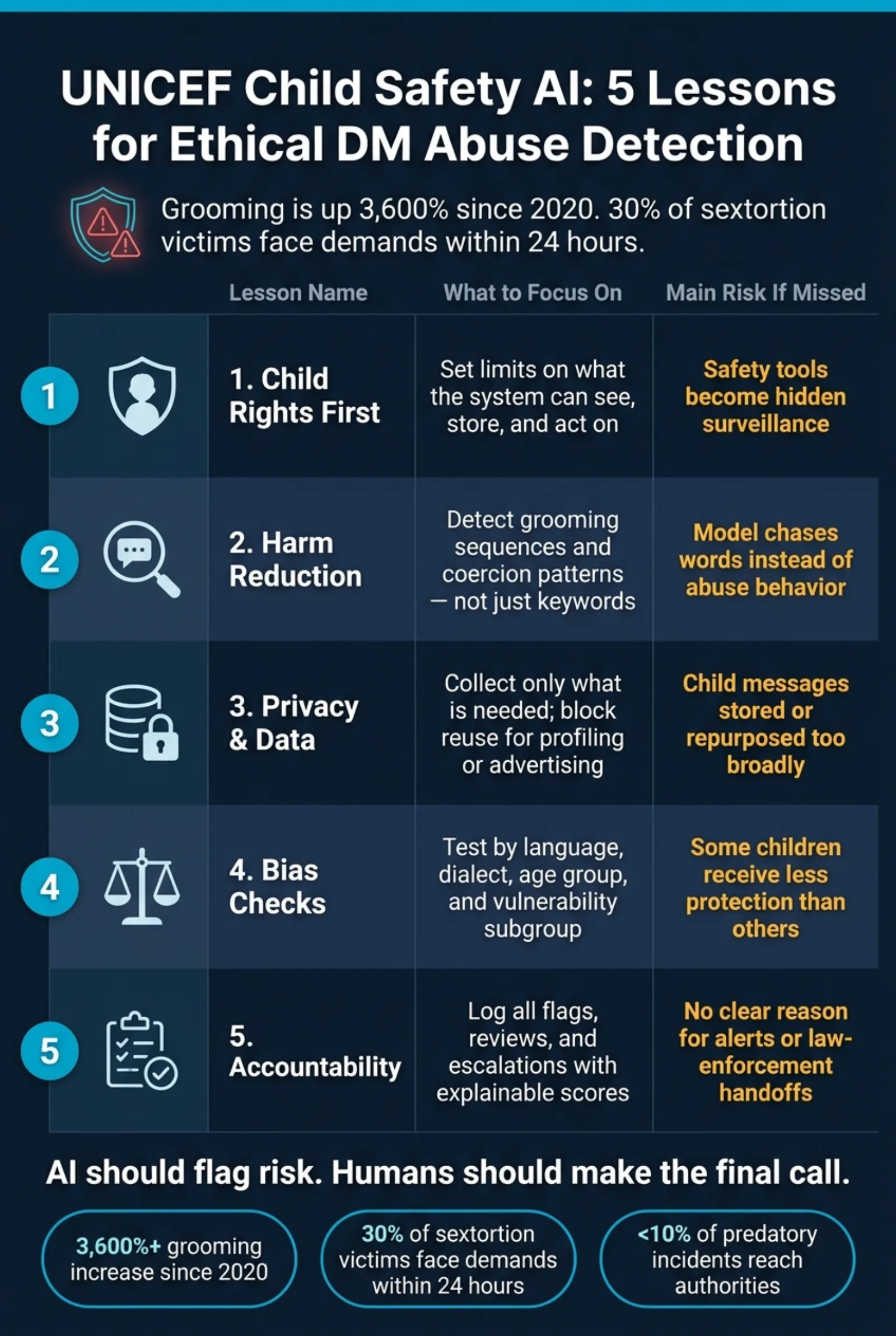
UNICEF Child Safety AI: 5 Lessons for Ethical DM Abuse Detection
Quick Comparison
| Lesson | What I’d focus on | Main risk if missed |
|---|---|---|
| Child rights first | Set limits on what the system can see, store, and act on | Safety tools turn into hidden monitoring |
| Harm reduction | Look for grooming and coercion patterns | The model chases words instead of abuse behavior |
| Privacy and data | Keep collection and retention tight | Child messages get stored or reused too broadly |
| Bias checks | Test by language, dialect, and subgroup | Some children get less protection than others |
| Accountability | Log flags, reviews, and escalations | No clear reason for alerts or law-enforcement handoffs |
What stood out to me most is the timing. The article notes that 30% of sextortion victims face demands within 24 hours and that grooming has climbed by more than 3,600% since 2020. So this isn’t just a policy issue. It’s a product-design problem with a short response window.
I also think the article gets one point right: AI should flag risk, but people should make the final call when the stakes are high. That’s how you protect children and keep trust.
sbb-itb-47c24b3
Why Private Messaging Is the Real Test for Child-Safety AI
Most predatory contact begins in DMs and public comments [3]. That’s the core design problem. If you want to stop harm early, you have to spot trouble before abuse is plain to see. But doing that at scale, without turning every inbox into an AI vs manual monitoring system, is a hard engineering and ethical problem in child-safety AI.
Predators usually don’t rely on obvious keywords. They lean on patterns of behavior instead: compliments, questions about age, and nudges to move the chat to another platform. Basic keyword filters can miss that. And the time to act is short. 30% of sextortion victims face demands within 24 hours of initial contact [4].
Once detection moves from keywords to behavior, the design tradeoff comes into focus. Call this pattern-based detection. It scores escalation arcs and coercion patterns without exposing full message content. That matters. A tool that scores escalation patterns is not surveillance. A tool that depends on transcripts and keyword lists is.
Getting this balance right takes four parts working together:
- early behavioral detection
- minimal data collection
- human review at the right decision points
- tamper-evident evidence logs for legal accountability
Miss one, and the system either fails to catch harm or drifts into a form of monitoring that children will avoid. Those four needs line up directly with UNICEF's framework - rights, harm reduction, privacy, fairness, and accountability.
That’s why the first lesson starts with child rights, not model tuning.
1. Build on Child Rights From the Start
If child-safety tools come first and rights checks come later, those protections end up as add-ons. And add-ons can be changed, weakened, or removed. So the model, the data pipeline, and the escalation rules need rights-based limits from the very beginning.
A rights-aligned system can spot conversation patterns like grooming, platform migration, and coercion without reading private transcripts. That isn't just a policy choice. It's a design rule. If the system cannot read transcripts, then the controls that remain need to set clear limits on what it can store, score, and escalate.
Use a least-data approach: collect only what is needed for detection, and block secondary uses like profiling or advertising. With children's data, retention limits need to be built in on day one, not tacked on later.
Undisclosed monitoring damages trust. Be clear and narrow about monitoring so children and families understand what the system does and does not see.
Detection can be automated. Intervention should not be. AI can flag risk and package evidence, but a human must approve any escalation to law enforcement or any direct intervention. Keep escalation decisions with a human reviewer.
Those rights limits set the boundaries for what the system may detect, retain, and escalate.
2. Make Harm Reduction the Organizing Principle
Rights-based limits tell you what the system cannot do. Harm reduction tells you what it should do. That difference shapes every design choice that comes next.
Safety is not surveillance. Harm reduction looks for coercion, not people. Those are different goals, and they lead to a different kind of detector.
When children feel watched in DMs, they often avoid the very tools meant to help them. That’s why it makes more sense to detect conversation patterns - grooming sequences, escalation arcs, and coercion signals - instead of exposing raw message content. The goal is to keep detection focused without pushing children toward channels that are harder to see.
With grooming up more than 3,600% since 2020 and sextortion cases targeting minors up 300% [1][3], harm reduction keeps the system narrow and purpose-built. For DM abuse detection, the model should score escalation patterns, not inspect every message.
AI can flag risk. Humans should approve escalation. Humans make the call on whether a case moves forward. The next question is simple: how little child data does the system need to do that well?
3. Protect Children's Data and Privacy in Every Detection Decision
A harm-reduction system falls apart if it shields children while exposing their private messages. UNICEF puts children's privacy at the center of this work. In DM abuse detection, that means looking for conversation patterns, not reading or storing full transcripts. It also means collecting only the data needed to stop harm.
Use the smallest amount of data required for detection, and never reuse it for advertising, profiling, or product training. If evidence has to be kept, store it as tamper-evident records that preserve chain of custody without giving the provider a way to browse or mine the content [1][3].
Privacy can't sit off to the side as a policy checkbox. It has to be built into each step of the detection pipeline. Here's how those safeguards map to the workflow:
| Detection Stage | Data Handling Method | Privacy Safeguard |
|---|---|---|
| Ingestion | Automatic streaming | No human review; messages ingested via official APIs [1][2] |
| Detection | Behavioral ontology scoring | Scores grooming and escalation patterns [1] |
| Classification | Severity tiering | Automatic triage without browsing content [1] |
| Packaging | Tamper-evident hashing | SHA-256 chain of custody for prosecution-ready evidence [3] |
| Escalation | Human-in-the-loop | Human judgment engaged only at the final decision point [3] |
Once data is minimized, the next test is whether the model treats children fairly across language, age, and context. This requires rigorous accuracy metrics for detecting online harassment to ensure the system remains effective without increasing false positives.
4. Prevent Bias and Discrimination in Child-Protection AI
Bias can make child-protection AI protect some kids better than others. That’s the problem. The real test is simple: does the model miss harm in multilingual, underrepresented, or high-risk communities?
One of the most common weak spots is linguistic bias. If a model hasn’t been trained on regional dialects, code-switching, or transliterated text, it can miss threats in multilingual or non-English speaking communities. When the training data leaves out a language or dialect, the model leaves out the threat too.
Pattern bias is just as risky. Basic keyword filters look for “known-bad” terms, but grooming usually doesn’t start there. It often begins with compliments, age checks, and casual chat. On the surface, that can look harmless. In practice, it’s often the start of a sequence that a keyword list won’t catch.
A third weak spot comes from missing subgroup coverage in training data. LGBTQ+ youth face higher levels of harm: 28% of sextortion victims reported self-harm, versus 14% overall [4]. That gap matters. It means one global threshold isn’t enough. You need subgroup-level evaluation.
These failures tend to show up in three main areas: language, behavior, and subgroup risk.
| Bias Type | Root Cause | Impact on Child Safety |
|---|---|---|
| Linguistic Bias | Lack of training on code-switching, transliteration, or regional dialects | Misses threats in multilingual or non-English speaking communities |
| Pattern Bias | Keyword lists instead of behavioral sequences | Fails to catch early-stage grooming using transfer learning in grooming detection |
| Vulnerability Bias | Treating all minors as one cohort | Fails to escalate for high-risk sub-groups, such as LGBTQ+ youth |
| Calibration Bias | Mis-set thresholds | Over-surveillance or under-protection of specific users |
The fix is practical:
- Train on dialect and language variation
- Test performance by subgroup
- Audit thresholds on a regular basis
- Send low-confidence cases to human reviewers
The next question is whether those decisions can be explained and audited.
5. Build in Transparency, Explainability, and Accountability
After fairness and thresholding, accountability is the next test: can every flag be explained and audited?
Spotting harm is only half the job. The other half is explaining what the system found, why it raised a flag, and what happened after that. Without that trail, parents, schools, regulators, and children have no solid reason to trust privacy-first child protection tools.
The hard part is striking the right balance. Transparency can't mean exposing message transcripts. That just swaps one problem for another. Instead, explainability should focus on conversation patterns like sustained targeting, escalation, or coercion, without showing the actual message content.
The same detection event should lead to different outputs for different groups:
- Parents get a risk level and alert type.
- Schools get alerts sent to designated safeguarding leads.
- Authorities get a tamper-evident evidence package after confirmation.
AI should handle volume, show confidence scores, and send unclear cases to a "Needs Review" queue where a human makes the final call. Every detection, escalation, and handoff should be logged. That way, each escalation can be checked later, with the full decision path tied back to accountability.
Children and families should be told that protection is active, but the system should not reveal how detection works.
What These 5 Lessons Mean for DM Abuse Detection in Practice
UNICEF's principles map to five DM safety design choices. Put together, they shape a practical workflow: detect, score, review, log, escalate.
Use AI tools for detecting predatory behavior to spot patterns, not just keywords. Look for conversation sequences like compliments, age checks, attempts to move to another platform, gifts, and requests for secrecy. That approach spots where a chat is heading before things get worse. A keyword filter, on its own, often misses that step-by-step progression.
Once the system spots that behavior, the next call is how fast to respond. Send high-confidence, high-severity flags to immediate escalation. Route lower-confidence cases to human review. Speed matters here: 30% of sextortion victims face demands within 24 hours of initial contact [4].
Minimize data at every stage. Privacy-preserving detection should report the pattern itself - sustained targeting, escalation, and coercion - without storing or exposing full message transcripts. Short retention windows and strict purpose limits put data minimization into day-to-day practice.
Then comes auditability. A system needs to be checked after the fact without laying bare private content. Log every detection, escalation, and human handoff with explainable scores and tamper-evident evidence packs.
That audit trail still depends on human judgment at the end. Use AI for triage, but keep humans in the loop for borderline cases and every authority escalation.
UNICEF Principle to System Design: A Comparison Table

The table below turns each lesson into a concrete detection choice: the signal to watch for, the risk that comes with it, the response tier, and the human checks around it.
| UNICEF Lesson | Example Detection Signal | Privacy Risk | Response Tier | Human Oversight |
|---|---|---|---|---|
| 1. Build on Child Rights From the Start | Age-probing or repeated friend requests after a boundary is set | Undisclosed monitoring can feel like spyware | Give a plain notice that protection is active and what it covers | Rights-based design review; clear notice to the protected user |
| 2. Make Harm Reduction the Organizing Principle | Grooming sequence in private messages: compliment → age probe → secrecy request → move to another app | Over-collecting all message content to chase edge cases | Immediate escalation for confirmed grooming or sextortion patterns | Human approval for every authority escalation; documented escalation rules |
| 3. Protect Children's Data and Privacy in Every Detection Decision | Pattern score based on conversation structure, not transcript reading | Retaining readable message logs or repurposing data for profiling | Summarize low-risk flags; package serious cases with minimum necessary content | Least-data retention; restricted staff access; tamper-evident audit logs |
| 4. Prevent Bias and Discrimination in Child-Protection AI | Abuse written in Spanish, Arabic, AAVE, or code-switched slang | False negatives for non-English speakers; false positives on minority dialects | Apply the same tiering rules across languages and dialects, with calibrated review thresholds | Regular bias audits across languages and dialects; model monitoring |
| 5. Build in Transparency, Explainability, and Accountability | Plain-English flag for age-gap solicitation or sextortion demands | Opaque scoring that can't be challenged or explained | AI triage → human approval → logged escalation, with reason codes and clear next-step guidance | Full audit trail, human review for serious actions, and a documented appeal or override path |
This comparison makes the shift from principle to system design much easier to see. Each UNICEF lesson maps to a practical product decision: what gets flagged, how much data gets touched, what happens next, and where a person must step in.
That matters because detecting exploitation in messaging can go wrong in two directions at once. A weak system misses harm. An overreaching one starts to feel like surveillance. The point of these controls is to hold that line with care: detect risky patterns, limit data use, and keep serious actions tied to human judgment.
Conclusion
UNICEF's guidance is a design blueprint, not a box-ticking exercise. The hard test comes with private-message abuse detection, where safety, privacy, and accountability all crash into each other. In that setting, each of the five lessons shapes whether child-safety AI does its job.
In plain terms, that means rights-first design, behavior-based detection, minimal data use, bias checks, and human accountability.
This isn't optional. Online grooming has increased by more than 3,600% since 2020 [1][3], and less than 10% of predatory incidents ever reach authorities [1][3].
Child-safety AI earns trust only when it can protect private messages without turning them into surveillance.
FAQs
How can AI detect grooming without reading full chats?
AI can detect grooming by analyzing behavior patterns and intent across whole message threads, not just single keywords.
It watches for signs that things are escalating, like moving a chat to another platform, asking for secrecy, pulling out personal details, or offering rewards. By scoring those patterns in real time, it can flag grooming, sextortion, and manipulation even when the messages look harmless on the surface.
What should human reviewers decide instead of AI?
Human reviewers should decide if and how to act on the small set of high-priority cases that AI sends to the decision point.
That means using human judgment to weigh the severity of the case, check whether the evidence is strong enough, and confirm that the case fits the right jurisdiction. From there, they should choose the enforcement outcome based on the evidence and the audit trail - not let AI make the final call on its own.
How do teams test child-safety AI for bias?
Teams test child-safety AI for bias by checking how it performs across real-world differences in context, language, and the groups it may affect. Then they adjust for any gaps they find.
Here, that means scoring intent and escalation within the full message context, using triage backed by auditable evidence, and checking coverage across 40+ languages and regional dialects so grooming and abuse patterns aren’t unfairly missed or misclassified.