

How Unsupervised Online Activity Impacts Child Safety
Most online harm to kids starts in private messages, not in public posts. If I had to boil this article down to one point, that’s it.
Here’s the short version:
- Unsupervised online use often means kids are in DMs, game chats, disappearing-message apps, or backup accounts adults never see.
- The main risks are grooming, sextortion, cyberbullying, harmful content exposure, and privacy abuse.
- One stat stands out: 83% of online exploitation happens in private messages, not public feeds or comment sections.
- The first clues are often behavior changes, like hiding screens, deleting chats, acting tense after notifications, or refusing to talk about online contacts.
- Risk tends to grow when chats move from public spaces into private channels, especially late at night or with unknown people.
- Simple filters often miss this because they look for words, not changes in behavior over time.
- A layered response works best: home rules, school processes, early documentation, and AI tools that flag risky DM patterns.
If you’re a parent, teacher, or safeguarding lead, the takeaway is simple: don’t focus only on what kids post in public. Pay close attention to private-message behavior, secrecy, and shifts in routine.
What I see in this piece is a clear path:
- Know where risk shows up
- Spot warning signs early
- Document patterns, not just one-off events
- Use tools and rules that help adults act fast
That’s the core of the article in plain English: hidden conversations create the biggest blind spot, and child safety gets better when adults can spot risk before it turns into harm.
Protecting Kids Online: How Grooming leads to Trafficking
sbb-itb-47c24b3
How Unsupervised Use Raises the Risk of Harm
Once children are online without filters or adult oversight, the risk doesn't stop at hidden messages. It spreads into unsafe content, privacy problems, and direct contact with people who may want to exploit them.
Content and Privacy Risks During Unfiltered Use
Unfiltered browsing can expose children to sexual content, self-harm material, scams, and predatory contact. In many cases, that contact starts in chat threads or comment sections and then shifts into private messages.
When this kind of use becomes routine, the risk gets worse. Kids may spend more time online, switch to private apps, and leave adults with less visibility into what they're seeing, who they're talking to, and where those conversations are going.
Behaviors and Conditions That Increase Risk
Some patterns make harm more likely:
- Long, unmonitored sessions online
- Use of multiple accounts
- Conversations that move into private channels adults can't see
These patterns tend to follow the same path already in view: public exposure turns into private contact, and private contact is where predator grooming patterns and abuse can take hold.
Warning Signs That a Child May Be at Risk Online
Behavior Changes Adults May Notice First
The first signs usually show up in behavior, not in the content on a screen. A child may hide a phone, clear chats, or seem tense the moment a notification appears. You might also notice a sudden reluctance to talk about online friends, or an unusual urgency to get back online or reach a device.
On their own, these behaviors don't prove exploitation. Kids can act secretive for lots of reasons. But when several signs show up at once, or a child who used to be open becomes withdrawn and guarded, that pattern deserves a calm, supportive talk.
Interaction Patterns Linked to Grooming or Coercion
Some online exchanges grow more risky through pressure and secrecy. One major red flag is repeated pressure to move a conversation to a less visible channel. That move cuts down adult visibility and is a recognized sign of grooming escalation. It isn't just a platform switch. It's often an attempt to reduce oversight.
How Schools and Agencies Can Document Risk Indicators
When the same behavior keeps showing up, documentation matters. Safeguarding teams do better when they log incidents in a consistent way and separate a one-time event from a growing pattern. One deleted message may mean very little. Repeated secrecy and withdrawal point to escalation.
Good documentation also separates direct observation from pattern-based inference. That makes it easier for human reviewers to tell the difference between direct evidence and a broader assessment when deciding whether to escalate a case.
The table below matches observable behaviors with common risks:
| Observable Behavior | Possible Underlying Risk |
|---|---|
| Hiding screens or devices when adults approach | Secretive online contact |
| Distress or anxiety after receiving a notification | Coercion or cyberbullying |
| Sudden social withdrawal or reluctance to discuss online contacts | Grooming or emotional manipulation |
| Systematic deletion of chat histories or call logs | Hidden contact or escalation |
| Pressure to move a conversation to a less visible channel | Grooming escalation |
| Unusual urgency to stay online or reach a device | Pressure from an online contact |
Shared, structured logs help teams track escalation and decide when to escalate the case. They also make automated escalation detection more useful.
Why Behavioral AI Works Better for Child Protection
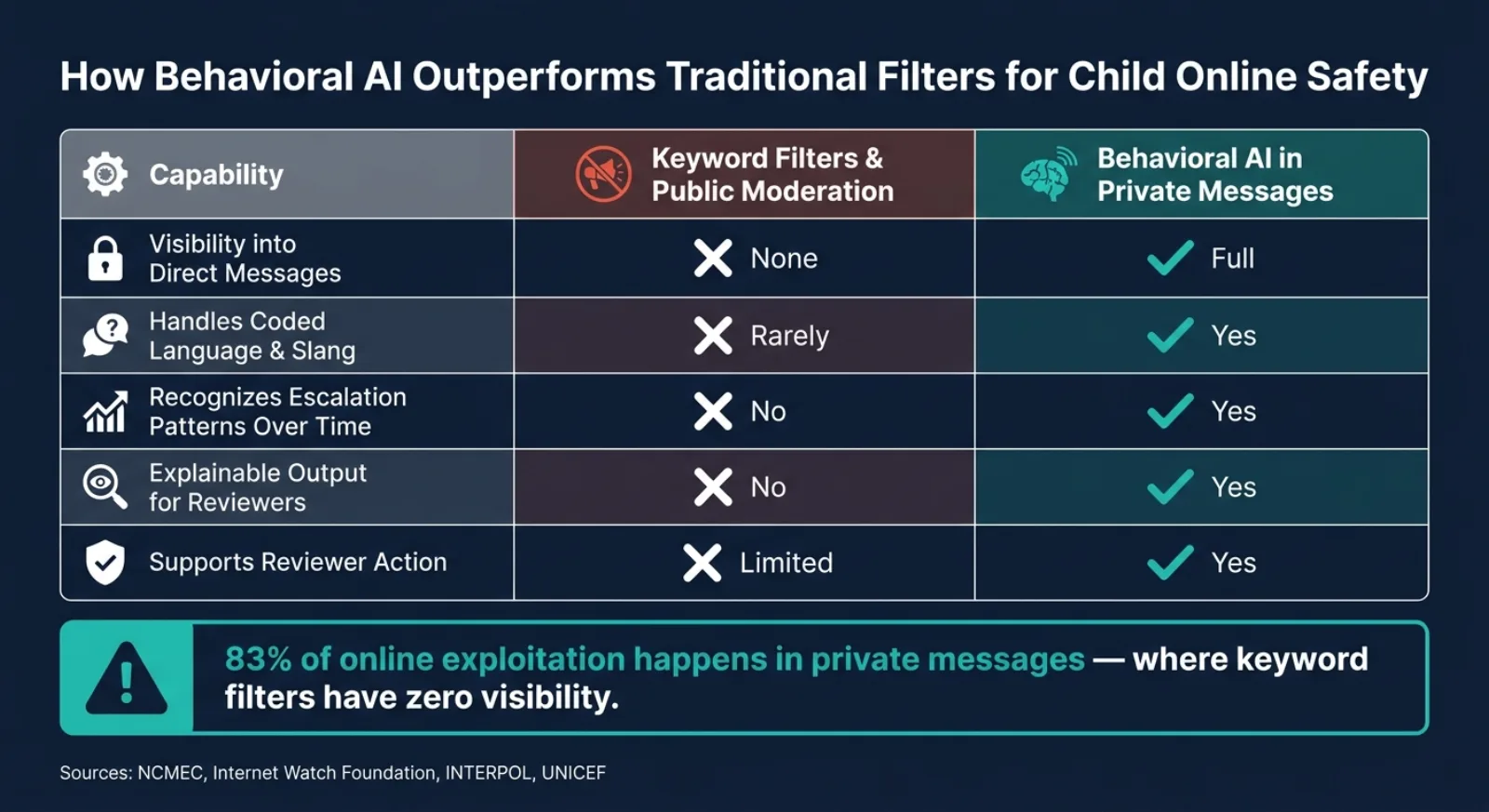
Keyword Filters vs. Behavioral AI: Child Safety Online Protection Comparison
Where Traditional Filters Fall Short
When kids are online without an adult watching, the risk isn't just harmful content on the screen. It's the quiet shift that can happen inside private chats.
The issue isn't only hidden contact. It's hidden escalation. Keyword filters miss coded slang, misspellings, and abuse in more than one language. Public-post moderation still can't see private messages. And grooming can look harmless at first, right up until the pattern starts to change over time.
That's why pattern-based systems do a better job than simple word lists in direct messages.
| Capability | Keyword Filters | Public-Post Moderation | Behavioral AI in Private Messages |
|---|---|---|---|
| Visibility into DMs | ✗ None | ✗ None | ✓ Full |
| Handles coded language / slang | ✗ Rarely | ✗ Rarely | ✓ Yes |
| Recognizes escalation arcs | ✗ No | ✗ No | ✓ Yes |
| Explainable output for reviewers | ✗ No | ✗ Limited | ✓ Yes |
| Supports reviewer action | ✗ Limited | ✗ Limited | ✓ Yes |
How Guardii Detects Escalation in Direct Messages
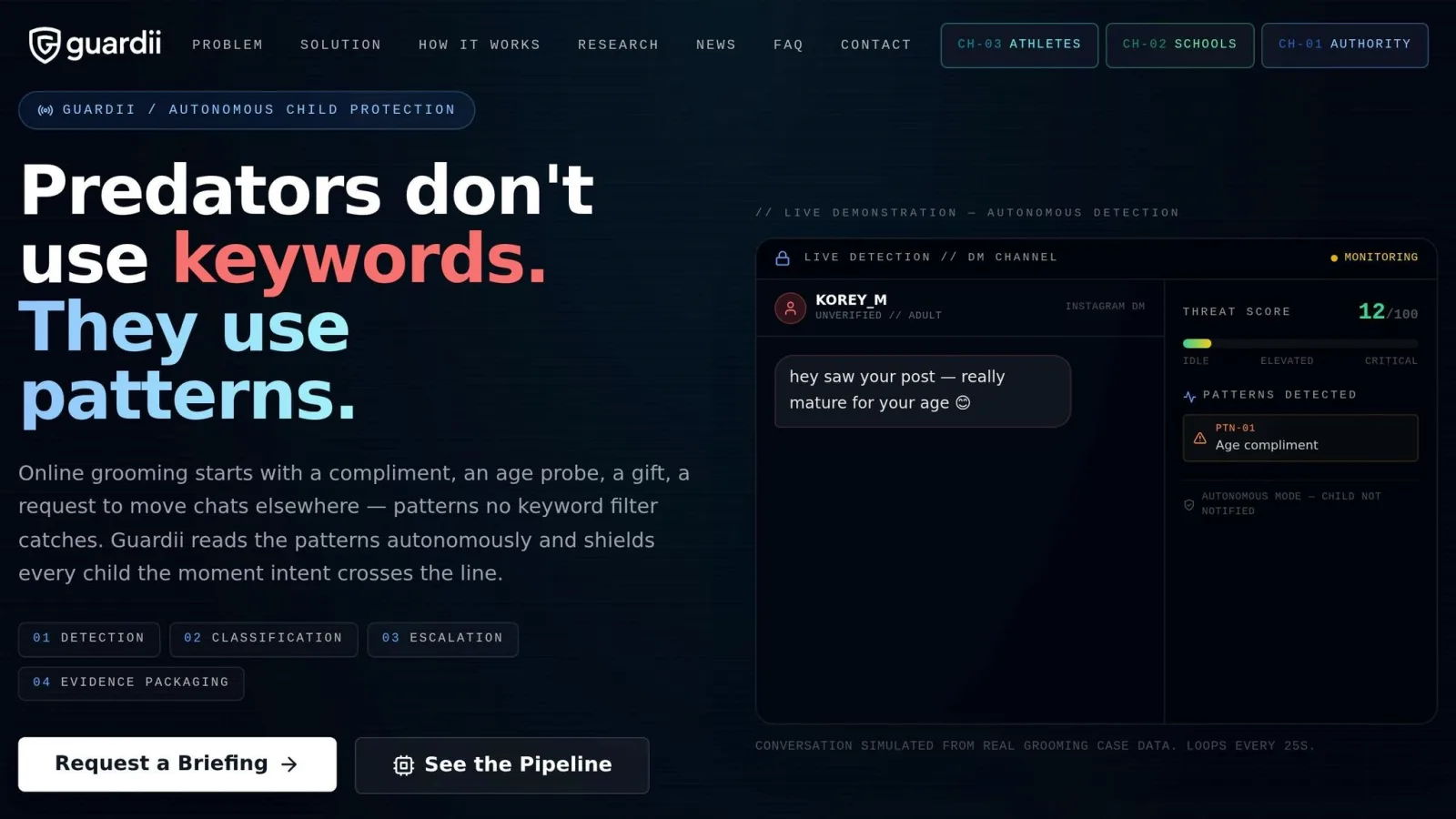
In practice, that means looking at how a conversation shifts, not just which words show up.
Guardii is an AI-powered online safety platform that tracks how risky behavior builds over time inside private messaging. Instead of looking for banned words, it spots escalation signals such as moving the chat to another app, asking for personal details, offering gifts or rewards, secrecy requests, and threats of harm or exposure.
The platform draws on behavioural research from NCMEC, the Internet Watch Foundation, INTERPOL, and UNICEF to detect sextortion and grooming progression in the place most moderation tools can't reach. It then shows a live, explainable risk score so reviewers can see why the conversation was flagged.
Why Explainable Detection Matters for Schools and Law Enforcement
For safeguarding teams, detection only helps when the reason behind the alert is clear.
If a system can tell the difference between behavior it directly observed and a pattern inferred from repeated behavior, reviewers can move faster and act with more confidence. That kind of clarity also helps document behavior shifts and interaction patterns - the same indicators described earlier - so schools and agencies have a clear path from observation to intervention.
Steps to Reduce Harm and Build Safer Digital Environments
Home and School Controls That Lower Exposure
Once warning signs show up, the next move is simple: cut exposure and speed up response.
The best approach uses layers. Home rules can limit access. School policies can make responses more consistent. And AI can help spot hidden escalation that adults may not catch on their own.
At home, a few small rules can go a long way. Keep devices in shared spaces. Set overnight charging rules. Review privacy settings together. And make sure a child knows exactly who they can contact if a chat starts to feel unsafe.
At school, structure matters. Use network controls. Limit risky apps on school devices. Require one clear workflow for documenting concerns, escalating them, and responding. That kind of setup makes action easier to track and easier to move forward when something looks off.
Layered Protection With AI, Policy, and Clear Escalation Paths
Policies and device controls can lower exposure, but they don’t catch everything. A risk that starts at home may need one type of response. The same issue at school may need another. Automated systems can fill some of the gaps.
Match each risk with a response path.
| Risk Scenario | Home Controls | School Controls | AI / Response |
|---|---|---|---|
| Grooming via private DMs | Shared-space device use, clear reporting rules | Restrict risky apps on school devices | Behavioral AI detection flags escalation and sends alerts |
| Sextortion attempt | Encourage immediate disclosure | Train staff to recognize coercion | Evidence packs and escalation to the appropriate authorities |
| Cyberbullying from peers | Regular check-ins about online interactions | Documented reporting workflow | Platform reporting and follow-up action |
| Harmful content exposure | Review privacy settings together | Network-level filtering and supervision | Update controls and notify support staff |
| Contact with an unknown adult | Discuss block-and-report steps ahead of time | Teach students how to report suspicious contacts | Immediate escalation if the contact appears predatory |
Each layer does a different job. Home rules cut down exposure. School policy creates a reporting structure. Behavioral AI can flag escalation in direct messages that people may miss.
Guardii can add that extra layer by flagging escalation in direct messages and preserving evidence for review.
Conclusion: Key Child Safety Takeaways
Most serious harm starts where adults can’t easily see it: direct messages.
Unsupervised online activity carries the most risk in private chats. That’s why it helps to document warning signs early, keep escalation paths clear, and use layered safeguards to interrupt harm sooner.
FAQs
Why do private messages pose the biggest risk to kids online?
Private messages are a major online safety blind spot. Unlike public feeds, they usually don't have the same moderation and reporting systems. So a lot of what happens there goes unchecked.
That privacy gives predators room to groom victims over time, often through messages that look harmless when you read them one by one. And that's the problem: older filters may miss the pattern because each message, on its own, doesn't set off alarms.
Tools like Guardii take a different approach. They analyze behavior in real time and look for warning signs as they start to form, not just after the situation has already turned serious.
What warning signs should parents and teachers watch for first?
Watch for grooming patterns that begin with flattery or emotional pressure. That can look like intense compliments, love-bombing, or someone insisting that a child is different or “better understood” by them than by anyone else.
Other red flags show up when an adult tries to pull a child away from trusted people, make inappropriate topics seem normal, or shift chats into secret or private messaging spaces. Tools like Guardii can spot these escalation patterns in real time.
How can schools and families respond before online harm escalates?
Schools and families can use AI-powered platforms like Guardii to spot risk early by looking at behavior patterns in real time, not just flagged keywords.
That matters because grooming rarely shows up as one obvious phrase. It often builds slowly through isolation, emotional manipulation, and boundary testing in private messages.
By picking up on those patterns, these systems can send timely, explainable alerts and risk scores that help adults step in before harm gets worse.