
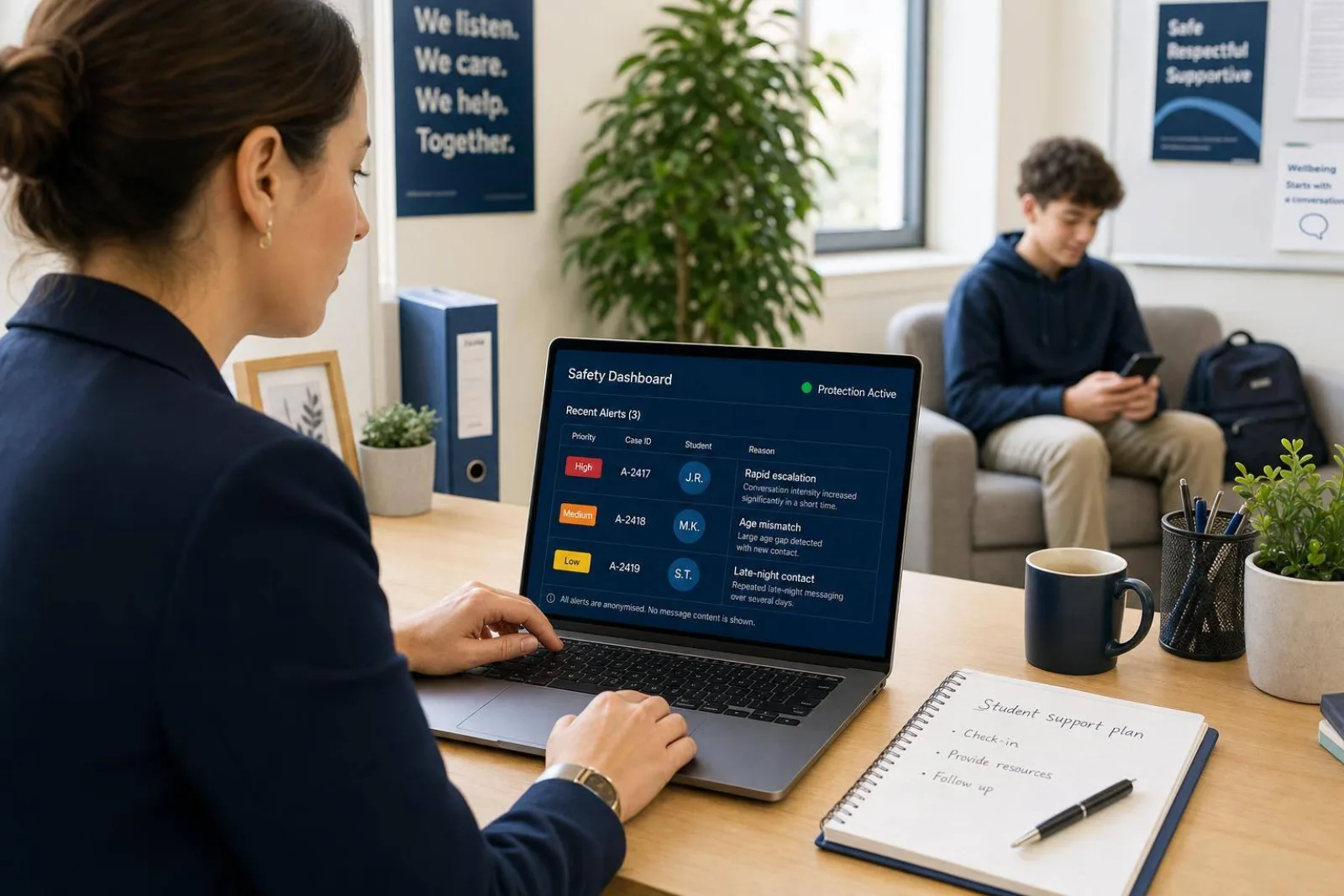
How Schools Use AI to Protect Students Online
AI in schools works best when it flags risky message patterns, shows staff the reason, and leaves the final call to people. Since 2020, student activity on school-run platforms has grown faster than staff can review by hand, especially in private messages, where abuse often starts and older filters miss context.
If I had to boil this down, here’s what matters most:
- Schools are not just scanning for bad words. They look for patterns tied to grooming patterns, coercion, sextortion, and pressure over time.
- Private messages are the hardest place to monitor well. That’s where many high-risk cases begin.
- Alerts need context. Staff need to see what was directly found versus what the system guessed from the conversation.
- Human review still runs the process. AI can flag risk, but staff decide whether to support a student, escalate, or investigate.
- Privacy rules matter as much as detection. Schools need clear limits on access, storage, and deletion.
- The best score is not raw accuracy alone. Schools should track false positives, missed incidents, review time, and escalation quality.
In other words: more alerts do not mean better safety. What schools need is a system that helps staff spot the right cases, review them fast, and respond in a way that supports students.
A few facts from the article stand out:
- Research looks at measures like recall@10 and QA accuracy
- Some systems label evidence as EXTRACTED vs. INFERRED
- Privacy controls can include local processing, audit logs, and data deletion after use
- Procurement teams may ask for SOC 2 Type II and written retention terms
What I take from all of this is simple: school AI monitoring only works when it is explainable, limited by policy, and tied to student support. That is the standard schools should use before rollout.
What Research Says About AI Detection in Schools
Main Risks These Systems Are Built to Detect
Research shows schools need systems that spot escalation, not just a few risky terms. That’s the big shift. Instead of flagging isolated words, schools use AI to detect grooming, sextortion, coercion, and other abuse patterns that build over time.
That matters because harmful behavior in student messages often unfolds step by step. A single word may mean very little on its own. But a conversation path can tell a very different story. For that reason, schools also separate observed evidence from inference so reviewers can see why an alert fired and what the system is assuming.
How Studies Measure System Performance
In evaluation studies, researchers look at whether the system brings forward the right evidence. They use metrics such as recall@10 and QA accuracy to test that.
They also check explainability. In those studies, labels like EXTRACTED and INFERRED help mark the line between evidence and inference. That distinction is a big deal in school settings because staff need alerts they can review fast and act on without digging through a messy trail.
Why Behavior-Based Detection Matters in Private Messaging
Behavior-based detection follows the path of a conversation, which makes it especially useful in private messaging. That’s where risk can build quietly, out of view, and where a keyword-only system can miss the point.
In real time, school-controlled systems can score those patterns and show a plain-language reason for each alert. So instead of handing staff a black-box warning, the system gives them something they can read, check, and use right away.
sbb-itb-47c24b3
How Trust-Centered AI Monitoring Works in Practice
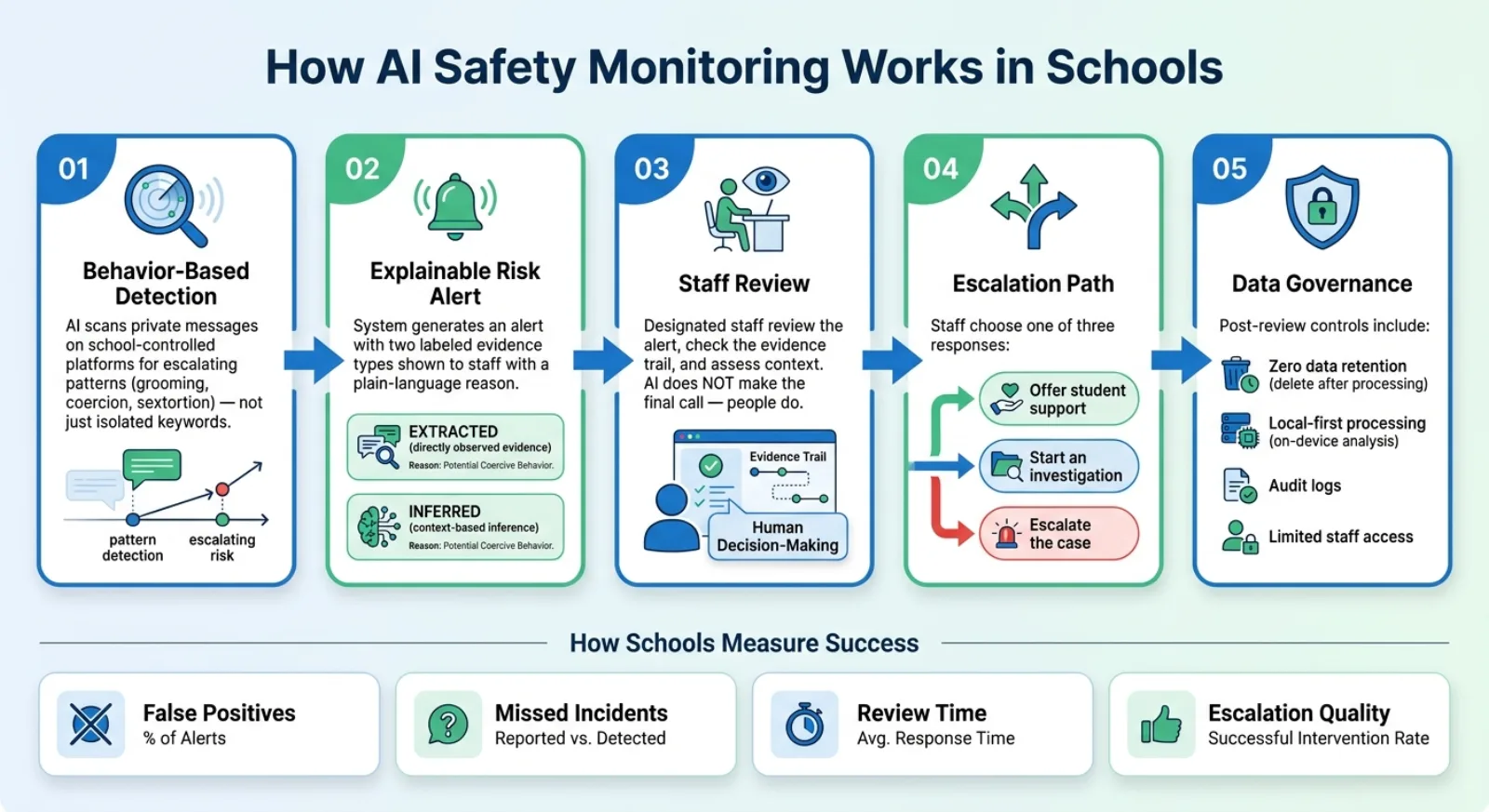
How AI Safety Monitoring Works in Schools: From Alert to Student Support
From Keyword Filters to Explainable Risk Alerts
When a system flags risk, staff need to know why fast. In a school setting, an alert can't just say something looks wrong. It has to show what triggered the flag in a way people can review quickly and safely.
Modern systems do this by separating what was directly observed from what was inferred. They link the alert to the exact pattern that triggered it, distinguishing between information explicitly found in the source (EXTRACTED) and information inferred from context (INFERRED) [1]. Some systems also connect alerts to linked reasons, such as inline notes, so reviewers can see the pattern behind the alert [1].
That kind of explanation matters. An alert is only useful if staff can understand it and decide what to do next.
Human Review, Escalation Paths, and Student Support
After an alert comes in, designated staff review it and decide the next step. That might mean offering student support, starting an investigation, or escalating the case.
The point isn't to let software make the call on its own. People still have to look at the context, weigh the risk, and respond with care.
Privacy, Transparency, and Monitoring Limits
Trust also depends on how schools handle the data behind each alert. If the guardrails are weak, the whole system starts to feel shaky.
Privacy controls need to be built into the design from the start. Case studies recommend data-deletion policies that remove monitored data as soon as it is no longer needed [2]. Some systems also use on-device processing, which means sensitive content is analyzed locally instead of being sent somewhere else [1]. Other safeguards include limited staff access and audit logs.
Policies should spell out a few basics:
- What is monitored
- Who can access alerts
- How long data is kept
Without that clarity, even a well-built monitoring system can lose staff and student trust fast.
Case Studies: How Districts Deploy AI Safety Systems
The available sources don’t include district-level case studies, so this section can’t report district outcomes from the source set.
What the sources do show is how schools set up alerts, review workflows, and escalation paths. That shifts the focus a bit. Instead of asking whether a district saw a certain result, the more useful next step is to look at policy controls and outcome checks.
Put simply: if the case studies aren’t there, the best clue is how these automated safeguarding systems are run day to day.
Governance, Compliance, and Lessons From the Evidence
Policy Controls Schools Need Before Deployment
Operational safeguards only do their job when districts turn them into written policy. Before any AI safety tool goes live, a district needs clear rules that spell out what gets monitored, who can view flagged content, and how long data is stored.
Two controls matter most: zero data retention, which deletes student data after processing, and local-first processing, which keeps analysis on school-controlled devices or networks. Put together, these controls help districts keep sensitive data under their own governance while protecting student trust.
Before signing, procurement teams should ask for:
- SOC 2 Type II evidence
- Written data-retention terms
How Schools Can Tell Whether a System Is Working
Once the rules are in place, districts need a simple way to check whether the system is helping. The clearest signal is whether staff can review alerts fast and send them to the right place. That’s the line between a tool that supports school safety and one that just creates more noise.
On the technical side, schools should prioritize Recall - the system’s ability to catch all genuine safety incidents - over raw accuracy. A system that misses rare but critical events is making the wrong trade-off.
Track four measures:
- False positives
- Missed incidents
- Review time
- Escalation quality
Those four metrics connect directly to the outcome that matters most: faster triage, fewer false positives, and better student support.
Conclusion: AI Works Best When Paired With Trust
The point of monitoring is not more alerts. It’s faster, better support.
For schools looking at new tools, the right questions focus on explainability (can staff understand why an alert fired?), accuracy (does the system catch real threats without flooding reviewers?), privacy (is student data handled responsibly?), and outcomes (are students getting help?).
Trust grows when alerts are explainable, reviewable, and limited by policy.
FAQs
How does AI tell context from keywords?
Context-aware AI looks past single keywords and reads the pattern, intent, and flow of a conversation.
Instead of reacting to isolated terms, it looks at the surrounding messages to make sense of slang, sarcasm, and coded language. That matters because the same word can mean very different things depending on what came before and what happens next.
It also tracks tone and how a conversation changes over time. That helps it spot grooming signs like manipulative flattery, attempts to isolate someone, or intimacy that escalates too fast - signals that static word lists often miss.
Who reviews school AI alerts?
School AI systems scan communication channels for signs of predatory behavior, grooming, and abuse. When the system spots a high-priority threat, it bundles the evidence and sends an alert to the school’s designated safeguarding lead.
That shifts staff time to the moment that matters most: the decision-making stage. Instead of sitting through routine monitoring, they can focus on the cases with the highest level of risk.
How can schools monitor messages without overstepping privacy?
Schools can do this with privacy-by-design AI that focuses on behavior patterns and signs of intent instead of blanket surveillance. It can process data on local devices and use anonymization to help protect student privacy.
Rather than exposing full conversations, these systems show only actionable risk scores or alerts. That gives schools a way to spot harmful activity while keeping everyday messages private and respecting trust.