
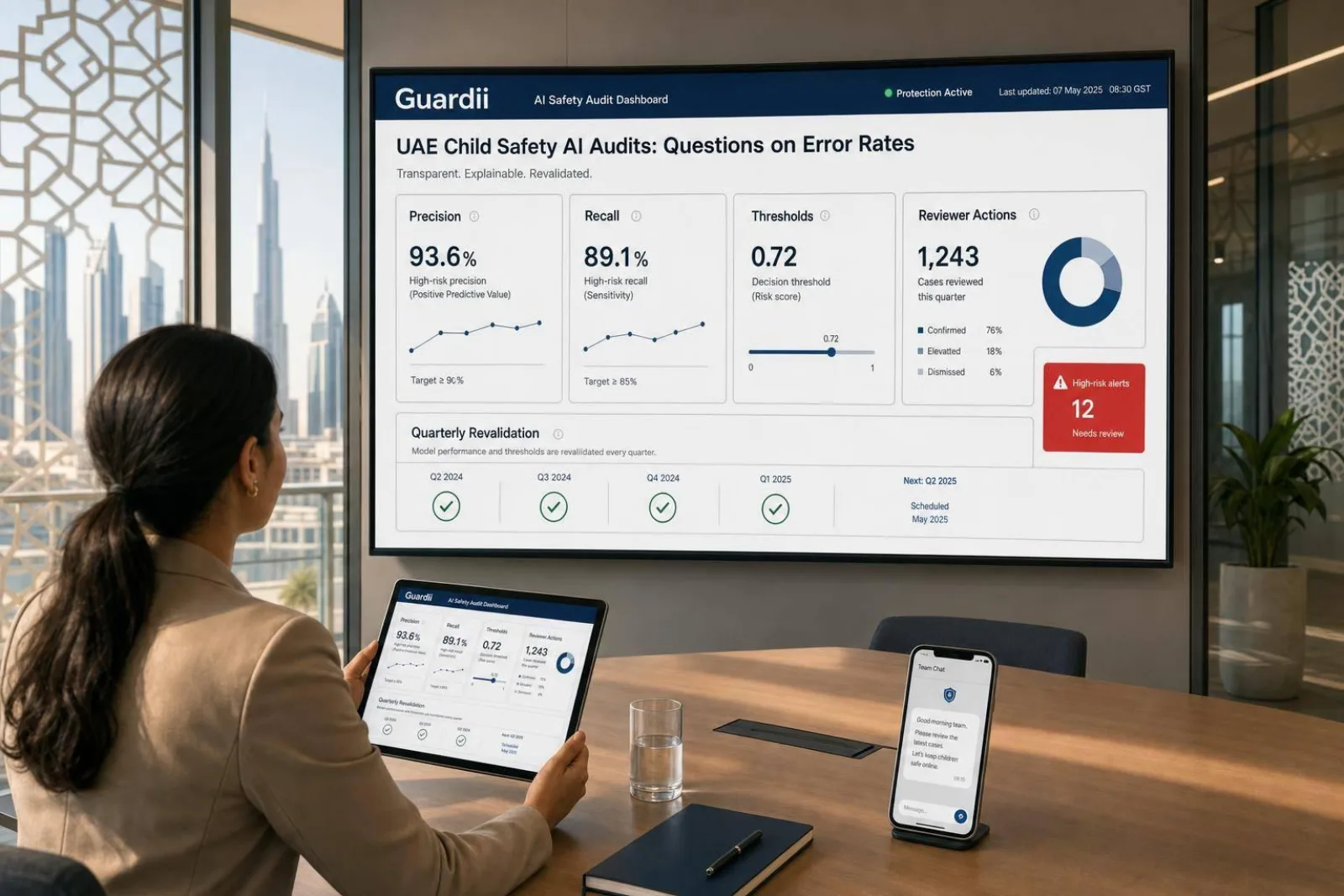
UAE Child Safety AI Audits: Questions on Error Rates
If your platform serves kids in the UAE, error rates are now an audit issue. By January 1, 2027, you need to show how your system flags harm, how often it gets things wrong, who reviews edge cases, and what records back each decision.
Here’s the short version:
- I’d treat false negatives as the top safety risk because missed grooming, sextortion, or CSAM can keep going without action.
- I’d track false positives just as closely because too many bad alerts bury review teams and can expose private chats for no good reason.
- I’d measure precision and recall by model, language, harm type, and channel, not as one blended score.
- I’d keep Arabic separate from English, and split out dialects, code-switching, and transliterated text when possible.
- I’d log every threshold change, human override, and model version so an inspector can trace each number back to one setup.
- I’d make sure private-message records show the pattern behind an escalation instead of dumping full transcripts.
- I’d recheck high-risk models every quarter, and sooner after drift, policy changes, model updates, or a jump in misses.
- I’d keep tamper-evident evidence packs with SHA-256 hashes, timestamps, reviewer actions, and export-ready files.
In other words: this is no longer just model tuning. It’s performance, review, and record-keeping tied together.
A few facts from the article frame the risk:
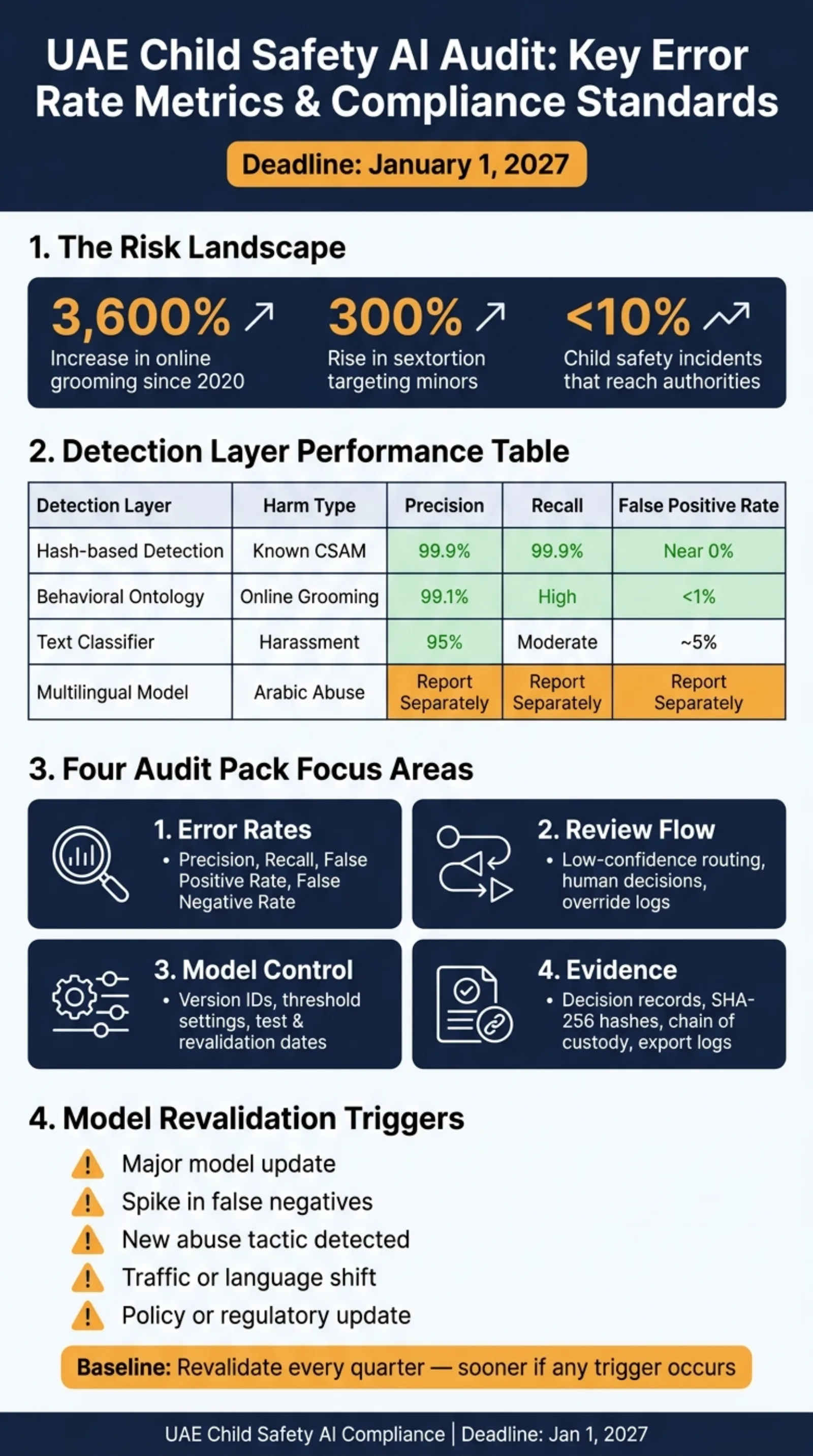
- Online grooming has climbed by 3,600% since 2020
- Sextortion targeting minors is up 300%
- Fewer than 10% of child safety incidents reach authorities
- Example figures cited include 99.9% for known-hash CSAM detection and 99.1% precision for behavioral grooming detection
If I were building an audit pack today, I’d keep it focused on four things:
| Area | What I’d show |
|---|---|
| Error rates | Precision, recall, false positive rate, false negative rate |
| Review flow | Low-confidence routing, human decisions, override logs |
| Model control | Version IDs, threshold settings, test dates, revalidation dates |
| Evidence | Decision records, hashes, chain of custody, export logs |
Bottom line: UAE inspectors will want more than a model score. They’ll want proof that your system catches harm at a high rate, limits bad flags, keeps humans in charge at key steps, and leaves a clean trail from detection to final action.
UAE Child Safety AI Audit: Key Error Rate Metrics & Compliance Standards
How to Define False Positives and False Negatives in Child Safety AI
Once a platform falls in scope, auditors need a shared way to define two things: what counts as a missed case and what counts as an over-flag.
False Positives, False Negatives, Precision, and Recall: Plain-English Definitions
In UAE inspections, these terms shape how platforms show child-safety performance. Use them the same way across audit packs:
| Term | Operational meaning | Audit relevance |
|---|---|---|
| True positive | A harmful message or grooming pattern correctly flagged | Shows the system catches real risk |
| True negative | A benign message correctly left alone | Shows the system doesn't overreach |
| False positive | A benign message wrongly flagged or escalated | Privacy, trust, and workflow concern |
| False negative | A harmful message the system fails to flag | Safety-critical - harm can continue undetected |
Precision answers: "When the system flags a message, how often is it truly harmful?" A system with 99.1% precision means 991 of 1,000 flagged messages are truly harmful [1][2].
Recall answers: "Out of all harmful messages sent, how many did the system catch?" This matters because harmful actors often rely on behavior patterns, not just keywords.
These definitions give auditors a clear baseline for tracking error rates in audit packs.
Why Missed Harm and Over-Flagging Carry Different Compliance Risks
False negatives and false positives are not the same kind of problem. They create different compliance risks, so they need separate treatment.
False negatives are safety failures. If grooming or sextortion is missed, the harm can keep going without anyone stepping in. Online grooming has increased by more than 3,600% since 2020, and sextortion targeting minors has risen 300% [1][2]. On top of that, less than 10% of child safety incidents ever reach authorities [1][2]. So when a system misses harmful patterns, it leaves a major gap in child protection.
False positives create rights and workflow risks. If a normal conversation gets flagged or escalated, privacy is harmed for no good reason. At scale, too many false alerts can swamp human review teams and make it harder to spot the cases that matter most.
"The signal-to-noise ratio in their messaging feeds is very low, but the signal that is there is high value." - Cam McMaster, Co-founder, Guardii.ai [4]
It also helps to break the process into layers. A message-level detector, a thread-level classifier, and a human escalation decision are three separate steps. Each step has its own error rate. If you report them separately, inspectors can see where mistakes happen instead of treating the whole system like a black box.
sbb-itb-47c24b3
How to Measure and Document Error Rates for UAE Inspections
Knowing what counts as a false positive or false negative is only part of the job. The tougher part is setting up a measurement process that can hold up during an inspection.
Test Sets, Review Workflows, and Segmented Reporting
Start with a fixed labeled validation set. Run every model version against that same set, then record precision and recall against the same ground truth. That baseline becomes your reference point for the review cadence in the next section.
You should also sample live traffic, send low-confidence cases to human review, and log every override as labeled outcome data. That way, your measurement process isn’t stuck in a lab setting. It reflects what happens in production.
Report results separately by language, harm type, channel, and decision source. Keep Arabic separate from English because dialects, code-switching, and transliterated text change performance [2]. Those split results also make later threshold changes much easier to defend.
A Sample Error-Rate Table for Audit Packs
Different detection layers carry different levels of risk. So in your audit documentation, report each one on its own.
| Detection Layer | Harm Type | Precision | Recall | False Positive Rate | False Negative Rate | Reviewer Notes |
|---|---|---|---|---|---|---|
| Hash-based Detection | Known CSAM | 99.9% [2] | 99.9% [2] | Near 0% | Near 0% | Uses known-bad hashes for immediate filtering [2] |
| Behavioral Ontology | Online Grooming | 99.1% [2] | High | < 1% | Low | Focuses on intent sequences like age probes and gift-giving [2] |
| Text Classifier | Harassment | 95% [3] | Moderate | ~5% | Low | High-confidence flags are auto-hidden; lower-confidence items go to a Needs Review queue [3] |
| Pattern Detection | Sextortion | High | High | Low | Low | Monitors progressive predatory patterns in DMs [2] |
| Multilingual Model | Arabic Abuse | Report separately | Report separately | Report separately | Report separately | Fine-tuned for RTL scripts, dialects, code-switching, and transliterated text [2] |
Each row should also include the model version ID, the sensitivity setting in use, and the date the measurement was taken. If a threshold changes, log the change with a reason and an approval record. An inspector should be able to trace every number back to a specific configuration. Just as important, those same measurements need to point back to individual decisions.
Explainable Detection Records for Private Messaging
For private messages, the record needs to show why the system escalated, not just that it did. Use structured outputs instead of screenshots so reviewers can see the signal sequence without full transcripts.
A good record might show a risk score, the escalation pattern that triggered it, and the sequence of behavioral signals. For example, it may show a shift from a public channel to a private one, then requests for secrecy, then incentive-offering. That gives an inspector something they can audit without exposing full message transcripts.
"Detection reports the shape of a conversation - sustained targeting, escalation, coercion - not its contents." - Guardii.ai [2]
Metric tables alone won’t satisfy an inspector. They also expect a clean evidence trail behind each decision. Include a tamper-evident audit trail, along with file hashes for exported records, so inspectors can verify that nothing changed [2]. That standard ties directly into the model revalidation cadence covered in the next section.
How Often to Review Models and When to Change Thresholds
Quarterly Reviews, Drift Checks, and Trigger-Based Revalidation
Once error rates are documented, auditors usually ask the next plain question: how often are those numbers updated?
For high-risk child safety models, revalidation should happen every quarter using current precision and recall figures. The point is simple. If an inspector asks for model performance, the reported metrics need to be current and ready for review. And if recall drops, that needs attention right away.
Drift is the other problem. Language changes fast. New slang, code-switching, dialect shifts, and local manipulation tactics can chip away at model accuracy between scheduled reviews. Fresh-sample testing helps catch that drift before recall starts to slide [5].
A quarterly cycle is the baseline. But some events should trigger an immediate out-of-cycle revalidation:
| Trigger Event | Why It Matters |
|---|---|
| Major model update | New code can shift the precision/recall balance unexpectedly |
| Spike in false negatives | Indicates predators may be bypassing current filters |
| New abuse tactic detected | Existing behavioral ontology may not cover the new pattern |
| Traffic or language shift | Changes the baseline the model relies on |
| Policy or regulatory update | May require realigning sensitivity settings with new legal thresholds |
Each of these triggers should tie back to a documented threshold decision.
Threshold Tuning and Human-in-the-Loop Escalation
Thresholds don't stay fixed forever. Lower thresholds usually increase recall, but they also send more cases into review. Higher thresholds cut alert volume, but they also increase the chance of misses. So the right setting depends on the type of harm, the channel, and the live risk level.
A tiered confidence routing setup works well here:
- High-confidence cases can be auto-actioned
- Lower-confidence cases should go to human review
That approach keeps obvious violations out of the review queue, while humans handle the gray-area cases.
For UAE inspections, the biggest issue is the paper trail behind every threshold change. Each change should be logged with the metric shift that justified it, the reviewer approval, and the effective date. In other words, threshold changes need to be traceable to risk, not convenience [5].
Records That Support UAE Inspections and Key Compliance Takeaways
Logs, Evidence Packs, and Review Records Inspectors Will Expect
Once thresholds are in place, the next audit issue is simple: can you trace each decision from start to finish?
Inspectors will expect a clear, timestamped trail from input to final action. That means records for the content, model score, confidence, reviewer, and outcome. These logs are the source data used for error-rate calculations.
Use SHA-256 hashes to keep chain of custody intact for inspection. In private messaging cases, the most useful logs usually show the escalation pattern, coercion signals, and any shift to another platform instead of leaning on raw transcripts alone. Export records in PDF, CSV, or JSON.
A Records Checklist Table for Child Safety AI Audits
The easiest way to handle inspection requests is to group records by what they show.
| Record Type | Purpose in UAE Inspection | Key Fields to Capture | Responsible Team | Retention Period |
|---|---|---|---|---|
| Interaction Logs | Proves real-time detection coverage | Timestamp, User ID, Channel ID, Confidence Score, Threat Score, Action Taken | Trust & Safety | Per retention policy |
| Model Cards/Versions | Documents AI logic and versioning | Model Version, Ontology Type, Language Support, Precision/Recall | AI/Engineering | Per retention policy |
| Threshold Change Logs | Justifies sensitivity adjustments | Old/New Threshold, Rationale, Approving Officer, Date of Change | Policy/Legal | Permanent |
| Human-Review Records | Ground truth for precision and recall calculations | AI Flag, Human Decision, Reviewer ID, Rationale | Moderation Lead | Until legal hold ends |
| Evidence Packs | Legal and prosecutorial integrity | SHA-256 Hash, Chain of Custody, Incident Summary, Metadata | Legal/Security | Until case resolution + statutory limit |
| Transparency Stats | High-level compliance reporting | Precision, recall, false positive rate, volume, date | Compliance Officer | Per retention policy |
Conclusion: The Minimum Standard for Defensible Error-Rate Governance
The minimum bar for defensible child-safety AI compliance is clear: measurable performance, review records, threshold logs, and tamper-evident evidence packs.
FAQs
What error rates will UAE inspectors expect to see?
UAE inspectors will look for auditable, transparent performance metrics. They won't accept one catch-all error rate.
Teams should be ready to show how well triage works in practice, including:
- triage precision
- how accurately the model identifies threats
- how accurately it classifies those threats
Inspectors will also expect audit trails for every recommendation and action. Those records should show the rationale, timestamp, and responsible human supervisor.
On top of that, teams should maintain live records of human approval rates and classification performance. In plain terms, inspectors will want to see not just what the system did, but who signed off on it and when.
How often should child safety AI models be revalidated?
Child safety AI models need constant revalidation. They shouldn't be treated like static systems you set up once and leave alone.
Why? Because grooming and abuse patterns change. Language shifts. Tactics shift. Bad actors don't stay still.
An iterative revalidation process helps keep risk scoring and pattern detection accurate over time. It lets the model adjust to new behavioral ontologies and keep flagging harmful conversations with a high level of consistency.
What records do we need to keep for a UAE audit?
Keep tamper-evident records that show a clear chain of custody and support inspections.
This should include:
- Full audit logs and evidence packages for detected threats or incidents
- Threat-scoring logs by severity and jurisdictional relevance
- Flagged-content records that preserve the full conversation context
- Model performance records, including triage precision and risk-scoring rationale