
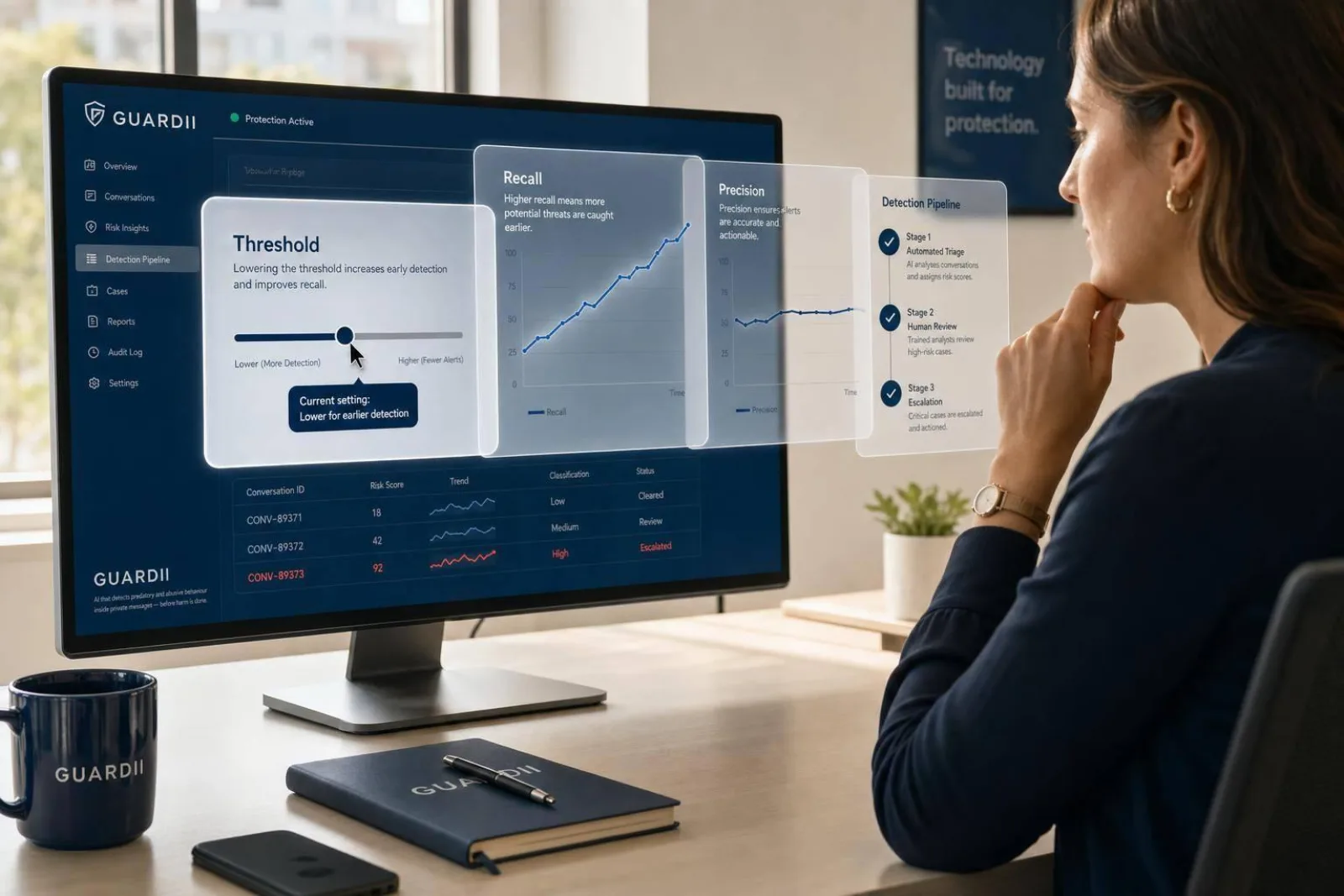
Precision vs Recall in CSAM Detection AI
If I set the threshold too high, I miss harmful cases. If I set it too low, I flood reviewers with weak alerts. That is the whole problem in one line.
Here’s the short answer: in abuse detection, I usually want to miss fewer real cases, then control alert volume with staged review, behavior signals, and clear audit steps. Precision tells me how many alerts are right. Recall tells me how many harmful cases I catch. And in private messages, where grooming patterns build over time, recall often matters more at the start.
Before I pick a threshold, I need to answer four simple questions:
- What hurts more here: a false alert or a missed case?
- Who reviews alerts: school staff, trust and safety, or law enforcement?
- How much context matters: one message, or a pattern across many messages?
- What happens next: triage, escalation, evidence, or reporting?
A simple way to think about it:
| If I optimize for... | I get... | I risk... | Best fit |
|---|---|---|---|
| Precision | Cleaner alerts | Missing slow or coded abuse | Tight review teams, later-stage case work |
| Recall | More case coverage | More false alerts | Early detection, child safety, broad screening |
| Balance | Mixed alert quality and coverage | Neither side fully maxed out | Schools, platforms, limited staffing |
My takeaway is simple: one hard cutoff is rarely enough. I get better results when I use lower front-end thresholds, pattern-based scoring, and human review to sort what matters fast.
That is the lens I would use to read the rest of this article.
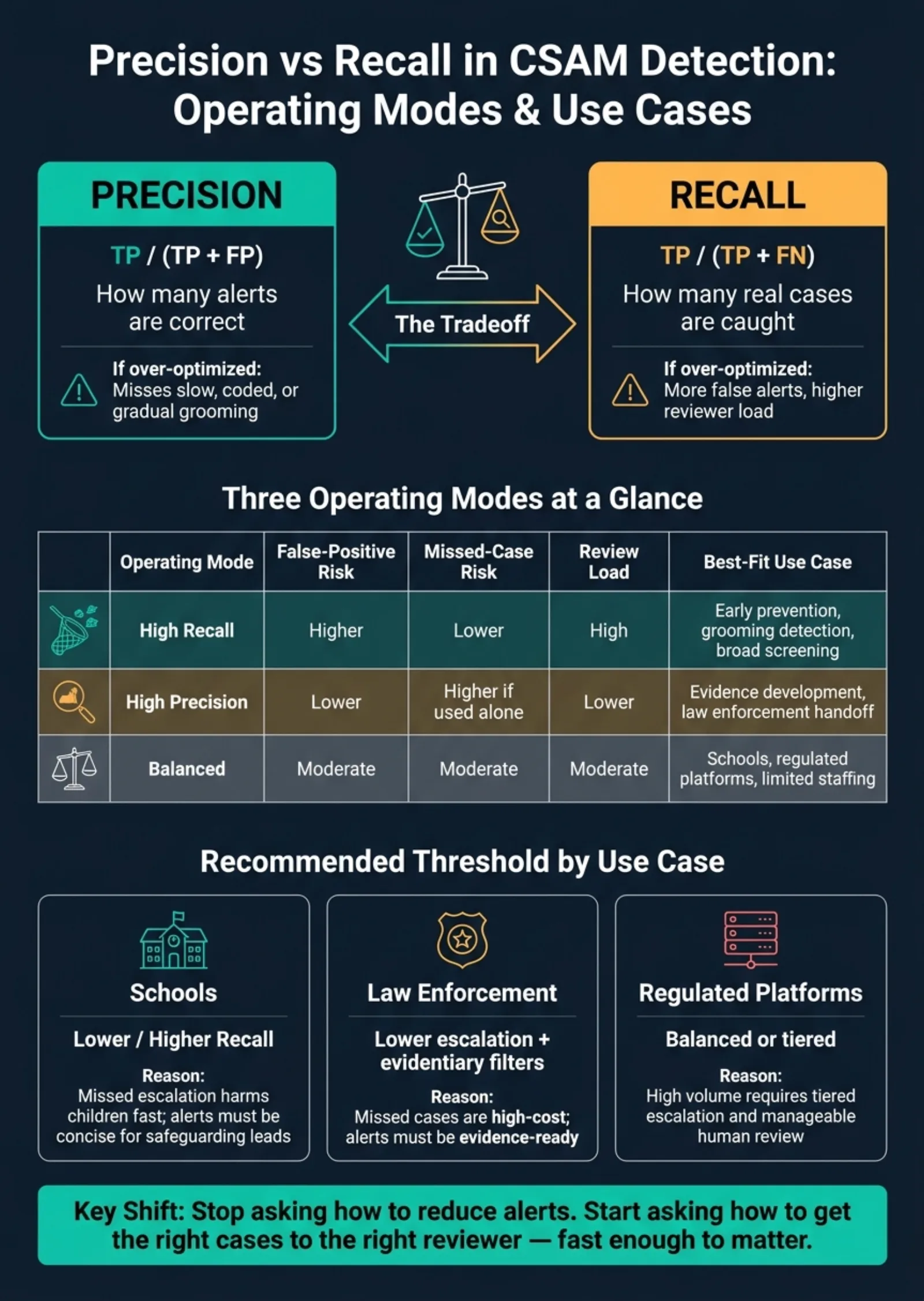
Precision vs Recall in CSAM Detection: Operating Modes & Use Cases
AI In CSAM Investigations And The Role Of Digital Evidence In Criminal Cases
sbb-itb-47c24b3
Precision in CSAM Detection: Measuring Alert Quality
Precision measures how many flagged conversations are actual cases: TP / (TP + FP). On the ground, this shows up fast in two places: queue quality and reviewer trust. In privacy-sensitive settings, alert quality often decides whether people rely on the system or second-guess it.
What High Precision Does for Daily Operations
High precision keeps the review queue centered on conversations that are more likely to matter. That means analysts can spend more of their time on cases worth a close look and less of it sorting through noise.
That matters even more when review capacity is tight and every escalation needs careful handling. A cleaner queue doesn't just save time. It also helps teams stay focused when the work is sensitive and the margin for error feels small.
What a Precision-First Setting Can Miss
A precision-first setting can still miss early grooming, coded language, and slow escalation. One big reason is simple: each message may look harmless on its own. Grooming often appears as a pattern over time, not in one line of chat.
So while cleaner alerts help with day-to-day review, they don't fix the harder issue of missed cases.
Recall in CSAM Detection: Measuring Case Coverage
If precision tells you how clean the alerts are, recall tells you what slips through. The formula is TP / (TP + FN): the share of actual harmful cases the system catches. In private messaging, that matters a lot, because harmful exchanges often build over dozens of short, ordinary-looking messages.
Why Missed Cases Carry the Highest Safety Cost
When a detection system misses a grooming conversation, the damage doesn't stop. Abuse keeps going, intervention gets delayed, and evidence can vanish. Low recall makes an already serious reporting gap even worse.
One documented case shows how cross-platform abuse can avoid detection for years when systems fail to spot rising patterns across multiple apps and channels [1][2]. Every missed case leaves open a moment when someone could have stepped in, but didn’t.
Why Lower Thresholds Usually Increase Recall
Every system uses a threshold: messages above it get flagged. Set the threshold higher, and the system flags only cases with strong confidence. Set it lower, and it catches more subtle threats, but it also sends more items to review.
In child safety work, the imbalance in harm is plain. False positives use reviewer time. False negatives can let abuse continue. That’s why many teams use lower thresholds with human review and real-time moderation instead of betting everything on a single cutoff.
The Tradeoff: Thresholds, Operating Modes, and Harm Models
Every system has to make a tradeoff: fewer missed cases usually means more alerts. There’s no way around it. The right threshold depends on who’s using the system, how much review time they have, and what it costs if a case slips through. Precision and recall describe that tradeoff. Operating modes show how teams put it to work day to day.
High-Precision, High-Recall, and Balanced Operating Modes
| Operating mode | False-positive risk | Missed-case risk | Review load | Best-fit use case |
|---|---|---|---|---|
| High recall | Higher | Lower | High | Early prevention, grooming detection, broad screening |
| High precision | Lower | Higher if used alone | Lower | Evidence development, law enforcement handoff |
| Balanced | Moderate | Moderate | Moderate | Schools, regulated platforms, limited staffing |
In practice, most teams don’t stick to just one mode. They mix them. A platform might cast a wide net at the start, then tighten standards as a case moves closer to action. That’s why the best setups rely on layered review, not one hard cutoff.
Why Multi-Stage Review Is Safer Than a Single Threshold
Grooming doesn’t happen in one message. It builds over time. Because of that, a layered review process does a better job of spotting escalation than a single score ever could. Broad screening, context scoring, secondary filtering, and human review work best as a pipeline.
What makes that usable in the real world is explainability. Reviewers need plain-English flag reasons, severity labels, and audit logs. That way, they can see why something was escalated and decide whether to act without digging through full conversation transcripts.
How Behavioral Signals Improve the Precision-Recall Tradeoff
The biggest gains come from signals tied to behavior rather than keywords. Keyword filters create a blunt tradeoff: add more words to catch more cases, and false positives usually jump too. Behavioral detection changes that. It looks for escalation patterns like secrecy, platform switching, coercion, and threats.
When a system spots those arcs, it can surface alerts that are more specific to actual abuse and harder for offenders to dodge. Instead of forcing every case through one global cutoff, teams can route alerts based on severity and legal relevance. For teams deciding where to set thresholds, the core idea is simple: behavioral signals support a lower alert threshold because the alerts are more actionable, not just more frequent.
Conclusion: How Safety Teams Balance Alert Quality Against Coverage
After operating modes and multi-stage review, the last call is where to set the threshold. That choice comes down to your risk model, the staff you have, and the legal duties you need to meet.
In private messaging, missed cases usually cost more than false positives [3]. Behavioral scoring is what makes this workable in practice. Instead of leaning on keyword lists alone, pattern-based detection can surface action-ready alerts earlier, without burying reviewers in noise.
That balance changes with the use case, so teams shouldn't all use the same threshold profile.
Key Takeaways for Schools, Law Enforcement, and Regulated Platforms
In higher-risk settings, lean toward recall. Then control precision through tiered triage and multi-stage review, not one hard cutoff.
| Use case | Threshold tendency | Core reason |
|---|---|---|
| Schools | Lower threshold / higher recall | Missed escalation harms children fast; alerts need to stay concise for safeguarding leads |
| Law enforcement | Lower escalation threshold with evidentiary filters | Missed cases are high-cost; alerts need to be evidence-ready |
| Regulated platforms | Balanced or tiered thresholds | High volume calls for tiered escalation and human review that teams can actually handle |
For teams setting thresholds, the key shift is simple: move from asking "how do we reduce alerts?" to asking "how do we make sure the right cases reach the right reviewer, fast enough to matter?"
FAQs
Why does recall matter more in private messaging?
In private messaging, recall matters even more. Abuse can escalate fast in a space with very little visibility. And predatory behavior usually doesn’t show up as a single obvious phrase. It tends to unfold through subtle, multi-step grooming patterns.
Miss just one early signal, and the harm can be serious. That can include exploitation and self-harm. High recall gives teams a better shot at spotting those patterns early, so intervention can happen before the damage becomes irreversible.
How should teams choose the right threshold?
Teams should set the threshold by weighing detection coverage against human review capacity. There’s always a trade-off here. If too many cases get flagged, reviewers get buried. If too few do, serious threats can slip through.
Because review capacity is limited, automated systems should lean toward high-precision triage. Put simply, the system should send only the most critical cases to human decision-makers.
A tiered severity score makes that easier. It lets teams match the response to the level of risk. For example, lower-risk content might be auto-hidden, while urgent, high-intent threats should be escalated to the right authorities.
Can behavior signals reduce false alerts?
Yes. Behavior signals can cut false alerts because they look at intent in context, not just single words.
Instead of flagging harmless content, behavioral analysis tracks how an interaction develops over time. It looks for grooming progression and escalation patterns, like secrecy requests, information extraction, or attempts to move the conversation to another platform.
That gives systems a better way to score risk over time and push likely threats to human review first.