
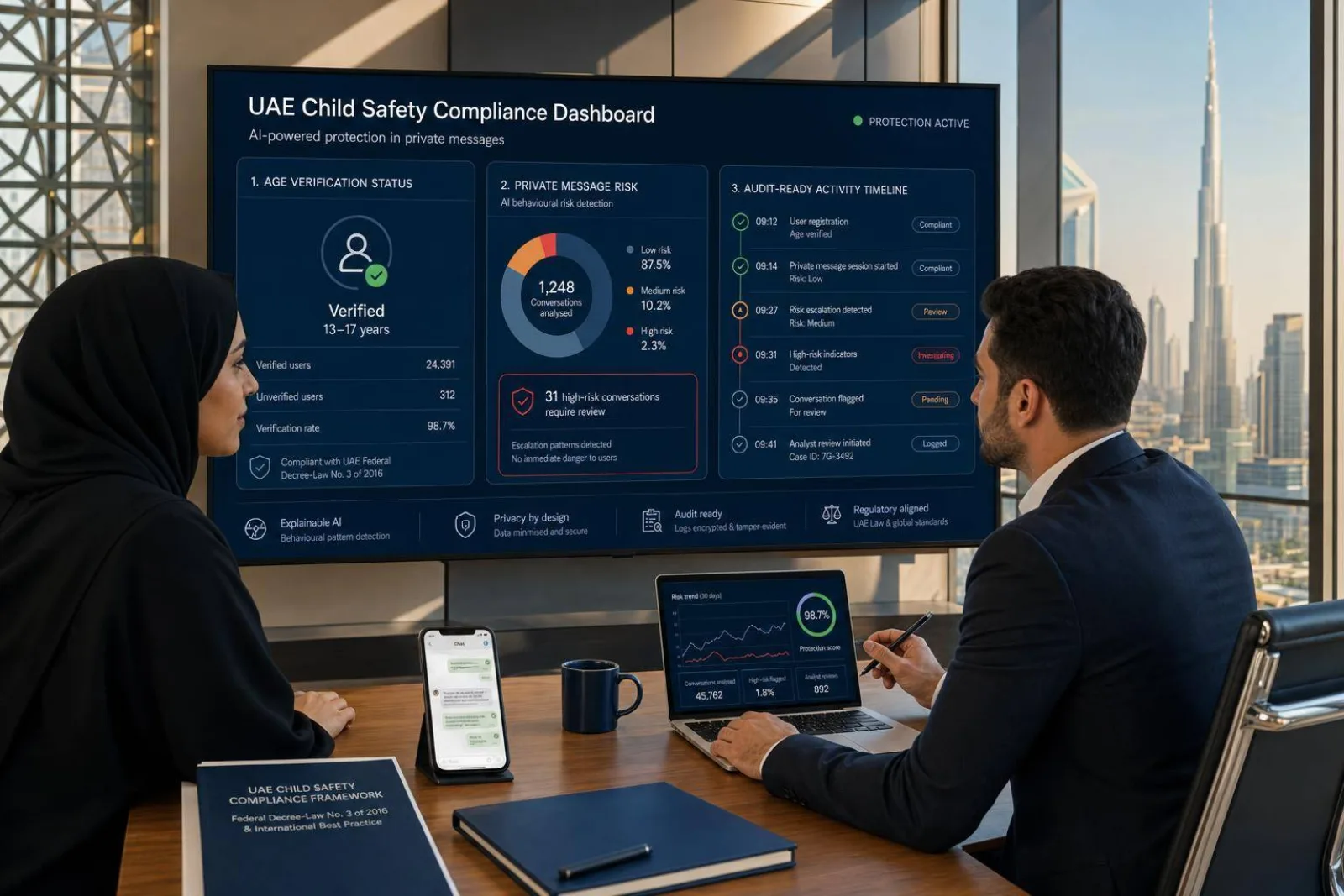
AI in UAE Child Safety Laws: What to Know
If your platform serves people in the UAE, the rule changed on January 1, 2026: child safety now needs AI-based detection, not just user reports.
Here’s the short version: I’d treat this as a systems and evidence issue, not just a moderation issue. The law expects platforms to do more than wait for complaints. It pushes them to use AI to spot grooming, sextortion, CSAM, privacy abuse, and harmful contact patterns - including in private messages - and then remove, report, and log what happened.
Before I go further, here are the points I’d keep in view:
- Deadline: the law took effect on 01/01/2026, with full compliance due by 01/01/2027
- Who it hits: platforms and ISPs in the UAE, plus services that target UAE users
- What changed: self-reported age and basic keyword filters are not enough
- What teams need: age checks, child-default privacy settings, AI-based message risk detection, reporting tools, and audit logs
- Main failure points: weak age assurance, poor review flows, thin evidence records, and slow escalation
- Main risk: service blocking in the UAE for non-compliance
What stands out to me is the shift from single-message review to pattern review. A grooming case may look harmless one message at a time. But over a thread, the signs add up: stranger contact, secrecy, gifts, platform switching, image requests, then pressure or threats. That is the gap the law is trying to close.
I’d also keep the data rules front and center. For children under 13, services need verifiable parental consent, and child data cannot be reused for ads, profiling, or tracking. So the same system that checks risk also needs tight rules on what child data is collected, stored, and used for.
In plain terms, I’d read the article’s takeaway like this:
- Age assurance must be stronger than a date-of-birth box
- Child accounts need privacy locked down by default
- Private-message detection matters as much as public-post filtering
- Human review still matters after an alert fires
- Logs, timestamps, and evidence packs need to be ready for inspection
The bottom line: UAE child safety compliance is now about detection, decision trails, and fast action. If a platform only has policy language and basic filters, I would not assume it is ready.
Social media ban for kids under 15: UAE mandates ID verification, AI technologies
sbb-itb-47c24b3
UAE child digital-safety rules now driving AI use
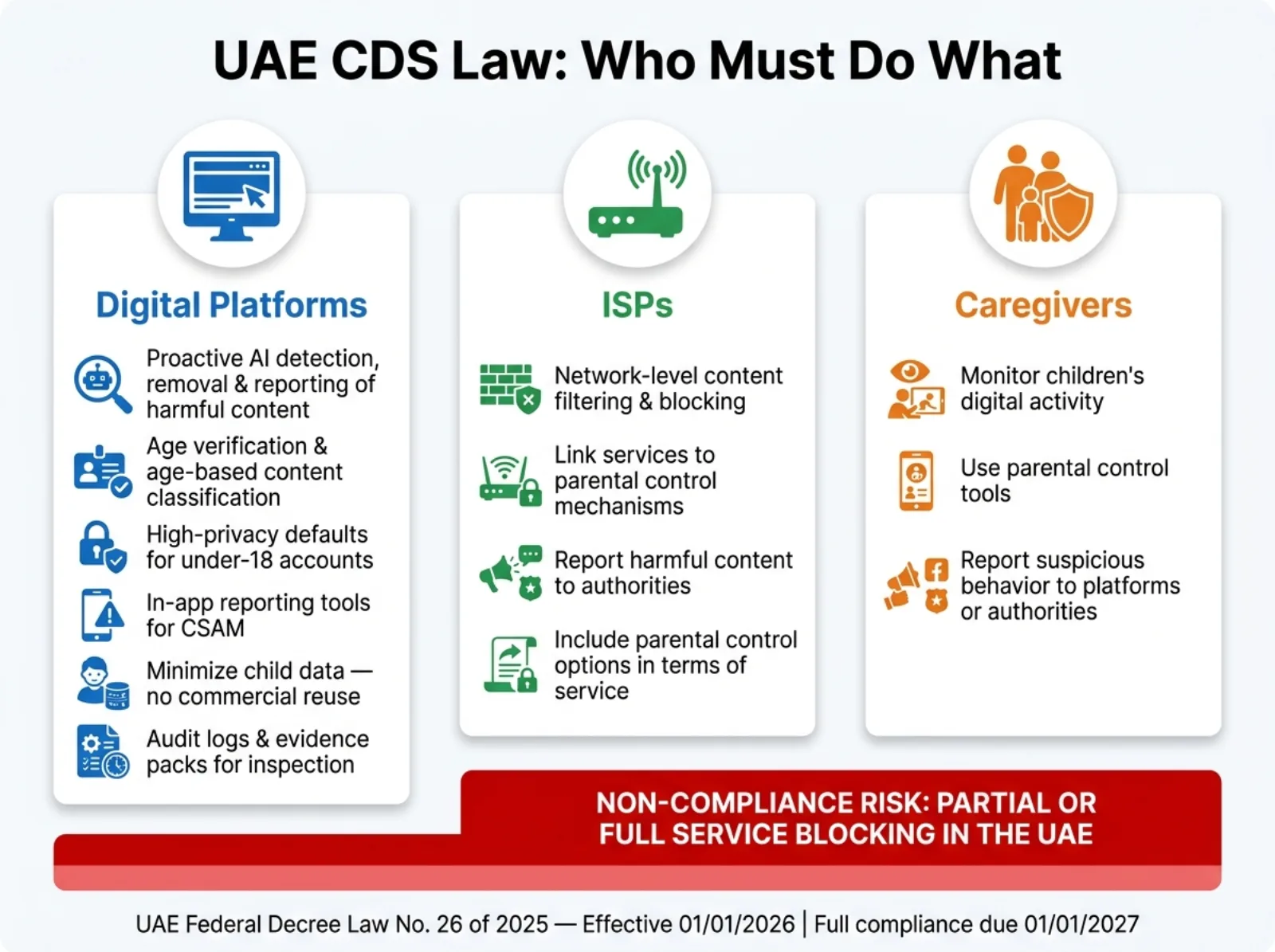
UAE Child Safety Law: Platform, ISP & Caregiver Compliance Duties
The CDS Law makes child safety a day-to-day duty, not just a policy statement. If a service operates in the UAE or targets UAE users, it may need to detect, block, and report harm before that harm spreads. That reach covers major social, gaming, and streaming platforms.
In practice, the rules push platforms toward three core jobs: identity checks, high-privacy defaults, and live risk detection.
What covered services are required to do
Age checks need to go past self-reported birthdays. Platforms must set high-privacy defaults for users under 18, filter harmful content, and offer simple in-app reporting tools [1][3].
The law also treats harmful content broadly. It includes non-explicit material that contributes to grooming, coercion, or psychological harm [2]. That matters because risk does not always look obvious at first glance. A message may seem harmless on its own, but the pattern behind it can point to a much darker direction.
That is why platforms must use AI and machine learning to proactively detect, remove, or report harm before it escalates [1][3].
Because this detection work depends on child data, the law also places limits on how that data can be collected and reused.
Where child data rules raise the bar
For children under 13, platforms need explicit, documented, verifiable parental consent. They also cannot reuse that data for ads, profiling, or tracking [3][1][5].
That sets a tight boundary. A platform cannot say it is protecting children with one hand while turning their data into an ad signal with the other.
Duties of platforms, ISPs, and caregivers
Compliance is split across platforms, ISPs, and caregivers, and each group has its own set of duties:
| Obligation Area | Digital Platforms | ISPs | Caregivers |
|---|---|---|---|
| Content Control | Proactive AI detection, removal, and reporting of harmful content [1][3] | Activate network-level content filtering and blocking [1][8] | Monitor children's digital activity and use digital safety tools for parents [8][7] |
| Access Management | Implement age verification and age-based content classification [5][8] | Link services to parental control mechanisms [3][4] | - |
| Reporting | Provide reporting tools and report CSAM immediately [1][3] | Report harmful content to relevant authorities [3][8] | Promptly report suspicious behavior or harmful content to platforms or authorities [7] |
| Data & Privacy | Minimize child data; no commercial reuse [5][3] | Ensure terms of service include parental control options [1] | - |
Regulators also have teeth. Non-compliance can lead to partial or full blocking of a service in the UAE [3][6].
The hardest cases now show up in private messages, where escalation is behavioral rather than keyword-based.
Why keyword filters fall short for grooming and exploitation
This matters most in private messages, where grooming almost never starts with banned terms. Keyword filters look for blocked words or phrases. But predators usually begin with plain, everyday language long before any obvious term shows up.
So the main problem isn't filtering public posts. It's spotting hidden escalation inside direct messages.
How grooming and sextortion escalate in private messages
The danger grows because abuse usually unfolds step by step. Exploitation almost never appears in one blatantly obvious message. Grooming tends to build through repeated, low-level contact instead of a single clear exchange.
The harm sits in the sequence: platform migration, requests for personal details, gifts or rewards, secrecy requests, image solicitation, then threats of real-world harm. On its own, each message can look harmless or at least easy to miss. Put together, the pattern tells a very different story.
And that's the gap keyword filters miss. No single message in that chain triggers a keyword flag.
### How AI tools help detect online predators
Behavioral AI follows escalation across a thread, flags risk in real time, and shows reviewers the signals behind the alert. That extra context helps teams review cases faster and make moderation calls with more consistency.
Those signals only matter when they connect to age checks, logging, and reporting workflows.
AI controls that align with UAE compliance requirements
Age assurance, filtering, and default child protections
In practice, these rules boil down to three core controls: age assurance, message monitoring, and audit trails.
UAE Federal Decree Law No. 26 of 2025 requires effective age verification. A simple birthdate field doesn’t meet that bar. The law points toward AI age estimation, with ID checks added when needed.
Child accounts also need to start with high-privacy defaults. That means restricted visibility, blocked contact from adults, and linked parental controls plus content-blocking controls built in from day one.
Platforms also need to spot age-verification bypass attempts, including VPN use and other evasion signals.
Once access is locked down, the next job is dealing with abuse that shifts into private messages.
Private-message risk detection, evidence logging, and reporting
The CDS Law calls for proactive AI detection in direct messages. In plain terms, platforms can’t rely only on user reports after the fact. They need systems that catch the same escalation patterns basic keyword filters tend to miss, then send the highest-risk cases to human review before things get worse.
At the same time, platforms should keep audit-ready logs of detections, reviewer decisions, timestamps, and reporting actions. They should also produce audit-ready evidence packs for internal review and law-enforcement referral.
Mapping legal duties to operational controls
| Control Type | Risk Prevented | UAE Legal Obligation |
|---|---|---|
| Age assurance | Underage access and VPN workarounds | Effective age-verification mechanisms |
| Proactive AI detection in private messages | Grooming, sextortion, CSAM | Proactive detection, removal, and reporting of harmful content |
| High-privacy defaults | Unauthorized data exposure and stranger contact | High-privacy settings for children's accounts by default |
| Parental control layers | Excessive use and unmonitored access | Usage limits, monitoring, and linked parental controls |
| Verifiable parental consent | Illegal processing of under-13 data | Explicit, documented, and verifiable parental consent |
| Audit logs and evidence capture | Regulatory non-compliance | Audit logs and incident reports |
| Immediate reporting tools | Delayed escalation of abuse | Immediate reporting to authorities |
Where do platforms usually fall short? Not in the policy deck. In the actual rollout.
The weak spots are often poor age checks, thin logging, and slow escalation. That’s where teams can get a false sense of safety: the controls exist on paper, but the deployment is weak, the logs are messy, and the response flow breaks when pressure hits.
Implementation gaps to avoid and key takeaways
Common compliance failures in child-safety deployments
Once the legal duties are clear, the next problem is execution. In practice, compliance usually breaks because of weak rollout, not weak policy.
One of the biggest gaps is leaning on self-declared age instead of actual age assurance. That issue hits hardest during age checks, where bypass attempts can gut the whole system. Regulators don’t just expect platforms to collect birthdays. They expect them to watch for signs that users are getting around the checks.
Another common miss shows up after an alert fires: no clear escalation path. If a system flags risk but the next step is fuzzy, the control starts to fall apart.
Governance steps that make AI defensible
Detection on its own doesn’t cut it. Every alert needs a documented decision trail.
A better way to think about governance is to tie it directly to the threats covered throughout this article: grooming, sextortion, and other private-message risks. Those cases need human review at each escalation point, along with timestamps and recorded outcomes that show why a case moved forward or was dismissed. In plain English, the system can’t just wave a red flag and stop there.
That means teams need to:
- Set clear review thresholds
- Keep UAE-hosted audit logs ready for inspection [9]
- Audit the system on a regular basis
There also needs to be one accountable owner for compliance. It can’t sit only with the legal team.
Conclusion: What organizations should do next
After those gaps are fixed, what remains is day-to-day discipline. The strongest setup combines behavioral detection, explainable alerts, and documented human review.
Organizations that bring all three together - and test them before the deadline - are the ones most likely to be ready.
FAQs
Does this law apply to platforms outside the UAE?
Yes. The law has extraterritorial reach. That means it can apply to any digital platform or internet service provider that operates in the UAE or targets users there, even if the company has no physical presence, office, or legal entity in the country.
So if people in the UAE can access your service, it may fall within the law’s scope. That can include social media, gaming, messaging, streaming, and e-commerce platforms.
What counts as effective age assurance?
Under UAE rules, age assurance has to do more than ask users to type in a birth date. Platforms need to use approved, enforced checks such as government digital ID, official ID scans, or biometric matching.
They can also use AI-based age estimation, but only if it is accurate and reliable. And the job doesn’t stop after the first check. Platforms also need to look for signs that users may be trying to get around the system, including VPN use.
How should platforms lawfully monitor private messages?
Under the UAE’s Child Digital Safety Law, platforms can’t just wait for reports and remove content after the fact. They now need to shift to proactive monitoring.
That means using technical systems, including AI and machine learning, to detect, block, and report harmful content.
Guardii helps with this by analyzing behavior patterns in private messages in real time. It can spot escalation arcs as they form, which helps platforms detect risk earlier and meet reporting duties.