

How AI Flags Grooming Risk Message by Message
Most grooming does not start with explicit language. It starts with patterns across DMs.
If you need to protect athletes, creators, students, or members, here’s the core idea: AI can score each new message in context, track risk across the full thread, and show a short reason for the flag. That helps teams move from guesswork to action, especially when risk shifts from casual chat to secrecy, off-platform moves, sexualization, or threats.
Here’s what matters most:
- Single keywords miss early risk
- Message history changes meaning
- Risk scores shift step by step
- Plain-English labels help reviewers act
- Evidence records matter when cases escalate
- Speed matters: 30% of sextortion victims face demands within 24 hours
If I strip the article down to one point, it’s this: the system does not just read one DM. It reads the sequence, scores the pattern, and tells a human reviewer why the risk changed.
That matters for teams handling private-message safety, evidence logging, and fast response.
How AI Reviews Each New Message in Real Time
Every time a new DM arrives, the system attaches it to the full conversation thread and starts analysis in under 200 ms [2]. It doesn't judge that message on its own. It reads it in context, pulls out behavior signals, and updates the score.
Ingesting the Message and Attaching It to the Conversation Thread
When a new DM comes in, the system ingests it through official platform APIs and adds it to the existing thread. Once that message is in place, the system can evaluate it against everything that came before instead of treating it like a standalone note.
Turning the Message and Context into Behavioral Signals
With the thread attached, the model looks for escalating behavior signals, not isolated words. That's a key distinction. A single compliment may mean nothing. But a pattern of compliments, age probes, requests to move the DM to another platform, gift offers, and emotional dependence can point to grooming behavior [2].
The system uses a behavior pattern model to spot those sequences and map them to the stages described above, from rapport-building to coercion.
Assigning a Per-Message Score and Label
After analyzing the DM in context, the system assigns a risk score from 0 to 100, along with a severity label such as Idle, Elevated, or Critical, plus a confidence percentage [2]. That score then becomes the baseline for the next message in the thread.
Human reviewers see:
- The detected pattern
- The current risk level
- The confidence score
- A plain-English reason for the flag
sbb-itb-47c24b3
How Risk Scores Change as the Conversation Progresses
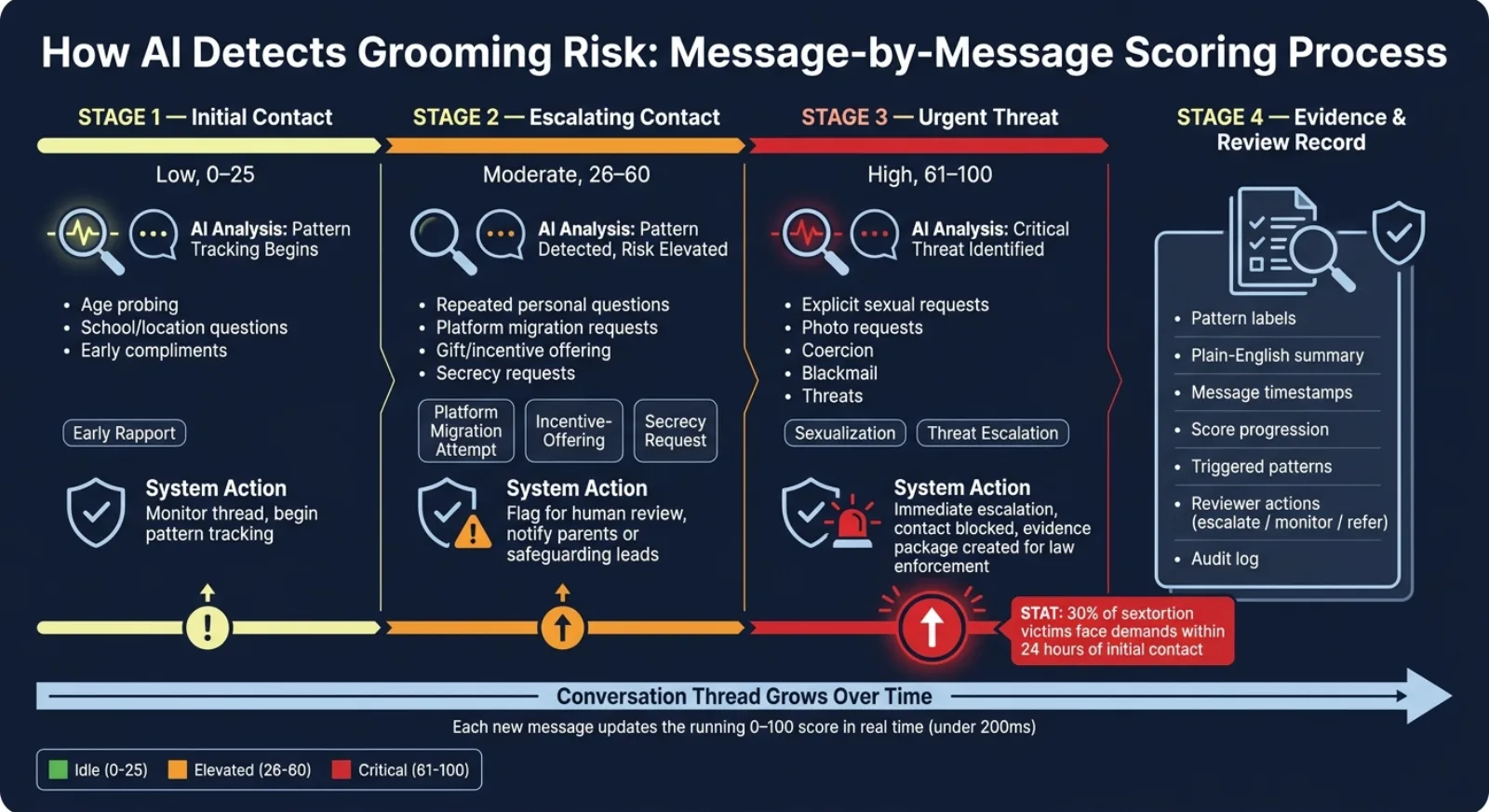
How AI Detects Grooming Risk: Message-by-Message Scoring Process
Once each message gets a score, the system looks at how small warning signs stack up over time. One message, on its own, usually doesn't say much. But as the conversation grows, each new message updates the 0–100 conversation score in context, so the system can spot escalation as it happens.
Early-Stage Signals That Raise Risk Gradually
Early grooming can look pretty normal at first. An unknown adult might ask a child how old they are, what school they go to, or whether they live nearby. On their own, those messages may not seem alarming. But when the same account keeps asking personal questions, adds compliments, and starts pushing the chat toward a private app, the pattern starts to take shape.
At this point, the score usually stays in the Initial Contact band or starts moving toward Escalating Contact. The shift doesn't come from one message alone. It comes from a cluster of signals that start to point in the same direction. The system tags those patterns with labels like Early Rapport or Platform Migration Request and keeps watching the thread. If those signals keep showing up, the score moves higher.
Mid-Stage Signals That Show Grooming Progression
In the middle stage, the conversation gets more personal. The adult may offer gifts, in-game items, or money. Flattery often increases too, and the child may be framed as unusually mature for their age. Requests to keep the conversation private also tend to become more direct.
When the model spots age questions, repeated personal questions, incentive-offering, and secrecy requests close together, the score can move into the Escalating Contact band. That matters because the system reads it as a clear escalation pattern, not just a handful of strange comments. At this stage, the conversation is flagged for human review, and parents or safeguarding leads can be notified when needed.
Late-Stage Signals That Trigger Urgent Action
Late-stage signals are much more direct. Explicit sexual requests, requests for private photos, coercion, blackmail, or threats can push the score into Urgent Threat. When that happens, the system escalates at once, blocks the contact, and creates an evidence package for review or law enforcement [2].
The time to step in can be very short. Research shows that 30% of sextortion victims face demands within 24 hours of initial contact [3]. That's why the model is built to react to sharp score jumps as soon as linked behaviors appear.
The next step is explanation: why the score changed and which message caused the jump.
How the System Explains Flags in Plain Language
After each score update, the system needs to show exactly what caused the change. A score means very little if a reviewer can’t see what shifted. When a new message pushes risk up or down, the system explains that change in the context of the full thread. That plain-language layer turns a score into something a person can act on.
Plain-Language Pattern Labels
The system turns triggers into short labels that reviewers can scan in seconds. Instead of dumping a wall of message text in front of someone, it surfaces brief behavior labels for each signal it detects. Labels like Information Extraction, Platform Migration Attempt, Secrecy Request, Incentive-Offering, Sexualization, and Threat Escalation show, at a glance, what kind of behavior triggered the flag.
That helps reviewers spot the risk pattern right away and decide what to do next:
- escalate
- monitor
- refer
The result is a review process that’s faster and easier to follow.
A Short Summary of Why the Conversation Was Flagged
Labels help, but they don’t tell the whole story on their own. So the system also generates a one- or two-sentence summary that explains the behavior sequence in plain English.
For example: "The sender quickly asked for personal details, attempted to move the conversation off-platform, and introduced secrecy."
That short summary gives the reviewer the arc of the interaction without quoting the messages directly.
"Detection reports the shape of a conversation - sustained targeting, escalation, coercion - not its contents. You are told what is happening and how serious it is." - Guardii [2]
The summary focuses on what happened, not the exact wording. That gives reviewers context without showing more text than they need.
What a Review Record Should Contain for Evidence Purposes
When a flagged conversation moves into formal review - whether by a school administrator, an athlete-protection team, or law enforcement - the record needs to stand up to scrutiny. It should be structured, traceable, and tied to the message-by-message pattern that drove the alert.
Each label should map back to the exact message that triggered it. That keeps the record anchored to the core mechanism: one message, then the next, then the pattern shift.
| Record Element | What to Include |
|---|---|
| Pattern labels | Plain-English behavior tags (e.g., Secrecy Request, Threat Escalation) |
| Plain-English summary | One or two sentences describing the behavior sequence |
| Message timestamps | Exact date and time of each flagged message |
| Score progression | How the risk score changed across the conversation thread |
| Triggered patterns | Which specific behaviors fired the alert and when |
| Reviewer actions | Reviewer action: escalate, monitor, refer, archive |
| Audit log | Chain-of-custody metadata, package integrity, and review history |
The record should also include chain-of-custody metadata so it can support later review. In practice, that means every alert needs to stay tied to the exact messages, timestamps, score changes, and reviewer actions taken.
Conclusion: From Individual Messages to Early Intervention
In practice, each message is ingested, scored, and linked to a running behavioral thread. That thread updates in real time, so the system tracks what’s happening as the conversation unfolds. But a score alone doesn’t help much if a reviewer can’t make sense of it at a glance.
That’s where plain-English explanations come in. Pattern labels and short summaries show why a conversation was flagged, without forcing someone to read a raw transcript. In other words, the score becomes a trigger for action, not just another line in a report. The system stays centered on safety, not broad monitoring.
With 30% of sextortion victims facing demands within 24 hours of initial contact [3], speed matters. Behavior-based AI helps close that gap by handling detection at scale and sending only high-risk cases to human review. That means earlier review, faster escalation, and less reliance on manual scanning.
"The human is engaged only at the decision point - where their judgment is decisive." - Guardii [1]
The goal is simple: catch escalation early enough for people to act.
FAQs
How does context change a message’s risk score?
Context changes risk scoring because the system looks at the full message thread over time, not just single words on their own.
It tracks behavior patterns and how things escalate as the conversation changes.
For example, a score might start lower with early signs like compliments or questions about age. Then it can move up when the chat shifts into mid-stage behavior, like pushing the person to move to a private channel or asking for personal details.
Later, the score can climb again if the conversation turns toward secrecy, coercion, or threats of real-world harm.
What behaviors raise risk before explicit content appears?
Risk can climb before any explicit content shows up. A conversation may start off looking harmless, then drift into grooming behavior like:
- compliments that turn into age probing
- attempts to move the chat elsewhere
- gift or incentive offers
- gradual requests for personal information
- requests for secrecy
- threats or claims of real-world consequences
Sextortion often follows that same pattern. It may begin with casual contact, then move into shared personal details, and later shift into threats and coercion.
How do human reviewers use AI flags?
Human reviewers use AI flags to sort through large volumes of private messages and step in when a case needs human judgment. The AI spots suspicious grooming patterns or urgent threats, so people can spend their time on the moments that matter most.
When action is needed, the system puts together tamper-evident case packages with a full audit trail. It then sends them to designated authorities, parents, or legal teams for review, confirmation, or next steps.