
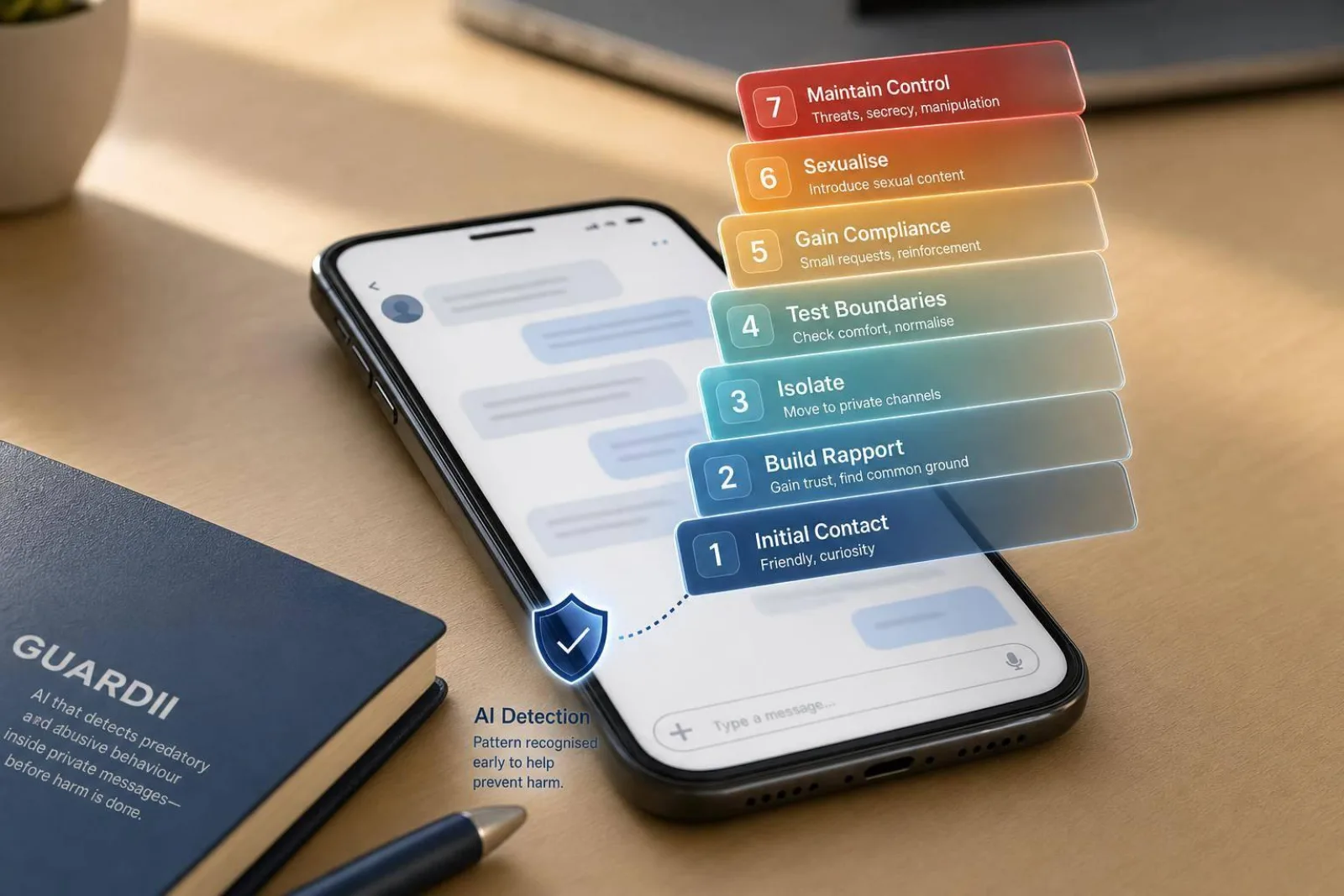
7 grooming sequences AI models detect in chats
A grooming chat usually follows a pattern, and that pattern is what AI looks for first. I’d sum it up like this: the chat often moves from friendly contact to personal questions, then to gifts or favors, secrecy, moving off-platform, sexual testing, and finally threats or sextortion.
Here’s the short version of what matters most:
- One message is often not enough to spot risk.
- The order of messages matters more than keywords alone.
- Early signs can look harmless until you see them stack up.
- The danger can move fast: some victims face demands within 24 hours.
- The worst stage is coercion, where pressure turns into threats, blackmail, or sextortion.
If I were explaining the article to someone in one minute, I’d say this: AI is not just looking for bad words. It is looking for a shift in behavior over time. That’s the difference between a chat that feels normal and one that is moving toward harm.
Quick comparison of the seven sequences:
| Sequence | What happens | Risk trend |
|---|---|---|
| Rapport building | Compliments, check-ins, trust-building | Starts low |
| Personal detail extraction | Questions about age, school, location, routine | Moves up |
| Gift offers and incentives | Money, credits, favors, special treatment | More pressure |
| Secrecy and exclusivity | “Don’t tell anyone” or “this is between us” | High concern |
| Off-platform move | Push to switch apps or channels | Higher danger |
| Sexual boundary testing | Sexual jokes, comments, or image requests | Critical |
| Threat and sextortion escalation | Demands, blackmail, image threats | Immediate action |
Bottom line: I see this article as a simple guide to how grooming grows in stages, and why sequence-based AI can flag risk before the chat becomes openly abusive.
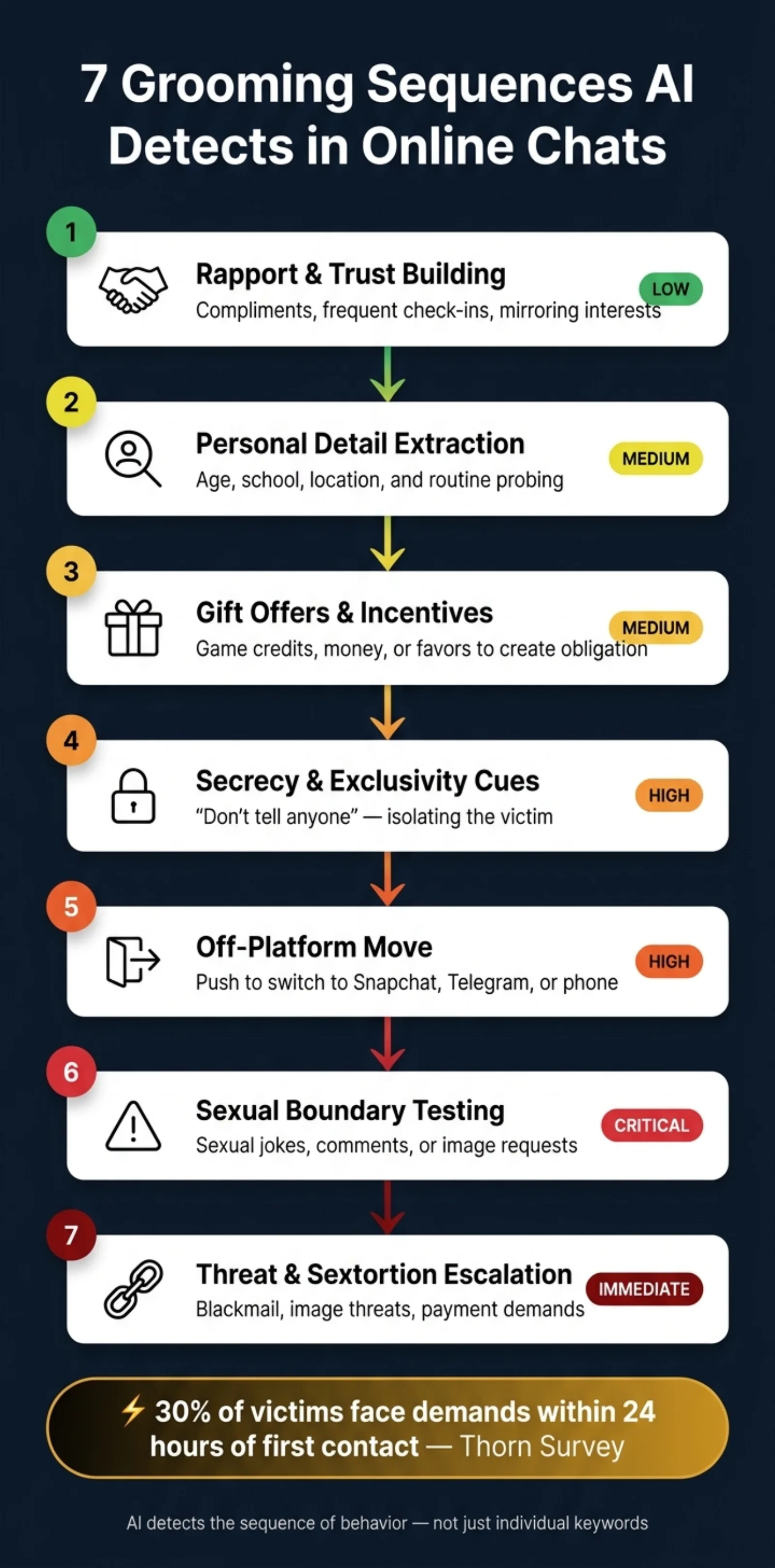
7 Grooming Sequences AI Detects in Online Chats
Why Sequence-Based Detection Matters in Direct Messages
A single DM can be hard to read on its own. Harmful intent usually shows up in the sequence - the way a chat changes over minutes, hours, or days. That’s why AI models look for repeated patterns of escalation, not just one word or one message.
For example, a conversation might start with compliments. Then it turns to questions about age or location. After that, the person may push for secrecy or ask to move the chat to another platform. That pattern tells you far more than any single message by itself.
And this can move fast. In a Thorn survey, 30% of victims faced demands within 24 hours of first contact. [4]
The next section breaks down that first sequence.
sbb-itb-47c24b3
1. Rapport and Trust Building
Grooming often begins with praise that looks harmless or with casual small talk. In these chats, a compliment is often followed by questions about age or location, steady contact, and, at times, an early push to move the conversation to another platform.[1][3] AI flags this stage when praise shows up alongside repeated contact, age-related questions, or attempts to move the chat elsewhere. The risk goes up when those questions keep coming or the chat starts sliding into the next stage.
Once trust is in place, the next step is often gathering personal details. (See our FAQs on AI detection for more on these tactics.)
| Signal | What It Looks Like in DMs | AI Detection Cue |
|---|---|---|
| Flattery | Unprompted praise | Excessive or age-inappropriate praise |
| Age probing | "How old are you?" / "What grade are you in?" | Age or identity probes |
| Sustained targeting | Frequent messages aimed at one specific person | Repeated contact from a new account |
| Mirroring | Mirrored slang or tone | Mirrored slang or tone |
From there, the conversation often shifts to questions about age, school, location, or daily routine.
2. Personal Detail Extraction
After rapport comes collection. Once trust is in place, the chat often turns to age, location, daily habits, and later, requests for personal photos or sexual images [5].
This stage is tough to catch by hand because it unfolds so slowly. One day it’s a question about grade level. The next day it’s a question about a neighborhood. On the surface, each message can seem harmless. But when the same account keeps asking for personal details across multiple sessions, that points to escalation, not casual curiosity [3].
In a Thorn survey, 30% of victims faced demands within 24 hours of first contact [4]. That’s a short window. It’s why early pattern detection matters so much.
| Signal | What It Looks Like in DMs | AI Detection Cue | Intervention Urgency |
|---|---|---|---|
| Age probing | "What grade are you in?" | Intent scoring on identity queries | High - early warning |
| Location gathering | "What school do you go to?" | Repeated location probing | High - early warning |
| Routine mapping | "What time do you get home?" | Behavioral schedule probing | Elevated - monitor closely |
| Image requests | Asks for personal photos or sexual images | Coercion detection | Critical - immediate action |
Once those details are mapped, the next move is often incentive-based contact.
3. Gift Offers and Incentives
Gift offers in DMs can be part of grooming. That includes game credits, gift cards, cash, prizes, or special treatment used to create a sense of debt before any direct demand starts. The main issue isn't the gift on its own. It’s whether the offer is tied to continued contact, secrecy, or some later ask.
That’s the line between a friendly gesture and a grooming tactic.
| Benign-looking offer | Grooming pattern |
|---|---|
| One-time, no strings attached | Repeated gifts used to build dependency |
| No secrecy, no pressure | Paired with "don't tell anyone" cues |
| Public or transparent context | Followed by a push to move off-platform |
| No expectation of reciprocity | Implicit or explicit ask for photos or compliance |
AI systems don’t flag the word itself. They score the surrounding sequence: the incentive, the secrecy cue, and the push to move to another platform. Then they check whether that pattern lines up with a known grooming arc [3]. By the time the demand shows up, the sense of obligation is often already there.
Once that leverage exists, the chat often turns toward secrecy or moving off-platform.
4. Secrecy and Exclusivity Cues
After an offer or incentive, secrecy becomes the control step. Once trust or a reward is in place, secrecy starts to cut the child off from adults and peers. That makes outside help less likely. In many cases, secrecy shows up right after a reward and sets up the move to a new app.
In DMs, this can sound like "this is just between us," "don't tell your parents," or "you're the only one who really gets me." On their own, those lines may seem harmless. That's the tricky part. The warning sign isn't just the phrase itself. It's the pressure behind it and where it shows up in the conversation. AI flags secrecy when it appears after rapport, gifts, or repeated contact.
Secrecy becomes urgent when it appears alongside incentives, platform shifts, or sexual testing.
| Signal combination | Intervention urgency |
|---|---|
| Secrecy cue alone | Monitor closely |
| Secrecy + incentive | High priority review |
| Secrecy + platform shift | Immediate escalation |
| Secrecy + sexual test | Immediate escalation |
| Secrecy + incentive + platform shift or sexual test | Urgent intervention now |
When secrecy appears with platform migration, the next risk is direct sexual testing.
5. Off-Platform Moves
After secrecy comes the next move: taking the conversation to a place with less oversight. Once scrutiny drops, the chat often shifts to another app or platform. On the surface, the request can seem ordinary. The risk sits in the pattern around it.
A casual suggestion to switch to an encrypted chat, a gaming platform, or another messaging app can come after an earlier grooming arc. AI scores the sequence, not the app name.
The destination matters because it cuts down oversight. Some platforms make blocking and reporting easier to dodge, which is why the move itself can signal risk. AI looks at the behavior around that move, not the platform label. It checks whether the request comes after secrecy cues, gets repeated after the target pushes back, or shows up alongside sexualized content.
That repeated pressure matters. Persistence is a signal in itself. AI escalates risk when an off-platform move appears with age probing, secrecy, or sexualized content.
Once the chat leaves a monitored space, sexual boundary testing can happen fast. That shift often comes right before the next sequence.
6. Sexual Boundary Testing
After rapport, personal detail gathering, and secrecy cues, the chat can shift into sexual territory. It usually doesn’t start with an explicit request. Instead, the sender tests the waters with a sexual joke, a suggestive comment, or a flirtatious compliment to see what happens next. Does the target go along with it, brush it off, or push back? After secrecy or a move off-platform, this is often the next step.
The wording may sound playful on the surface, but the goal is different. It’s meant to make sexual talk feel normal and lower resistance. What matters most is the pivot from casual conversation to sexualized remarks. That shift, more than any single phrase, is what AI flags.
Once this testing begins, things can move fast. The main signals are the pivot, the hesitation, and the persistence. If the target hesitates and the sender keeps pushing, that’s a strong sign of escalation.
"We detect the shape of a conversation, not its contents." [3]
If the target resists, the pattern can shift into threats, blackmail, or sextortion.
7. Threat and Sextortion Escalation
When someone pushes sexual content and gets resistance, the conversation can turn into blackmail fast. This is the point where AI looks for repeated demands, image-based threats, and pressure tactics that leave little room to breathe.
This is often the moment the exchange moves from grooming into outright abuse. The sender stops trying to build trust and starts issuing demands instead: send more images, send money, or deal with the fallout.
AI doesn't just flag a single threat. It tracks the path of escalation. That means looking for patterns like repeated demands, threats to share images, and repeated contact after the target blocks or ignores the sender. If the target says no, the next warning signs often involve threats to expose images, personal contacts, or private information.
The harm here is severe. Sextortion targeting minors has increased 300% in recent years [1], and 14% of victims reported self-harm as a result, rising to 28% among LGBTQ+ youth [4].
At this stage, action needs to happen within hours. AI systems like Guardii are built to show a live risk score as soon as coercive patterns appear, so parents, safeguarding leads, or investigators can step in before the damage gets worse. The table below shows how this escalation tends to appear in DMs.
Comparison Table: What Each Sequence Looks Like in DMs
The table below shows how intent, behavior, and risk shift as a DM conversation moves from trust-building into coercion.
| Sequence | Primary Intent | Common DM Behaviors | Key AI Cues | Urgency Level |
|---|---|---|---|---|
| 1. Rapport Building | Establish trust | Excessive compliments, frequent check-ins, mirroring interests | Frequent praise from a new or unverified account, repeated engagement | Low |
| 2. Personal Detail Extraction | Map vulnerabilities | Age probes, asking about school, location, routines, "Are your parents home?" | Repeated personal-data requests, specificity-seeking patterns | Medium |
| 3. Gift Offers & Incentives | Create a sense of obligation | Offering game currency, money, favors, or exclusive access | Transactional language, quid-pro-quo framing, rapid escalation | Medium |
| 4. Secrecy & Exclusivity Cues | Isolate the victim | "Don't tell anyone", "This is just between us", exclusive-bond language | Isolation language, secrecy + trust combination patterns | High |
| 5. Off-Platform Move | Evade moderation and increase control | "Add me on Snap", "Text my number", moving to WhatsApp or Telegram | Platform-switch requests, external app or phone-number requests | High |
| 6. Sexual Boundary Testing | Normalize sexual contact | Suggestive comments, sexual jokes, requesting or sending explicit images | Sexualized language, repeated boundary violations, escalation arc | Critical |
| 7. Threat & Sextortion Escalation | Coerce and blackmail | Ultimatums, image-sharing threats, payment demands, intimidation | Coercive or extortion language, urgency spike, highest-priority threat score | Immediate |
This progression matters because harmful chats usually don’t start with an obvious threat. They often begin with friendly, low-pressure contact, then shift step by step into control, secrecy, and fear.
The next section shows how AI separates early grooming from high-risk abuse.
How AI Tells Early Grooming Apart From High-Risk Abuse
Across the seven patterns above, the main difference is how fast things escalate. AI tells early grooming apart from abuse by tracking changes across messages, not by reacting to one comment on its own.
Early signs like rapport building, age checks, and requests for personal details usually fall into low-to-medium risk. That means they should be watched, not treated as an instant emergency. High-risk signs look different, and they move faster too. Research shows that 30% of sextortion victims face demands within 24 hours of initial contact [4]. So the jump from “friendly stranger” to active threat can happen fast. Systems that only scan for keywords miss that lead-up.
That’s where severity scoring helps. It draws a clear line between monitoring and intervention. Guardii scores escalation in real time and explains which behaviors triggered the alert. In plain terms, Guardii doesn’t just give you a score. It shows why the chat was flagged by surfacing the patterns behind each alert, so parents, school administrators, and investigators can judge severity without reading an entire transcript.
"Detection reports the shape of a conversation - sustained targeting, escalation, coercion - not its contents. You are told what is happening and how serious it is. You are not handed a feed of what was said." [3]
That keeps review centered on harmful behavior instead of the full private chat. Those risk levels then help adults decide what to do next. The next section shows how real-time moderation best practices help parents, schools, platforms, and investigators handle each risk level.
What Parents, Schools, Platforms, and Investigators Should Know
Once a chat gets flagged, what happens next depends on who sees it. The same DM pattern can call for very different actions from parents, schools, platforms, and investigators.
For families, the big shift is visibility into private messages. That’s where a lot of the risk sits. Parents don’t need to read every chat line by line to spot trouble. Real-time behavior alerts can help them step in early, before a situation gets worse.
For schools, the shift is fast routing instead of manual review. Messages between students and outside contacts often show warning signs well before anything lands on a counselor’s desk. That can include secrecy cues, requests to move off-platform, and fast emotional closeness. If high-severity alerts go straight to school safety leads or student support staff, administrators don’t have to wait for a student to speak up first. And with less than 10% of grooming and exploitation incidents ever reaching authorities [1], relying on self-reporting just doesn’t work.
For platforms, the key change is sequence-based DM detection. Keyword filters often miss the way harm builds over time in private chat. A single message may look harmless on its own. The pattern across many messages is where the danger shows up. Tracking escalation arcs instead of isolated terms helps close that gap without needing a huge moderation team.
For investigators, the priority is preserving the full escalation arc as digital evidence. Automated case packaging with hashing keeps timestamps, message order, and chain of custody intact [1][2][3]. Guardii supports this process with agentic AI pipelines for law enforcement and child-protection teams, assembling case-ready evidence packs with a human in the loop [1][2][3].
Conclusion
Grooming unfolds as a sequence, not a single message. It often begins with a compliment and ends in coercion or blackmail. The seven sequences above - rapport, probing, incentives, secrecy, migration, sexual testing, and escalation - show how this shift can hide in plain sight inside direct messages. On their own, individual messages may look harmless. Put together, they form a pattern. And that pattern is what makes early intervention possible.
The value of sequence-based AI is simple: it helps flag risk before harm becomes explicit. When you spot the pattern early, adults have a better chance to step in before threats or sexual content show up.
That time frame can be tight. Some victims face demands within 24 hours of first contact [4]. Since most of this plays out in private chat, detection needs to focus on message-to-message behavior. The sooner the pattern is spotted, the more time adults have to act.
FAQs
How does AI tell harmless DMs from grooming?
AI tells the difference between harmless DMs and grooming by looking at patterns of behavior and how a conversation escalates over time. It doesn’t rely on keywords alone.
Common signs include rapport-building, probing for age or personal details, gift offers, secrecy requests, attempts to move the chat off-platform, sexual testing, and threat escalation. Systems like Guardii watch for these signals across a series of messages and can escalate when the pattern starts to point to harmful intent.
Can grooming happen without sexual messages at first?
Yes. Grooming often starts without sexual messages. Predators may open with normal-looking behavior, like compliments, questions about age, or gifts, to build trust and make the conversation feel harmless at first.
That matters because early exchanges like these may not include sexual language at all. As a result, they can slip past keyword filters. Behavioral detection helps catch the quieter warning signs, such as secrecy cues or attempts to move the conversation to private channels.
What should I do if a chat shows these patterns?
Stop engaging. Don’t try to “solve” it in the chat.
Instead, preserve the evidence. Save screenshots and the full message thread, because keyword-only filters can miss patterns.
Then report it through the platform’s abuse tools. After that, escalate it right away to a trusted adult, safeguarding lead, or the right authority. That matters even more if there are secrecy requests, attempts to move the conversation off-platform, sexual pressure or testing, threats, or any real-world consequences.