

How Context-Aware Filtering Detects Online Grooming
Keyword filters miss grooming because grooming is a pattern, not one bad message. If I want to spot risk early, I need to look at the full DM thread: trust-building, secrecy, off-platform moves, photo asks, and meet-up pressure.
Here’s the short version:
- I look at conversation history, not isolated words
- I score behavior sequences like flattery → secrecy → migration
- I treat photo requests and meeting requests as top-risk events
- I send high-risk threads to human review
- I keep audit logs, timestamps, excerpts, and actions for later review
- I tune workflows for schools, law enforcement, and athlete safety teams
A few signals matter more than most:
- Secrecy requests like “don’t tell your parents”
- Platform migration like “add me on Snap” or “let’s move to WhatsApp”
- Fast escalation across days or weeks, not months
- Combined signals in the same thread, which often push risk much higher than one line alone
A simple rule set can catch blunt abuse. But grooming often starts with normal-looking chat. That’s why I need thread-level scoring, plain-English alerts, and a review flow that keeps the timeline intact.
Below, I break down the signals, scoring logic, alert setup, and evidence workflow in plain English.
Define the Grooming Behaviors a Filter Needs to Catch
Grooming tends to unfold in stages: trust-building, boundary testing, isolation, secrecy, and escalation. A context-aware filter needs to read the behavioral pattern, not just the text on the screen.
Map the Common Stages of Grooming in Direct Messages
A filter needs to track the full progression because a single message can look harmless by itself. The pattern often starts with flattery and rapport-building, moves into requests for personal details, then shifts into boundary testing, photo requests, and, later, meeting requests. Those stages come into focus when the system follows message order, timing, and reply patterns across the thread.
It also needs to track how fast the chat escalates - from casual talk to personal disclosure and sexual pressure. Normal conversations usually build at a slower pace. Grooming often compresses that timeline. [2]
Early-stage signals matter most when they start leading toward isolation, secrecy, or off-platform contact.
Why Platform Migration and Secrecy Requests Are High-Priority Signals
Two behaviors stand out as strong risk markers: moving the chat to another app and asking for secrecy. These deserve top attention because they often mark the moment grooming starts moving out of view.
Shifting a conversation from a monitored group chat to a private DM, or from an in-app thread to WhatsApp, Signal, or Snapchat, is a deliberate step to avoid oversight. That move alone should trigger closer review. [5]
Secrecy language points to concealment from adult review. Phrases like "don't tell your parents," "keep this between us," or "our little secret" suggest the relationship would not hold up under adult scrutiny. Risk climbs fast when both signals show up in the same thread. [4]
The table below turns those patterns into signals a filter can use.
Behavior-to-Signal Reference Table
The table maps core grooming behaviors to detectable signals and response levels.
| Grooming Behavior | Detectable Signals & Example Phrasing | Risk Level |
|---|---|---|
| Flattery / Trust-Building | Inappropriate praise about maturity, appearance, or intelligence; "You're so mature for your age", "You're smarter than other kids" | Monitor |
| Isolation | Undermining parents or peers; "They wouldn't understand you like I do" | Review |
| Testing Limits | Normalizing discomfort; "Don't be shy", "It's normal to feel this way" | Review |
| Secrecy Requests | Explicit asks to hide the chat; "Keep this between us", "Don't tell your parents" | Urgent |
| Platform Migration | Requests to move to unmonitored apps; "Add me on Snap", "Let's talk on WhatsApp" | High Priority |
| Photo Request | Pressure for personal photos; "Send me a picture", "What are you wearing today?" | Critical |
| Meeting Request | Push for in-person contact; "I can come pick you up", "Let's meet up" | Critical |
Context and co-occurrence matter more than any one message. Flattery paired with a secrecy request and a platform migration attempt in the same thread is a strong grooming pattern - even if no single message looks overtly alarming on its own. [4]
These behaviors become easier to act on when they’re scored across the full conversation, not treated as isolated words.
sbb-itb-47c24b3
How Context-Aware Filtering Outperforms Keyword Filters
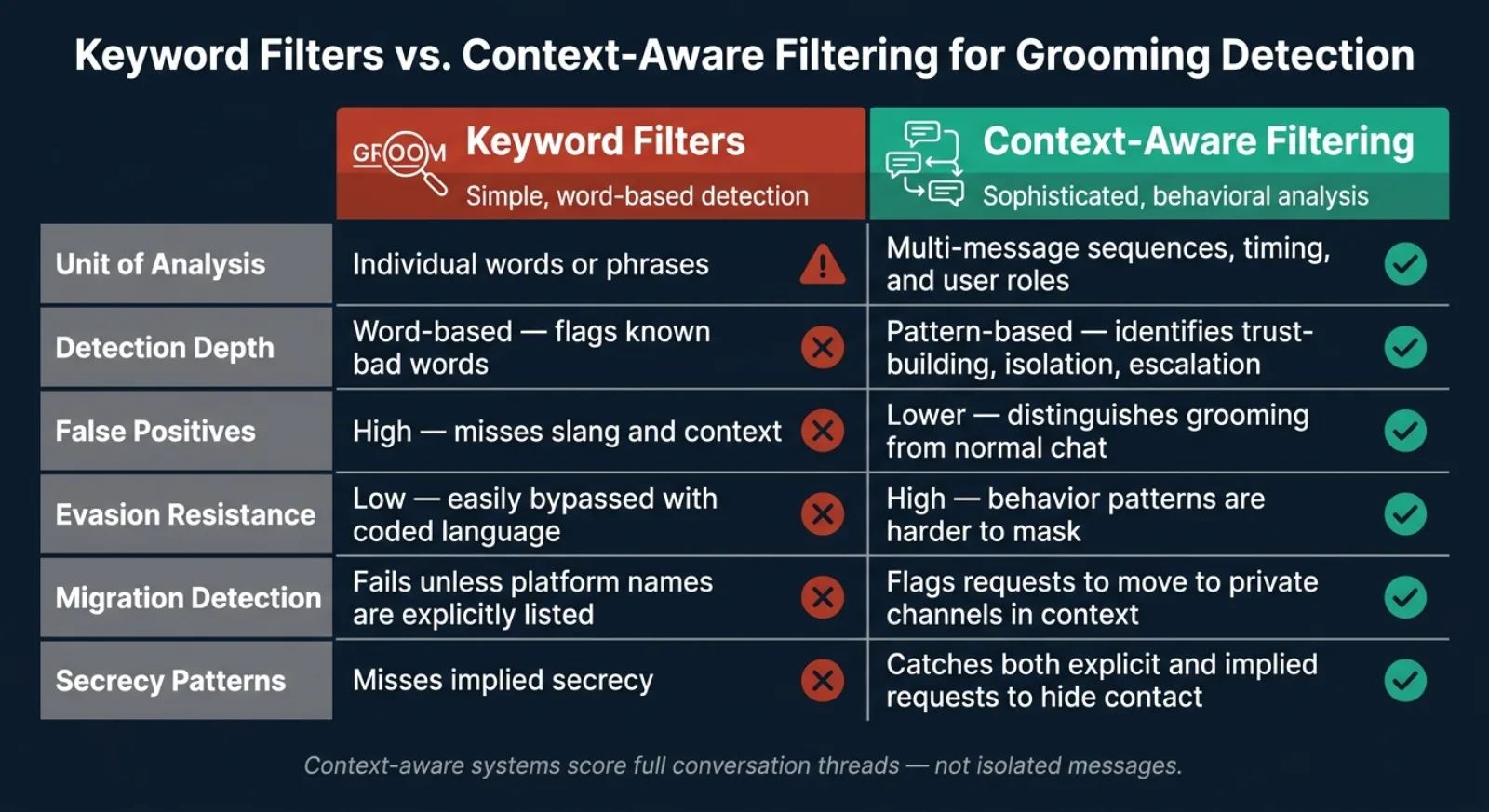
Keyword Filters vs. Context-Aware Filtering: Online Grooming Detection
Once behaviors are mapped, the next move is to score the full thread, not random messages pulled out of context.
Keyword filters look for banned words or phrases. That can catch blunt abuse. But grooming usually doesn't work that way. It tends to be slow, coded, and stretched across a longer exchange. A predator may use slang, soft language, or platform-specific terms that sound harmless on their own. A context-aware system looks at the surrounding conversation, so it can spot the same pattern even when no single message looks alarming.
Single-Message Rules vs. real-time risk scoring
Context-aware filtering scores the thread, not the message. It tracks escalation, reply patterns, and moves between channels.
"A series of friendly chats and supportive messages might take on a different meaning over the course of a longer conversational history, especially when it happens between users of different age groups." - Naren Koneru, Vice President of Engineering, Safety, Roblox [3]
The table below shows where keyword filters miss the mark compared with conversation-level systems:
| Feature | Keyword Filters | Context-Aware Filtering |
|---|---|---|
| Unit of Analysis | Individual words or phrases | Multi-message sequences, timing, and user roles |
| Detection Depth | Word-based (flags known "bad" words) | Pattern-based (identifies trust-building, isolation, escalation) |
| False Positives | High - misses slang and context | Lower - distinguishes grooming patterns from normal chat |
| Evasion Resistance | Low - easily bypassed with coded language | High - behavior patterns are harder to mask |
| Migration Detection | Fails unless platform names are explicitly listed | Flags requests to move to private channels in context |
| Secrecy Patterns | Misses implied secrecy | Catches both explicit and implied requests to hide contact |
The Core AI Signals Behind Context-Aware Detection
Three signal groups power context-aware detection.
- Linguistic signals track changes in tone.
- Temporal signals measure how fast a conversation escalates and whether messages arrive in bursts at odd hours.
- Graph signals track moves from a group chat to DMs or another app.
These signals work together. The system looks for co-occurrence. If flattery, secrecy requests, and attempts to move the chat off-platform show up in the same thread, the risk score can climb much higher than it would from any one signal on its own [4]. That's why behavior-based scoring is much harder to dodge than a simple word list.
Still, those signals only help if the system can explain why it fired an alert and keep data access under tight control.
Privacy, Proportionality, and U.S. Compliance Basics
Explainable detection has to support review, logging, and limited retention. That means logging triggers, actions, and reviewer decisions. It also means keeping flagged data only for as long as policy and law require. High-severity alerts should go to human review before any action is taken.
Those logs and severity levels then feed the alert workflow that follows.
How to Build a Detection Workflow for Private Messaging
Scores only matter if they lead to review, response, and user safety. A good workflow keeps the grooming sequence intact - trust-building, secrecy, migration, and escalation - instead of treating the final risk score as the whole story. In plain English: keep the conversation timeline, not just the alert.
Configure Conversation-Level Monitoring
The base layer is a rolling profile for each conversation built over days or weeks, not a one-day snapshot of messages [5].
Use three detection layers - linguistic, temporal, and graph - plus a fairness audit layer. Linguistic signals catch changes in tone and word choice when a chat shifts from casual to unusually intimate. Temporal signals flag faster contact patterns, odd-hour activity, and threads that pick back up after long gaps. Graph signals spot movement from group chats into private channels. The fairness audit layer checks for bias across demographic groups [1][6].
For long threads, process messages in 10–15-turn chunks and carry the state forward so the system keeps track of the conversation across sessions [4]. If age data is available, put adult-to-minor threads first and skip adult-to-adult chats so review capacity stays focused on the highest-risk cases [4].
Those signals should feed into alerts that show what happened and when it happened, not just a number.
Build Explainable Alerts and Tiered Response Paths
Each alert should spell out which behaviors and sequence caused it. For example: "Contact frequency increased 4.2x over 21 days, followed by a secrecy request and platform migration attempt." That kind of explanation helps cut moderator fatigue and makes decisions easier to defend [5][1].
The alert also needs to show why the thread crossed the threshold. Tie each risk tier to a set response so reviewers aren't forced to make hard judgment calls on the fly [2][1].
| Risk Tier | Typical Range | Response | Evidence Captured |
|---|---|---|---|
| Trusted | 0–20 | Normal operation | Standard metadata logs |
| Watch | 21–50 | Silent monitoring | Full behavioral trajectory log |
| Restrict | 51–80 | Warning prompts/shadowban | Interaction graph + message excerpts |
| Critical | 81–100 | Immediate human review and escalation | Hash-chained audit log |
For Critical-tier events like photo requests or meeting requests, the system should auto-trigger external reporting, including structured packages for the NCMEC CyberTipline [4][1].
Log Evidence for Investigations and Duty of Care
Every flagged conversation needs a tamper-evident record. At a minimum, logs should include timestamps, participant identifiers, the grooming signals that fired, allowed message excerpts, review actions, and a chain-of-custody log [2].
Use hash-chained audit logs for each score change and moderator action so any later tampering can be detected. Keep audit logs for 7 years to meet regulatory requirements and support legal proceedings [1][6].
Explainable logs also help investigations and reduce moderator fatigue because they give reviewers the full context on which grooming signals triggered the flag, not just one suspicious message [2][5]. That evidence package then becomes the basis for steady response across teams.
Deploying Context-Aware Filtering With Specialized Safety Platforms
Teams don't have to build this workflow from scratch. Specialized safety platforms can bring behavioral scoring, explainable alerts, and evidence logging together in one system.
How Guardii Operationalizes Context-Aware Grooming Detection
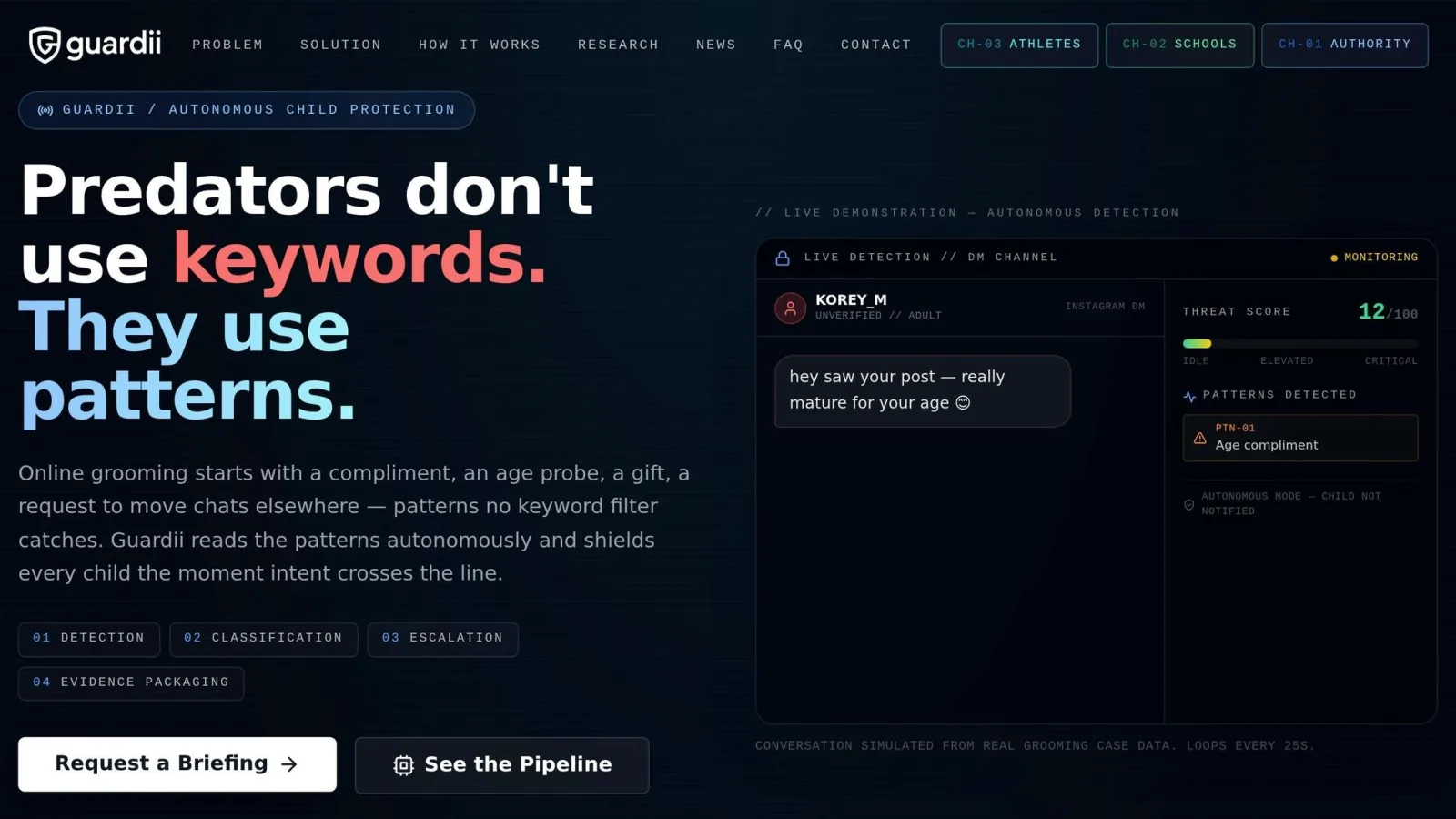
That same conversation-level logic can be put to work through specialized safety platforms. Guardii analyzes private-message behavior in real time, tracking grooming escalation, platform migration, secrecy requests, information extraction, and coercive threats. It returns a live risk score along with a plain-English reason for the flag.
Matching the Deployment Model to Schools, Law Enforcement, and Athlete Protection
The same detection engine can be tuned for different settings, depending on who needs to act and how fast they need to act.
| Deployment Context | Primary Need | Key Capability |
|---|---|---|
| Schools and districts | Early intervention within institutional networks | Real-time monitoring of direct messages with tiered alerts for staff review |
| Law enforcement | Triage at scale, evidence ready for legal review | Detection-to-evidence workflows that assemble tamper-evident evidence packs and escalate to the right unit |
| Athletes and clubs | Protection from targeted abuse and grooming in public-figure DMs | Priority review queues, repeat-offender watchlists, and evidence packs for legal action |
Conclusion: What Effective Grooming Detection Requires
Platform migration, secrecy requests, and escalation patterns call for conversation-level detection and an evidence-ready response. Effective grooming detection turns private-message patterns into timely review, evidence, and intervention.
FAQs
How is grooming different from normal teen or adult conversation?
Grooming is different because it’s a calculated, multi-step process built to gain trust and set up later exploitation. Regular conversation tends to grow on its own. Grooming follows a deliberate pattern, and that pattern may play out over weeks or even months.
You’ll often see unnatural escalation, a push to move into private channels, and more pressure to keep things secret. Early messages can look harmless on their own, which is why detection focuses on behavior over time instead of one single message.
What makes photo requests and meet-up requests high-risk signals?
Photo and meet-up requests are high-risk signs. They often show up in the later stages of grooming, when a predator tries to turn emotional pressure into direct abuse.
A meet-up request is especially serious because it brings an immediate physical safety risk. It also often comes with secrecy or pressure to be alone. By this stage, a child may already feel attached to the person, which can make saying no much harder.
How can a system flag grooming patterns without over-monitoring private messages?
By focusing on behavior patterns instead of single words. Advanced AI looks at how interactions unfold over time, like shifts in contact frequency, requests for secrecy, or movement from public spaces into one-on-one messaging.
That makes it easier to spot manipulative intent early, even when individual messages look harmless. At the same time, it cuts down on extra scrutiny of normal conversations.