
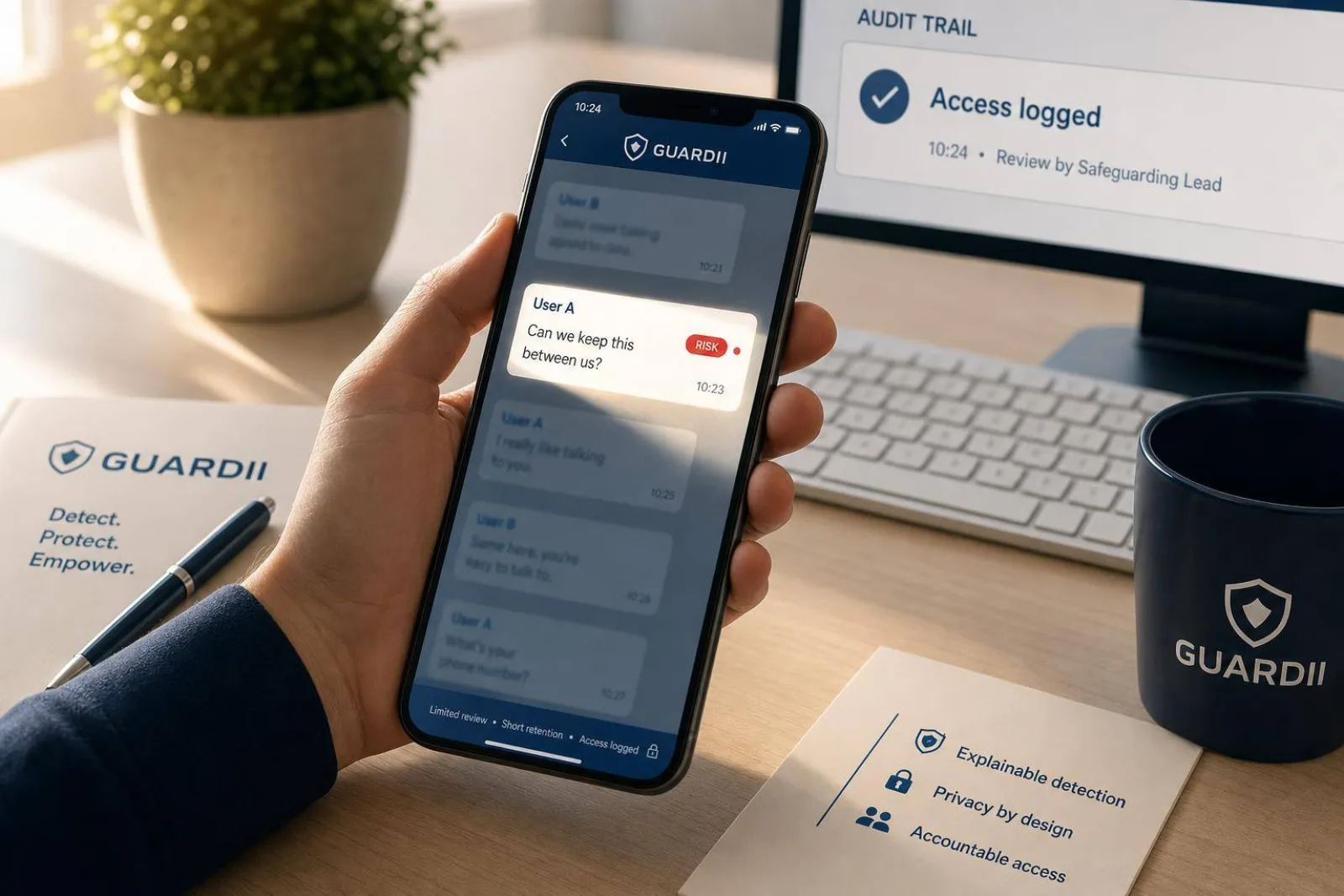
AI Risk Assessment vs. User Privacy: Key Tradeoffs
If you want to stop grooming, threats, sextortion, and sexualized abuse in DMs, some message access is hard to avoid. But if monitoring goes too far, private messaging stops feeling private.
Here’s my short take: the best path is limited monitoring with tight rules. I’d keep review narrow, store less data, use short retention, log every access, and send only the highest-risk cases to trained staff. That helps teams act on harm without turning every DM into an open file.
What this means in practice:
- More scanning usually means more privacy loss
- Behavioral scoring can spot risk early, but it can also build user profiles over time
- Long retention helps investigations, but it adds leak and misuse risk
- Schools, clubs, agents, and law enforcement need different rules
- Safety teams need evidence, audit trails, and clear response steps
- Women athletes, creators, and public figures often face sexualized abuse that needs fast handling
- Comment moderation and DM moderation are not the same problem
- False positives matter, especially with rivalry slang, mixed languages, and tour-specific fan behavior
A few points stand out for sports teams, leagues, clubs, and creator managers:
- If I auto-hide Instagram comments instead of deleting them, I reduce public harm fast, but I still need to think about fan reaction, sponsor risk, and whether escalation evidence is kept.
- If I want a club or agent team to move from DM threat detection to an evidence pack in 15 minutes, I need a fixed workflow: detection, triage, reviewer check, evidence export, and reporting path.
- If I manage accounts across 40+ languages, I need routing, tuning, and allow-lists for rivalry slang so normal banter in Hindi, Urdu, Tamil, Arabic, and other languages doesn’t get flagged too often.
- If I protect women athletes and creators, I need clear steps for sexualized DM abuse, cyberflashing, legal review, and staff response so business DMs stay visible while harmful ones are handled fast.
- If I care about sponsor-safe match-day social, I need moderation rules that cut public abuse exposure without crushing normal engagement.
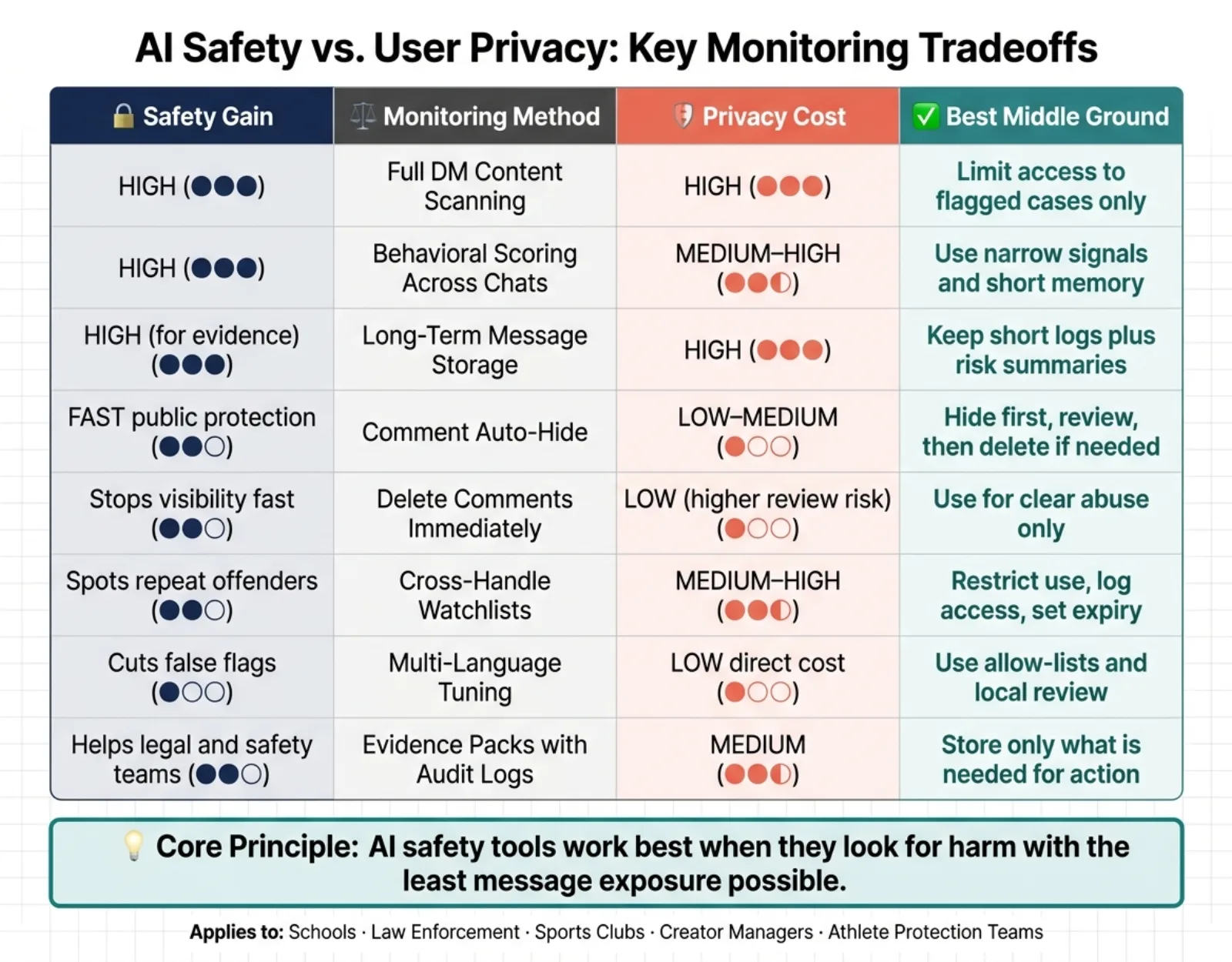
AI Safety vs. User Privacy: Key Monitoring Tradeoffs
Why Your Privacy Impact Assessment (PIA) Isn't Enough for AI
sbb-itb-47c24b3
Quick Comparison
| Issue | Safety Gain | Privacy Cost | Best Middle Ground |
|---|---|---|---|
| Full DM content scanning | High | High | Limit access to flagged cases only |
| Behavioral scoring across chats | High | Medium to high | Use narrow signals and short memory |
| Long-term message storage | High for evidence | High | Keep short logs plus risk summaries |
| Comment auto-hide | Fast public protection | Low to medium | Hide first, review, then delete if needed |
| Delete comments at once | Stops visibility fast | Low privacy effect, higher review risk | Use for clear abuse only |
| Cross-handle watchlists | Helps spot repeat offenders | Medium to high | Restrict use, log access, set expiry |
| Multi-language tuning and cultural context | Cuts false flags | Low direct privacy cost | Use allow-lists and local review |
| Evidence packs with audit logs | Helps legal and safety teams | Medium | Store only what is needed for action |
I’d sum it up like this: AI safety tools work best when they look for harm with the least message exposure possible. The core tradeoff is simple, but the rollout is not. You have to decide what gets scanned, what gets stored, who can see it, and how fast your team can act when abuse hits.
That’s the frame I’d use for the rest of the article.
AI Risk Assessment: What It Prevents and Why Organizations Use It
AI risk assessment exists for a simple reason: harmful DMs usually build step by step, not through one blunt threat. That pattern is exactly why organizations use these systems. It's also why privacy concerns hit so hard.
Early Detection of Grooming, Sextortion, and Targeted Abuse
Human reviewers and basic keyword filters just can't keep up with the volume or the workarounds people use. Predators often avoid flagged terms on purpose. Instead, they lean on sequences of messages that seem harmless when you look at each one on its own.
Behavioral systems look at the flow of a conversation, not just single words. They score the sequence and flag signs of escalation. Systems like Guardii track these patterns and return a live risk score with a short explanation.
That matters in cases of targeted abuse against women, athletes, and public figures. The same pattern-based approach that helps teams move faster and handle more cases also changes how much private content institutions end up reviewing.
How Schools, Law Enforcement, and Athlete Protection Teams Benefit
For organizations, the value comes down to three things:
- Speed: risky conversations can be flagged while they're still unfolding
- Scale: teams can review far more cases than manual moderation allows
- Evidence quality: investigators get more usable records and context
For law enforcement, AI systems can generate evidence packages with audit trails that support investigations. That helps close a major gap, since fewer than 10% of predatory incidents ever reach authorities through standard reporting channels [1].
For schools and clubs, these systems can send only high-risk conversations to a safeguarding lead, along with enough context to act. Athletic welfare teams can also step in faster when targeted abuse appears in DMs, before it reaches the athlete more directly.
The upside depends on deeper access to private messages, and that's exactly where the privacy risk starts.
User Privacy: What Gets Lost When Monitoring Goes Too Far
Good detection needs deep access. And that same access can make privacy fragile.
When a system can read private message content, score behavior, and package evidence, the privacy risk goes up fast if limits and oversight are weak. AI safety tools don’t just watch messages. They change what private messaging is by turning conversation into data that can be analyzed.
Confidentiality, Consent, and the Expectation of Private Communication
Most people see a direct message as a private conversation. The plain assumption is simple: nobody else is reading it.
That’s one reason platforms have long avoided moderating private messages. Doing so brings liability and governance concerns [2]. Once an institution adds monitoring, that private-space feeling starts to shift. Users may not know what is being scanned, how long data stays in the system, or who can get access to it.
That’s why transparency and consent matter so much, especially in schools and other institutional settings. The more aggressively a system searches for risk, the more it changes the meaning of private communication.
Profiling, Mission Creep, and Data Retention Risks
Modern behavioral AI often scores intent and communication patterns instead of just flagging single words [1]. That can help catch grooming sequences. But there’s a catch: it also builds a profile of how a person communicates [1].
So the privacy cost isn’t just exposure of message content. It’s also the creation and storage of a behavioral record.
Mission creep is another serious risk. A tool built for one high-risk setting can drift into much broader surveillance over time [1][2]. And if the system is trying to detect patterns across days, weeks, or months, it may need to store message content and keep audit trails [1][2].
That tension leads straight to the next issue: how much monitoring can be justified.
Key Tradeoffs: Detection Coverage vs. Privacy Intrusion
Better detection usually means deeper access to private data. In schools, law enforcement, and clubs, that tradeoff shapes a basic question: how much private communication should anyone be allowed to inspect? Once you look at the monitoring methods side by side, the privacy cost stops feeling abstract.
Broad Scanning vs. Limited Inspection
What a system scans sets the ceiling on what it can catch and what it puts at risk. A links-only system leaves a lot on the table. It may catch suspicious URLs, but it won't see abusive text, grooming language, or harmful media. Scan text and media too, and coverage goes up fast. So does exposure to private content.
| Scanning Approach | Detection Coverage | Privacy Impact |
|---|---|---|
| Links-only | Low - misses text and media abuse | Minimal |
| Media-only | Medium - detects CSAM and explicit content | Moderate |
| Text and Media | High - detects grooming and harassment in direct messages | High |
| Behavioral scoring | High - detects escalation and intent | Moderate - focuses on patterns, not content |
Coverage isn't the only tradeoff. The next one is just as important: is the system watching what people say, or how they act over time?
Behavioral Risk Scoring vs. Profiling Concerns
Behavioral scoring can cut down on direct content review, which sounds safer at first. But there's a catch. It still builds a record of how someone communicates across time, and that can drift into profiling if guardrails are weak.
| Risk Signal | Safety Rationale | Privacy Cost |
|---|---|---|
| Escalation patterns | Identifies grooming or radicalization stages | Risk of misreading context or slang |
| Frequency / velocity | Detects automated spam or flood attacks | May flag high-intensity legitimate users |
| Cross-session memory | Identifies persistent predatory behavior | Creates a lasting record of user behavior |
| Sentiment shifts | Spots sudden changes indicating mental health crises | Highly intrusive; it infers emotional state |
Cross-session memory stands out as the most invasive signal here. Why? Because it turns messages that might have been brief and temporary into a durable behavior trail.
That same tension shows up in retention. The more time a system keeps data, the more room there is for both investigation and misuse.
Longer Retention vs. Data Minimization
Retention is where safety value and privacy cost hit each other head-on. Evidence from private chats often takes time to build. A single message may mean little on its own. A pattern over two weeks may mean a lot. But every extra day of storage adds another day of risk if the system is breached, mishandled, or used for a broader purpose later.
| Retention Strategy | Investigative Utility | Privacy Risk |
|---|---|---|
| Short-term buffering | Low - only useful for immediate blocks | Low - data is purged quickly |
| Limited audit logs | Medium - supports short lookback windows | Moderate - vulnerable to short-term breaches |
| Long-term archives | High - essential for building historical evidence | Very high - increases mission creep and data leak risk |
A safer middle ground is to store a summarized risk record instead of raw message logs [3]. And even when retention is brief, users should be told clearly what is kept, for how long, and why.
How to Balance Both: Privacy-Preserving Safety Design
The previous section showed where detection and privacy push in opposite directions. This section looks at what organizations can do in practice, without trading one off against the other. The issue isn't whether to monitor. It's how to limit what the system can see.
Technical Controls That Reduce Personal Data Exposure
A strong first step is to cut down how much raw message data gets copied or kept. Selective inspection checks messages only when a trigger justifies it, instead of watching every conversation all the time [4]. And if a system stores context, it should keep only safety-related summaries so the data can't later be used for unrelated profiling [3].
Two day-to-day controls make a big difference:
- Least-privilege access means the system touches only the data needed for a safety decision.
- Controlled evidence views let reviewers see a risk summary instead of the full thread, so human oversight doesn't turn into open-ended reading of private conversations.
Those limits on the system matter. But they don't hold up on their own. Policy has to back them up.
Governance Rules That Make Monitoring Defensible
A defensible monitoring program rests on four pillars: role-based access so only designated personnel can view flagged content, short retention limits with a hard ceiling on how long any safety log is kept, audit logs that record every access event, and human review thresholds that define when a person must act before any action is taken.
Two points often get missed, even though they matter a lot for trust: bias testing and plain-English explainability. If you regularly check whether the system flags some user groups at higher rates, you're more likely to catch unfair outcomes. And when source views and audit logs show exactly which behavioral signals triggered an alert, reviewers aren't left guessing [3].
Safety overrides should stay narrow, documented, and tied to specific risk thresholds - not a blanket pass to monitor everything.
Deployment by Context: Law Enforcement, Schools, and Clubs
The right controls depend on who is doing the monitoring and why.
| Deployment Context | Key Privacy Consideration | Evidence Standard |
|---|---|---|
| Law Enforcement | Chain-of-custody integrity; sovereign data residency | Top AI features for digital evidence management can produce court-ready evidence packs with full audit trails |
| Schools & Districts | Student rights; designated safety officer access only | Risk summaries surfaced to designated staff only |
| Athletes & Clubs | Consent-based monitoring; public reputational risk | Flagged DMs and comment threats with one-click reporting |
For law enforcement, the main concern is tight evidence handling and legal approval before any inspection starts. Automated triage, paired with human review, can support that process. That can also include on-premise or sovereign data-residency options where required.
For schools, monitoring should stay limited to institutional networks, be disclosed in plain terms, and focus on safety-related behavioral signals instead of full-content review. Admin controls that can switch monitoring features on or off across user groups - students versus staff - matter for institutional governance [3].
For athletes and clubs, the goal is to protect public figures from targeted abuse in direct messages and public comments without shutting down normal fan interaction. Least-privilege API tokens, data-residency options, and clear consent frameworks help keep that setup defensible.
Deployment context changes how evidence is handled, who gets access, and how notifications move through the system.
Conclusion: AI Risk Assessment and User Privacy Can Work Together
After weighing the tradeoffs, the answer isn’t zero monitoring. It’s real-time moderation best practices for limited monitoring. The tension between AI risk assessment and user privacy is real, but it doesn’t lead nowhere. The issue isn’t monitoring by itself. The issue is monitoring with no clear limits.
This gets most tense when broad scanning sweeps in more personal data than a safety call even needs. That’s where the balance has to come from privacy-preserving controls that cut data exposure while keeping the risk signals teams can still use. Human review should stay narrow and focus only on the highest-risk cases.
Those safeguards also need to fit the setting. In law enforcement, schools, and athletic organizations, the duty of care changes. So does the acceptable scope of access and the level of proof needed before action. Better triage precision means fewer false positives and less intrusion into private conversations.
AI risk assessment and user privacy can work together. They’re not opposing goals. They’re design constraints that, when handled at the same time, lead to safer systems that are harder to abuse. The goal isn’t to pick privacy or safety. It’s to build systems that protect both.
FAQs
How much DM scanning is actually necessary?
Effective monitoring depends on constant review. Abuse in direct messages often builds step by step, not in one obvious moment. That’s why real-time monitoring matters. It helps catch the shift from casual chat to information gathering or grooming before things go further.
Thread continuity matters too. Context like timing, pacing, and message frequency can help separate manipulative behavior from normal peer-to-peer conversation.
What safeguards best protect user privacy?
The strongest safeguards put autonomous, context-aware analysis ahead of old-school human review. Instead of asking people to scan or save private content by hand, these systems look for behavioral escalation patterns in real time. That makes it possible to step in when harm starts to build, without turning private conversations into something routinely watched.
Strong protections also depend on opt-in use, non-invasive design, explainable risk scoring, and clear rules for transparency and data protection. Put simply, people should know what the system does, why it flags risk, and how their information is handled. That approach helps protect user choice while limiting intervention to moments when specific high-risk patterns show up.
How can teams reduce false positives?
Teams can cut false positives by moving past simple keyword filters. Those filters often miss context, so they flag the wrong things.
A better approach is to use systems that look at behavior and context, not just single words.
Instead of zeroing in on one term, these systems look at things like:
- patterns in the conversation
- timing and message frequency
- emotional escalation
- age gaps
- how intent develops over time
With real-time scoring, teams can then send only the highest-risk cases to human reviewers.