

Detecting Grooming Patterns with Federated Learning
If you want to catch grooming early without moving private messages to a central server, federated learning is the better fit. It looks at behavior over time instead of single words, keeps raw chats local, and gives reviewers a clear record of what was said versus what the model inferred.
Here’s the short version:
- Keyword filters miss the pattern. Grooming often starts with trust-building, then moves to secrecy, personal questions, off-platform contact, and pressure.
- Centralized scanning adds privacy risk. Once private messages are copied and stored, breach and compliance risk go up.
- Federated learning keeps raw messages local. Devices or local nodes train on-site and send back model updates, not chat content.
- Behavior-based detection works better for grooming. It can link weak signals across many messages instead of judging each message alone.
- Human review still matters. Good systems send explainable alerts, keep audit logs, and support chain of custody.
A few facts stand out from the article: grooming is usually a sequence of specific patterns, not a single explicit message; Zero Data Retention (ZDR) can be used to purge processed data after local analysis; and adding secure aggregation plus differential privacy can cut exposure while still improving the shared model.
For me, the main takeaway is simple: privacy and early detection do not have to be opposites. A local-first system can flag high-risk conversation paths sooner, while giving schools, law enforcement, and youth-safety teams a cleaner review path.
| Approach | What it does well | Main problem |
|---|---|---|
| Keyword / centralized monitoring | Easy to start; can scan for direct terms | Misses progression; stores private messages centrally |
| Federated / behavior-based monitoring | Tracks escalation across messages; keeps data local | Needs local setup, model tuning, and review workflows |
If I had to sum it up in one line: grooming detection works best when the system follows the pattern, not just the words.
The Problem with Centralized and Keyword-Based Monitoring
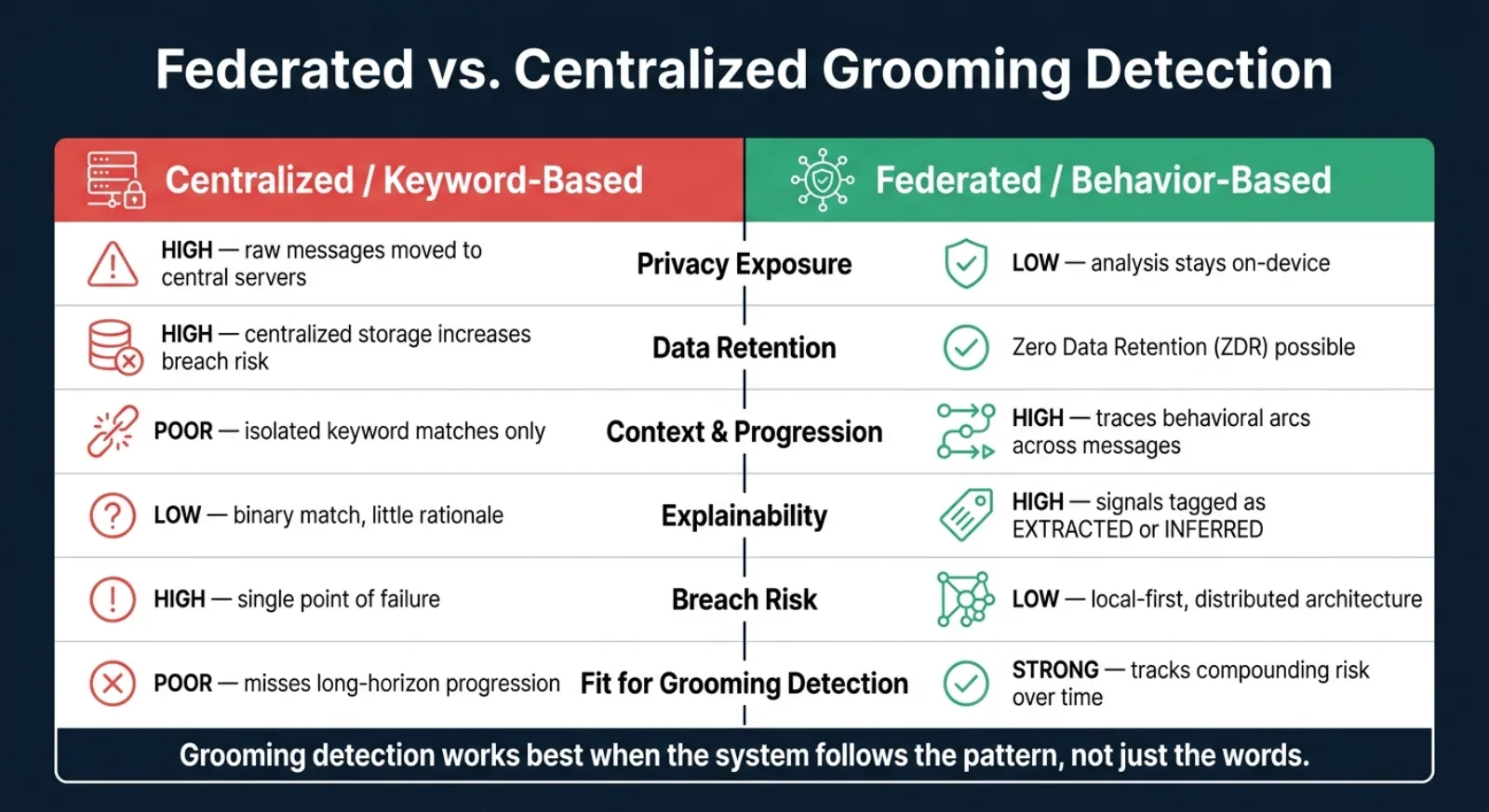
Federated vs. Centralized Grooming Detection: Privacy & Performance Compared
Why Keyword Filters Miss Grooming Progression
Keyword filters look for specific words or phrases. On paper, that sounds useful. In practice, it misses how AI detects grooming behavior online.
Grooming often develops step by step, with no single message standing out on its own. One message builds trust. The next introduces secrecy. After that, the conversation shifts to a less monitored platform. If a system checks messages one at a time, it won't see that pattern. It only sees isolated fragments.
That’s the core issue: the risk sits in the progression, not just in explicit language. A keyword-based system can catch blunt wording, but it often misses the slow build that makes grooming dangerous.
Why Centralized Scanning Creates Privacy and Compliance Risk
A common fallback is server-side scanning. Instead of checking messages locally, private conversations are copied to a central server so a model can review them.
This helps with context. But it also opens the door to a different problem.
For schools and law enforcement, centralized scanning packs privacy, access, and governance risk into one place. Every copied message becomes something that must be stored, protected, and controlled. That means one breach could expose a large set of private conversations. In sensitive settings, that’s not a small concern. It also puts pressure on trust: people know their private messages are being moved and stored elsewhere.
Privacy-preserving systems take a different path. They analyze messages locally and avoid central retention [1][2].
Centralized vs. Federated Detection: A Direct Comparison
The table below lays out the main tradeoffs. The pattern is pretty simple: you gain context, but often at the cost of privacy.
| Feature | Centralized / Keyword-Based | Federated / Behavior-Based |
|---|---|---|
| Privacy Exposure | High - raw messages moved to central servers [1] | Low - analysis stays on-device [1] |
| Data Retention | High - centralized storage increases risk [2] | Zero Data Retention (ZDR) possible [2] |
| Context & Progression | Poor - isolated keyword matches only [1] | High - traces behavioral arcs across messages [1] |
| Explainability | Low - binary match, little rationale | High - explicit and inferred connections are tagged [1] |
| Breach Risk | High - single point of failure | Low - local-first, distributed architecture [1][2] |
| Fit for Grooming Detection | Poor - misses long-horizon progression [3] | Strong - tracks compounding risk over time [3] |
Those tradeoffs make centralized monitoring a weak match for grooming detection. Federated learning deals with that tension by keeping analysis local while still learning the progression patterns that matter.
sbb-itb-47c24b3
How Federated Learning Detects Grooming Patterns Without Moving Raw Messages
How Federated Learning Works in a Private-Messaging Setting
Federated learning handles this by analyzing messages where they already exist. Instead of sending conversations to a central server, the model trains on the device itself or on a secure institutional node. A shared global model is sent out to those local systems, where it learns from conversation sequences on-site.
After that local training, only weight updates go back to a central aggregator. Raw messages, identifiers, and metadata do not leave the device. Secure aggregation then combines those updates into a better global model, while making sure no single node's update can be reverse-engineered. That local training step is what makes later alerts possible without storing messages in one central place. It also supports Zero Data Retention (ZDR): transient data used during local analysis can be deleted right after the update is produced [1][2].
Which Grooming Signals Can Be Learned Locally
When the model stays local, it can learn the sequence of behavior that often marks grooming. That matters because single messages may look harmless on their own, while a longer pattern tells a different story.
Local models can pick up signals that build over time, such as:
- age or location probing early in a conversation
- requests for secrecy
- attempts to move the exchange to an encrypted app
- incentive offering, such as gifts or money
- pressure after hesitation
- threats or sextortion-style escalation
A weak signal on its own may not mean much. Put several together, in the right order, and the pattern becomes much more telling.
Explainability matters more than a score by itself. Behavioral ontologies label signals as EXTRACTED when they are explicitly present in the conversation, or INFERRED when the model resolves them from context [1]. That gives a safety officer something concrete to review. They can see which signals fired and why, not just that the system crossed a threshold.
Keywords, Semantic Models, and Behavioral Ontologies: How They Compare
The detection method matters just as much as the model design. Some methods are fast but shallow. Others pick up nuance but cost more to run. And some are built to show how a pattern formed across many messages, not just whether one message looked suspicious.
| Detection Method | Strengths | Weaknesses |
|---|---|---|
| Lexical Keywords | Fast, low compute, easy to deploy | High false positives; misses evolving slang and coded language; no conversation context |
| Semantic Models | Understands intent and nuance; handles multilingual signals well | High compute cost; privacy risk if centralized; can produce false positives |
| Behavioral Ontologies | Explainable (every signal is tagged); local-first; maps long-term patterns across a conversation | More complex to deploy; requires careful initial behavioral mapping |
Keywords catch tokens. Semantic models catch intent. Behavioral ontologies catch escalation over time. Those tradeoffs shape the deployment stack in the next section.
What Deployment Looks Like for Schools, Law Enforcement, and Youth-Safety Teams
Core Architecture: On-Device Analysis, Secure Aggregation, and Explainable Alerts
Those tradeoffs only matter if the deployment stack works in day-to-day use. In practice, that stack has three parts: local analysis, secure aggregation, and explainable alerts.
Local analysis runs on a local or institutional node. The model processes conversation sequences there, without sending raw messages anywhere else. If a pattern crosses a risk threshold, the system generates an alert that shows which signals fired, such as a secrecy request, a platform migration attempt, or an incentive offer. Each signal is labeled as either direct or inferred, so a reviewer can tell the difference between what the model observed and what it inferred [1].
Once the model flags a pattern, the next step is human review.
From Risk Score to Review: How Response Workflows Should Work
A risk score by itself isn't enough. Detection only helps if it gets routed to a reviewer with enough context to do something with it. When a conversation crosses a defined threshold, it should move into a structured human review queue ranked by severity. The analyst should see the flagged signals, the confidence tags, and the surrounding conversation needed to review the case.
Chain of custody starts at detection. Audit logs need to record why a conversation was escalated - which signals fired, at what confidence level, and which policy rule triggered the review - not just the fact that it was flagged [2].
Privacy Controls in a Federated Detection Stack: What Each Layer Does
For schools, law enforcement, and youth-safety teams, these controls are the deployment baseline.
| Privacy Control | What It Does | Trade-off |
|---|---|---|
| Federated Learning | Trains the model on local data so raw messages never move to a central server. | Requires coordination across distributed nodes to aggregate updates. |
| Secure Aggregation | Combines local model updates so the central server only sees the combined result. | Adds computational overhead to the aggregation step. |
| Differential Privacy | Adds calibrated noise to updates to reduce the risk of individual data leakage. | Can slightly reduce model accuracy if the noise is too high. |
| On-Device Inference | Generates risk scores locally, keeping message content on the institutional node. | Requires enough local compute, and model updates take longer to propagate. |
| Zero Data Retention (ZDR) | Automatically purges queries and processed data after analysis. | Limits the ability to perform long-term historical analysis. |
Conclusion: A Practical Path to Privacy-Preserving Grooming Detection
Grooming is about behavior, not just words. That’s why local behavioral models do a better job than simple keyword filters. If the pattern lives in how a conversation unfolds, then privacy-first pattern detection makes sense.
The same idea carries through the whole problem. Grooming tends to move forward in small steps, not through blunt or explicit language. A person may push for secrecy, suggest moving to another platform, or offer rewards over time. That is exactly the kind of pattern local inference and federated training are built to spot.
Centralized scanning can give more context, but it also increases privacy exposure and compliance risk. Federated learning avoids much of that tension by keeping analysis on the device or within the local system, instead of sending raw messages elsewhere.
That matters even more when review teams are already stretched thin. A behavioral system can help keep false positives in check while bringing high-risk conversations to the surface earlier, before more harm is done.
Key Takeaways for Safety and Compliance Leaders
For safety and compliance leaders, this is an operational call, not an abstract one.
- Score escalation sequences, not isolated terms. Focus on behavior patterns such as platform migration attempts, secrecy requests, and incentive-offering. That makes the system harder to evade with slang or coded language [4].
- Keep raw messages local where possible. Federated learning can cut privacy exposure and make compliance simpler.
- Require explainable alerts. Each alert should show which signals fired and the confidence level for each one. Reviewers need to know why something was flagged, not just see a warning.
- Test false-positive performance before deployment. Better triage precision means less reviewer fatigue.
- Define the human-review path first. Detection only helps if the case gets to the right person with the right context. Audit logs should preserve chain of custody from the moment a conversation is flagged [4].
Privacy does not have to come at the cost of early detection. The better path is to analyze behavior locally, flag only the conversations that look high risk, and leave the final decision to human reviewers.
FAQs
How accurate is federated grooming detection?
The search results don’t include accuracy data for federated learning in grooming detection.
That said, Guardii reports 99.1% triage precision. It gets there by analyzing behavior patterns and how conversations escalate over time in private messages, instead of depending on keywords alone.
In plain English, it’s looking at the shape of the interaction, not just the words on the screen.
Guardii uses context signals like:
- emotional intensity
- age gaps
- communication frequency
Those signals help it spot predatory intent and surface live risk scores.
Can federated learning work on school or agency devices?
Yes. Federated learning can run on school or agency devices by training models across decentralized devices without moving raw user data off those devices.
That means institutions can look for grooming and predatory behavior patterns while keeping privacy protections in place. They can also monitor communications inside their own networks and flag detected threats for designated safeguarding leads.
What happens after a conversation is flagged?
When a conversation gets flagged, the system keeps the full thread intact and builds a tamper-evident evidence package with a complete audit trail.
From there, it sends the case to the right authority - such as parents, school officials, or law enforcement - for human review, follow-up, and protective action before harm occurs.