

AI Content Filtering: Meeting Global Child-Safety Laws
If your product has comments, DMs, or creator inboxes, basic keyword filters are no longer enough. I’d treat child-safety compliance as a system problem: detect risky behavior early, route cases by age and region, keep time-limited evidence, and make sure teams can act fast.
Here’s the short version:
- Private messages are the hardest area to police and often the first place grooming, sextortion, and sexual harassment show up.
- Behavior matters more than single words. Risk often appears as a pattern: age checks, flattery, secrecy, pressure, platform switching, threats, and image requests.
- Rules now shape product design. Teams need age checks, message and comment controls, review paths, logs, and deletion schedules that match each market.
- Speed matters. For sports teams, leagues, agents, and creator managers, the target should be real-time detection, reviewer handoff, and an evidence pack in 15 minutes or less for high-risk cases.
- False positives can wear people down. Allow-lists for rivalry slang, local dialect, and fan banter can cut bad flags across 40+ languages, including Hindi, Urdu, Tamil, and Arabic.
- Women athletes and creators face a different threat mix. Sexualized abuse, cyberflashing, and repeated DM harassment need tighter inbox rules and clearer legal paths.
- Sponsor risk is tied to moderation quality. Match-day brand campaigns can be hit fast by abuse in comments, so clubs need rules for when to auto-hide, unhide, or delete.
- Audit trails matter. Legal and safety teams need chain-of-custody records, watchlists for repeat offenders across 30+ handles, and weekly KPI dashboards for precision, recall, review time, and staff exposure minutes.
- Retention should stay tight. Keep what legal and safety teams need, delete what they don’t, and align data location and storage terms with each market.
If I were building this playbook today, I’d focus on five things first:
- Instagram comment control: know when auto-hide protects engagement better than delete, and when delete is the safer move for sponsor and player risk.
- DM threat response: move from detection to reviewer action to evidence pack in under 15 minutes.
- Language tuning: reduce bad flags on tours with slang lists, local examples, and weekend on-call coverage.
- Player and creator wellbeing: cut exposure time for athletes, agents, and moderators without shutting down normal fan talk.
- Proof for legal and brand teams: keep clean logs, case notes, screenshots, timestamps, and reporting paths ready.
A quick comparison helps frame the work:
| Focus area | What teams need |
|---|---|
| Public comments | Hide, unhide, delete rules; sponsor-safe match-day settings; repeat-offender tracking |
| Private DMs | Threat scoring, sexual harassment handling, cyberflashing response, evidence packs |
| Language coverage | Local slang allow-lists, false-positive review, routing for 40+ languages |
| Legal and audit | Chain-of-custody, retention limits, reporting paths, defamation and threat review |
| Performance | Precision/recall targets, review SLA, exposure-minute tracking, weekly dashboard |
Put simply: I’d summarize the job as safer inboxes, cleaner comment sections, lower sponsor risk, and better proof when something goes wrong. The rest of the article explains how to turn that into policy, tooling, and daily team workflows.
The Regulations That Shape Child-Safe AI Filtering
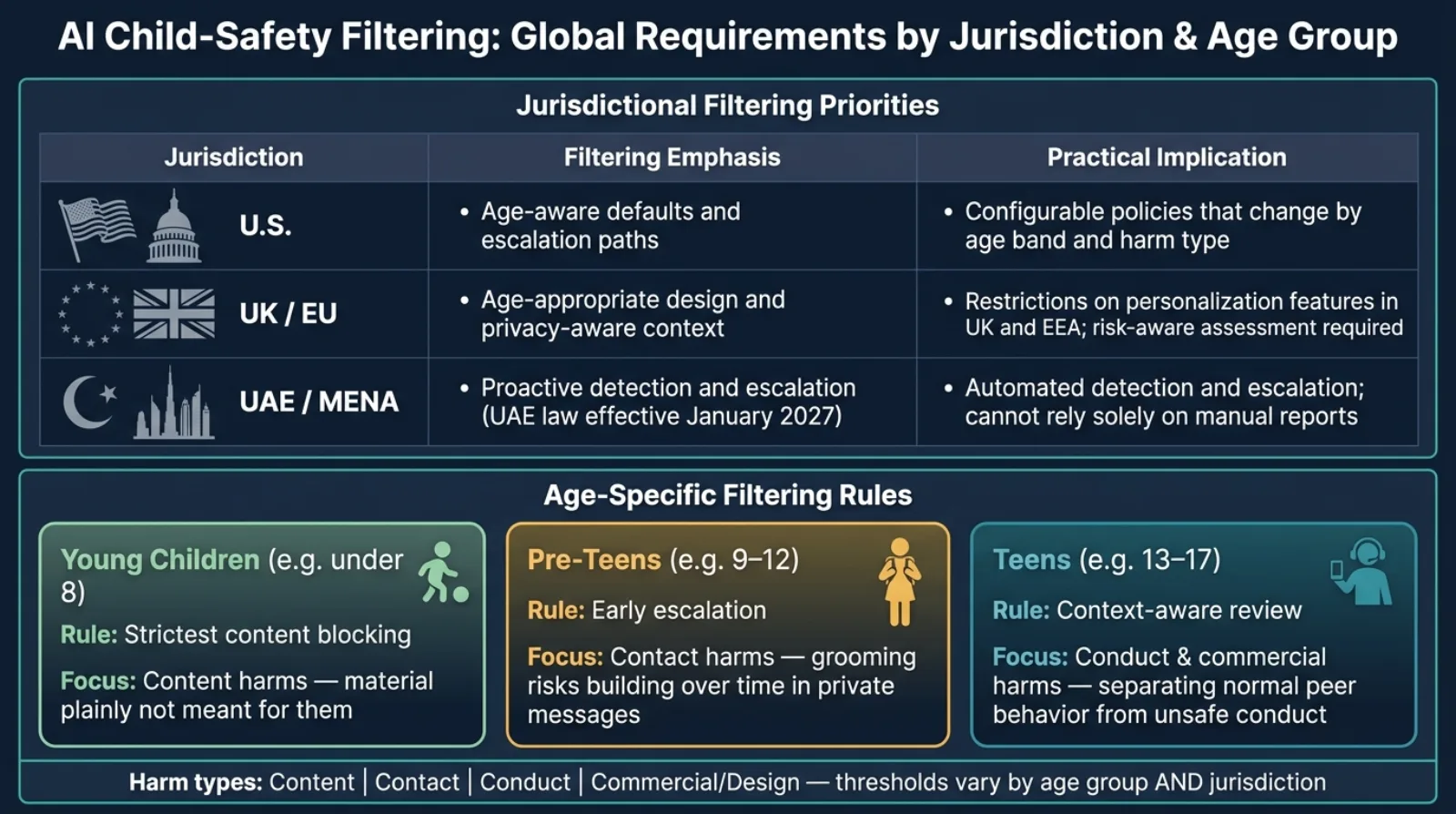
AI Child-Safety Filtering: Jurisdiction & Age-Group Requirements at a Glance
Child-safety rules are no longer just policy talk. They now shape product controls in a direct way.
In plain English, the law sets the ground rules for filtering systems: what age-inappropriate content to flag, which users count as minors, when to step in, and how long data can stay on file. That means the rules decide what a filter must catch, when it needs to escalate, and what it can keep or must delete.
U.S., UK, and EU Rules on Minors, Risk, and Age-Appropriate Design
Across the U.S., UK, and EU, the pattern is pretty clear: products need to be more age-aware and put stronger guardrails around minors.
That shows up most clearly in personalization. In parts of the UK, EEA, and Switzerland, data-heavy personalization is restricted for minors. Platforms are also expected to limit personalization when it could increase risk for younger users.
The UAE follows much of that same compliance logic, but it goes a step further by putting more weight on proactive detection.
UAE Child Digital-Safety Law and the Broader MENA Direction
The UAE's federal child digital-safety law, effective January 2027, requires proactive AI detection of harmful content and behavior in child-facing products. In other words, child-facing systems can't just sit back and wait for someone to file a report.
That same direction is taking shape across the broader MENA region. The push is toward automated detection and escalation in child protection, with systems expected to identify risks and escalate them fast instead of relying only on manual reports.
Those legal duties don't stay in a policy document. They flow straight into filter design.
Turning Legal Duties into Filtering Requirements
At the product level, those duties turn into concrete controls:
- Age assurance and verification
- Content limits
- Reporting workflows
- Retention controls
- Audit trails
Teams also need clear records that show what was detected, what action was taken, and why. Zero-retention rules can purge queries and related data after use[1]. And those controls aren't one-size-fits-all. They change based on the user's age group, the type of harm, and the jurisdiction involved.
sbb-itb-47c24b3
What AI Content Filtering Must Detect for Different Age Groups
Filtering has to change by age group because a 7-year-old, an 11-year-old, and a 16-year-old don't run into the same kinds of online risk. That simple fact turns one broad duty into different rules for different ages.
Age-Specific Harm Categories for Children and Teens
Younger children need the tightest protection from material that's plainly not meant for them. Pre-teens often need earlier warning when contact risks start to form. Teens need safeguards that can separate normal peer behavior from conduct that starts to look unsafe. Put plainly: children need stricter blocking, pre-teens need early escalation, and teens need review that pays attention to context.
A useful way to sort these risks is by content, contact, conduct, and commercial/design harms.
- Content harms are usually the easiest to spot because the risk appears in the content itself.
- Contact harms are tougher because they build over time, often in private messages. To catch them, systems need a rolling view of chat history and linked signals that show escalation.
- Conduct harms include bullying and harassment.
- Commercial/design harms cover platform or business-model patterns that are not age-appropriate for children.
The same type of harm may call for different controls based on the user's age and region. Region changes the intervention threshold, but age still drives how the filter responds.
Regional Comparison Table: Jurisdictional Filtering Priorities
| Jurisdiction | Filtering emphasis | Practical implication |
|---|---|---|
| U.S. | Age-aware defaults and escalation paths | Use configurable policies that change by age band and harm type. |
| UK / EU | Age-appropriate design and privacy-aware context | Account for restrictions on some personalization features in the UK and EEA when assessing risk. |
| UAE / MENA | Proactive detection and escalation | Use proactive detection and escalation. |
These age bands shape the detection logic, escalation paths, and review rules in the next section.
Building an AI Filtering System That Meets Child-Safety Laws
Those legal duties don’t stay on paper. They turn into detection logic, age-based routing, data retention limits, and review workflows.
From Keyword Blocking to Behavioral Detection
Keyword rules can catch known terms. That helps with obvious misuse. But abuse doesn’t always announce itself so plainly.
Behavioral detection looks at how a conversation changes over time. That matters because grooming, sextortion, and other contact harms often unfold step by step, not in one message. A system like this uses conversation history to spot escalation, not just isolated words.
| Detection approach | What it does | Compliance value |
|---|---|---|
| Keyword-based rules | Flags known terms and phrases | Basic coverage for obvious misuse, but weak for evolving abuse patterns |
| Behavioral detection | Tracks escalation arcs across a conversation, such as platform migration, information extraction, incentive-offering, secrecy requests, and threats | Better suited to grooming and sextortion workflows, with explanations reviewers can audit |
| Memory and retention controls | Limits stored sensitive data while preserving audit logs | Supports auditability without unnecessary data retention |
Age Assurance, Policy Engines, and Human Review
Age-aware filtering needs a policy engine that can apply different responses based on age group, risk level, and jurisdiction. That engine also has to work with tight retention and review controls. Otherwise, the system may flag risk in one place and mishandle data in another.
Human review should stay in the loop for edge cases. That’s where explainability features help. Source indicators or conversation summaries can show what earlier context shaped a flag or response, so reviewers aren’t left guessing [2].
Behavioral Detection in Private Messaging
Private messaging needs real-time behavioral scoring, not just keyword flags. The system has to catch escalation arcs like platform migration, information extraction, secrecy requests, incentive offers, and threats as they happen.
When it detects that pattern, it should surface explainable alerts for human review. That way, reviewers can see why the system reacted, instead of treating the alert like a black box.
These controls also need deployment rules, risk metrics, and audit processes to work in day-to-day use. The next step is turning them into a risk-assessment and audit workflow.
Implementation Roadmap for Regulated Organizations
Once the legal requirements are clear, the next move is the operational rollout.
Risk Assessment, Deployment, and Audit Workflow
Begin with a risk assessment before anything goes live. Map every child-facing surface - public feeds, private messages, and comment threads - to the rules that apply in each jurisdiction.
After that, use a phased rollout to cut deployment risk. Start with a pilot by region or user tier, measure the results, then expand. At the same time, log every filtering decision. Each record should show what triggered the action and why, so compliance teams can audit decisions without guesswork.
Policy thresholds and incident queues should be set up together. If a risk flag appears, the routing path needs to be clear ahead of time: who reviews it, how fast they need to act, and what actions they can take. Those paths should be documented as part of the audit package.
Key Metrics and Governance Controls
Use a small set of controls to show the system works in day-to-day use. Track the core metrics below.
| Metric / Control | What It Measures | Who Owns It |
|---|---|---|
| Detection precision and recall | Balance between catching real threats and avoiding false flags | Safety / Trust & Safety team |
| Review and escalation time | How fast flagged content reaches a human reviewer | Operations / Safety team |
| Age-band policy accuracy | Whether the right thresholds apply to the right user groups | Product / Compliance team |
| Source explanation coverage | Whether reviewers can see what context informed each flag | Legal / Compliance team |
| Evidence retention compliance | Whether logs are kept within required timeframes and no longer | Legal / Data Privacy team |
| Jurisdiction-specific reporting readiness | Ability to produce incident reports in the format regulators require | Compliance / Leadership |
Restrict policy changes and safety-log access with centralized admin controls and SSO.
For data handling, Zero Data Retention (ZDR) policies - where queries and data are automatically purged based on specific requirements - can help reduce extra sensitive data retention [1]. Even when some log retention is required for audit purposes, the scope should stay tight and time-limited.
Conclusion: What Compliant AI Content Filtering Requires
Compliant child-safety filtering works only when detection, review, retention, and reporting run as one system. That means real-time behavioral detection, age-based policy routing, explainable logging, and retention rules that support audit and reporting.
FAQs
How is behavioral detection different from keyword filtering?
Behavioral detection looks at intent and sequence, not just specific words. Keyword filters depend on blocked terms, and people can dodge those with ease.
Behavioral systems look at context too: timing, emotional intensity, and how messages shift over time. That helps them spot grooming patterns such as platform migration, secrecy requests, and boundary testing - even when the wording seems harmless.
What should teams log for child-safety compliance?
Teams should keep records that can stand up to audits and, if needed, legal review. That means keeping tamper-evident records, a full audit trail, and a clear chain of custody from start to finish.
They should also store message content securely so the full thread stays intact and the context doesn't get lost. On top of that, interactions should be sorted by severity, jurisdiction, and specific intent, so the documentation is ready to send to the right authorities when needed.
How do age and region affect moderation rules?
Age and region shape the legal rules and safety limits a moderation system needs to enforce. That means a one-size-fits-all setup usually falls short.
Instead of leaning only on keyword filters, AI-driven systems can look at conversation patterns to better line up with local rules. That matters because harmful behavior doesn’t always show up through obvious words. Sometimes it’s the pattern, the pacing, or the way someone keeps pushing a chat in a risky direction.
Take the UAE as an example. Laws there are changing, and that puts more pressure on platforms to spot predatory behavior earlier, not just after a clear violation appears. These systems can also work across languages, dialects, and different regulatory settings, which is a big deal when users don’t all speak or behave in the same way online.