

Age Verification and Child Rights: Policy Brief
Age checks can protect kids, but they can also block lawful help, collect too much data, and lock people out. My main takeaway is simple: platforms should use age checks only where the risk is high, use the least intrusive method they can, and pair that with product rules that reduce harm after people get in.
Here’s the short version:
- Age assurance is the big category.
- Age verification means a direct check, like an ID or a token.
- Age estimation means a system guesses age.
- The core test is proportionality: does the method match the risk?
- The main rights issues are transparency, privacy, and access rights, discrimination risk, security, and consent.
- The best fit for strict age gates is usually high-risk services like pornography and gambling.
- The weakest fit is often private messaging, where harm develops through behavior over time.
- In many cases, default safety settings, content limits, and behavior-based detection do more good with less data collection.
- Systems should keep data for the shortest time possible, with clear review paths and records.
A few facts stand out. The article points to cases where age checks can stop minors from reaching lawful mental health support, education, and peer resources. It also notes that private messaging needs a different approach, because abuse often unfolds in conversation, not at sign-in. And when platforms rely on hard checks like IDs or biometrics, they can create higher burden for people with poor internet access, disabilities, or no formal ID.
If I were turning this into policy, I’d keep the rule plain: check age at the door only when access itself is the main risk; otherwise, reduce harm through design, moderation, and behavior signals.
Age verification, assurance & estimation techniques for protection of minors online
sbb-itb-47c24b3
Quick comparison
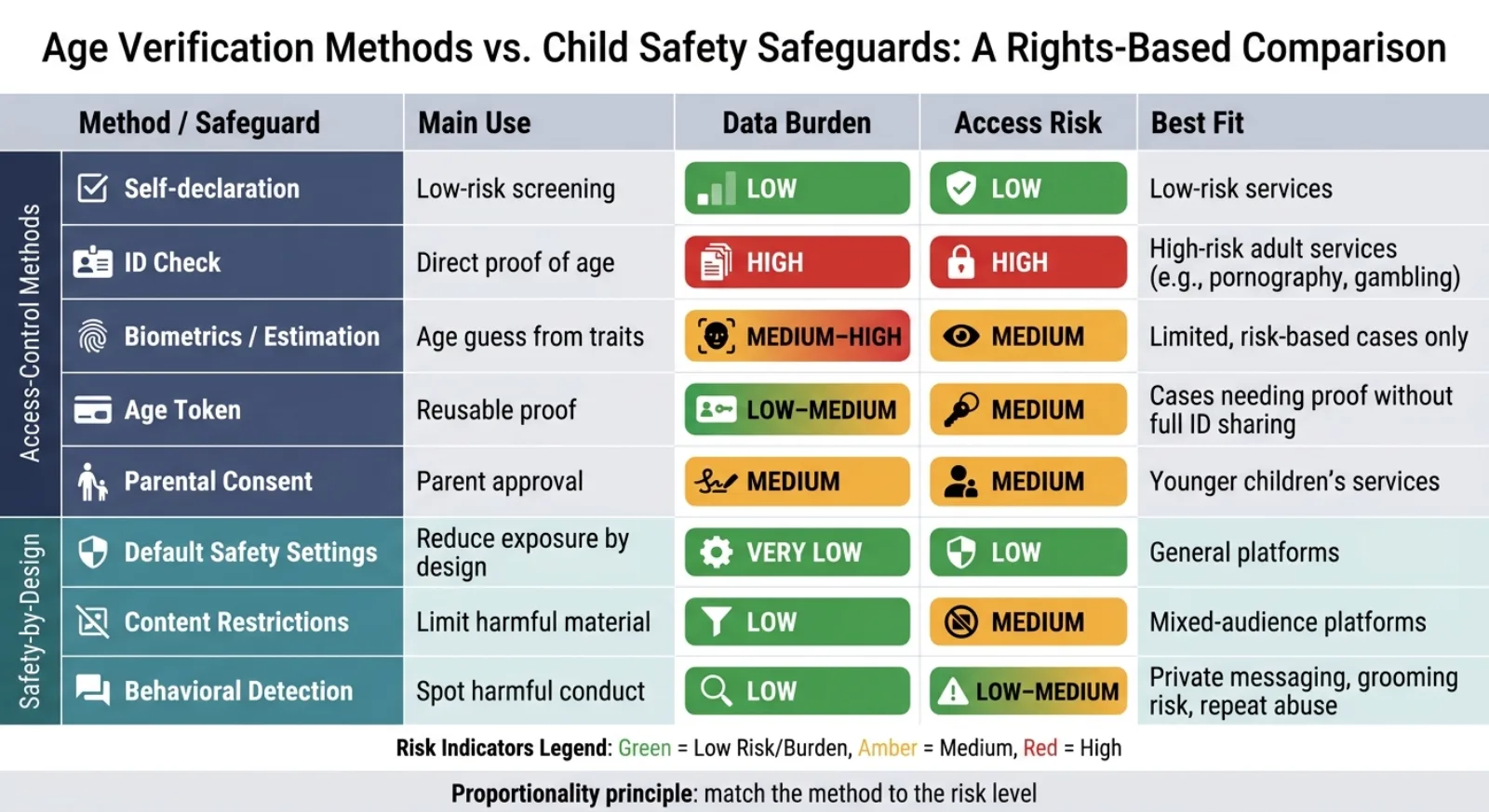
Age Verification Methods vs. Child Safety Safeguards: A Rights-Based Comparison
| Method / safeguard | Main use | Data burden | Access risk | Best fit |
|---|---|---|---|---|
| Self-declaration | Low-risk screening | Low | Low | Low-risk services |
| ID check | Direct proof of age | High | High | High-risk adult services |
| Biometrics / estimation | Age guess from traits | Medium to high | Medium | Limited, risk-based cases |
| Age token | Reusable proof | Low to medium | Medium | Cases needing proof without full ID sharing |
| Parental consent | Parent approval | Medium | Medium | Younger children’s services |
| Default safety settings | Reduce exposure by design | Very low | Low | General platforms |
| Content restrictions | Limit harmful material | Low | Medium | Mixed-audience platforms |
| Behavioral detection | Spot harmful conduct | Low | Low to medium | Private messaging, repeat abuse, grooming risk |
What follows is not just a legal summary. It’s a plain-language case for treating age checks as a child-rights issue, with a focus on what protects children without turning safety into surveillance or overblocking.
Policy and legal context: what U.S. and global rules require platforms to do
United States: COPPA, FTC expectations, and the duty-of-care debate
Those rights-based principles turn into legal tests in U.S. law. In the United States, COPPA and FTC expectations make age assurance more than a product choice. It becomes a question of need, proportionality, accuracy, accessibility, discrimination risk, retention limits, and accountability.
Put simply, a platform can't just say, "we're checking age because it seems like a good idea." It has to show why the check is needed, whether the method goes too far, how well it works, who it may leave out, how long data is kept, and who is responsible if things go wrong.
Global direction: risk mitigation, minors' protections, and proportionality
Across the globe, regulators are moving in the same direction. The basic idea is pretty plain: use the least intrusive method that lowers risk for minors without blocking lawful access or shutting out people who can't get through high-friction checks.
That proportionality test matters because it shapes what platforms can defend in practice. A method may be strong on paper, but if it creates too much burden, collects too much data, or leaves too many people behind, regulators may view it as the wrong fit.
These legal tests determine which age-assurance methods platforms can justify.
Technical methods and rights impacts: what each approach solves and what it can break
Common methods: self-declaration, ID checks, biometrics, and age tokens
That proportionality test stops being abstract the moment a platform picks a method. The core policy issue is simple: does the check fit the risk, and does it protect children without gathering more data than needed [1]?
Each method changes the trade-off between safety, privacy, access, and equality. And sometimes the privacy-first child protection tools work better. A platform dealing with lower-risk activity may not need heavy verification at all. In those cases, extra friction can do more harm than good.
Comparison table: data, accuracy, privacy, accessibility, and discrimination risk
The checklist below shows where each method can help and where it can harm rights. Each criterion connects to a child-rights concern: privacy, access, fairness, or security.
| Criterion | Test |
|---|---|
| Data minimization | Does the system collect only what it needs, and delete it quickly? |
| Accuracy | Is it accurate enough for the harm it is meant to prevent? |
| Privacy and security | Are verification records protected, access-limited, and deleted promptly? |
| Accessibility | Can children with disabilities, low connectivity, or no ID still use the service? |
| Discrimination risk | Does the method create uneven barriers for marginalized children? |
Security and inclusion risks that policymakers often overlook
One risk gets missed all the time: what happens to the data after the check. Some systems delete queries and verification data right after use [2]. That matters. If data sticks around, the rights risk does too.
Policymakers should also test whether a method shuts out children who cannot finish it. That includes children with disabilities, children with weak internet access, and children who do not have formal ID.
These trade-offs shape when verification makes sense and when other safeguards should do more of the work. This includes implementing AI-powered alerts in parent dashboards to monitor risks without requiring invasive identity verification.
Consent, access, and duty of care: when age verification is justified and when other safeguards may work better
The next question isn't whether age checks matter. It's when they make sense.
Parental consent and children's evolving autonomy
Parental consent rules can fit some settings. But forced parental involvement can clash with an older child's growing independence. It can also put kids at risk in sensitive cases like mental health support, identity exploration, or reporting abuse. In those moments, confidentiality is essential [1].
That’s why parental-involvement rules should be set in law and school policy, with clear limits around privacy and autonomy [1].
The same test applies when age checks affect access to lawful help and information.
Access to information versus restrictions on high-risk content
Age verification should be used for high-risk services like pornography and gambling. Broad age gates often drift past that narrow purpose and end up blocking lawful content too, including peer support, mental health resources, and education. That’s a rights issue, not just a usability problem [1].
Comparison table: age verification versus safety-by-design and behavioral detection
Age verification is only one tool. In some cases, the better move is to deal with risk after access, not before it.
| Safeguard | Main Purpose | Child Privacy Impact | Protection Value | Operational Burden | Best Use Case |
|---|---|---|---|---|---|
| Age verification | Restrict access by confirmed age | High - requires identity data | Strong for high-risk content | High - friction, exclusion risk | Pornography and gambling |
| Parental consent controls | Involve parents in access decisions | Medium - may involve shared family data | Moderate for younger children | Medium - consent workflows | Services for younger children |
| Content restrictions | Limit harmful content by default | Low - no identity data needed | Moderate - depends on enforcement | Low - policy and moderation decision | Age-inappropriate content on general platforms |
| Default safety settings | Protect all users through design | Very low - no data collected | Moderate - reduces ambient risk | Low - built into product design | Social platforms, messaging apps, and other general-purpose services |
| Behavioral detection | Detect harmful patterns in real time | Low - focuses on behavior rather than identity | High in high-risk private messaging | Medium - requires AI infrastructure | Private messaging and other high-risk contexts |
Behavioral detection fits private messaging better because it reacts to conduct, not identity.
These trade-offs set up the policy test for the final framework.
Policy brief conclusion: a rights-respecting framework for age assurance
After weighing the methods and their rights tradeoffs, one point stands out: age assurance works best as one part of a broader child-safety system. And the more intrusive the method, the stronger the case for using it has to be.
What a balanced policy should require
A rights-respecting framework should start with data minimization and purpose limitation. In plain English, that means collecting only the data needed to estimate or confirm age, and using it only for that job.
For higher-stakes cases, systems should include human review. Automated tools can handle routine checks, but people should step in when the decision could carry more serious consequences. Age-assurance tools also should not shut out minors who can’t complete the check. Before launch, those systems need testing for discriminatory impacts.
Key takeaways for regulators, platforms, schools, and child-safety teams
Age verification can help protect children in the right setting, but it also brings privacy and access risks. The core idea is proportionality: age checks make the most sense at entry points where access itself creates the risk. By contrast, private, high-risk spaces need safety-by-design measures and behavior-based safeguards that continue after access is granted.
The day-to-day policy question isn’t whether age should be checked everywhere. It’s where that check is worth the privacy tradeoff. That case is weakest in private messaging, where harm develops over time through conversation. In private messaging, abuse unfolds in conversation, so behavior-based detection is the better fit [3][4].
Age assurance and behavioral safety work best side by side. With clear legal guardrails, they can help protect children without weakening privacy or access.
FAQs
When is age verification necessary?
Age verification matters when it serves as a key safety check in online spaces where children can face risks like predatory grooming, sextortion, and exploitation.
It can help set safety boundaries and back up protective steps, especially in places where threats often show up in private messages. Tools like Guardii can add another layer by spotting escalating behavior patterns in real time, instead of leaning only on identity checks.
Why is age verification a weak fit for private messaging?
Age verification is a weak fit for private messaging because it blocks entry without dealing with how online exploitation usually works. Grooming tends to happen over time. It depends on trust-building, emotional pressure, and isolation, and those things can still happen even if an account was checked at the start.
Private messaging also tends to be decentralized and encrypted. That makes the problem harder in a very basic way: grooming unfolds as a behavioral sequence, not a one-time event. So static checks can't catch escalation patterns like secrecy requests or attempts to move the conversation to another platform.
How can platforms protect kids without collecting too much data?
Platforms can help protect children without sweeping up more data than they need.
Instead of broad, invasive monitoring, they can use targeted, behavior-based analysis that looks for signs of risk in a more focused way.
Tools like Guardii do this by analyzing communication patterns in real time. The focus is on context and intent, not excessive metadata, constant scraping, or basic keyword filtering.
That matters because simple keyword filters often miss the point. A harmless message can contain a flagged word, while a dangerous exchange can avoid obvious terms altogether. By looking at behavior patterns instead, platforms can spot high-risk interactions while limiting how much private information they handle.