
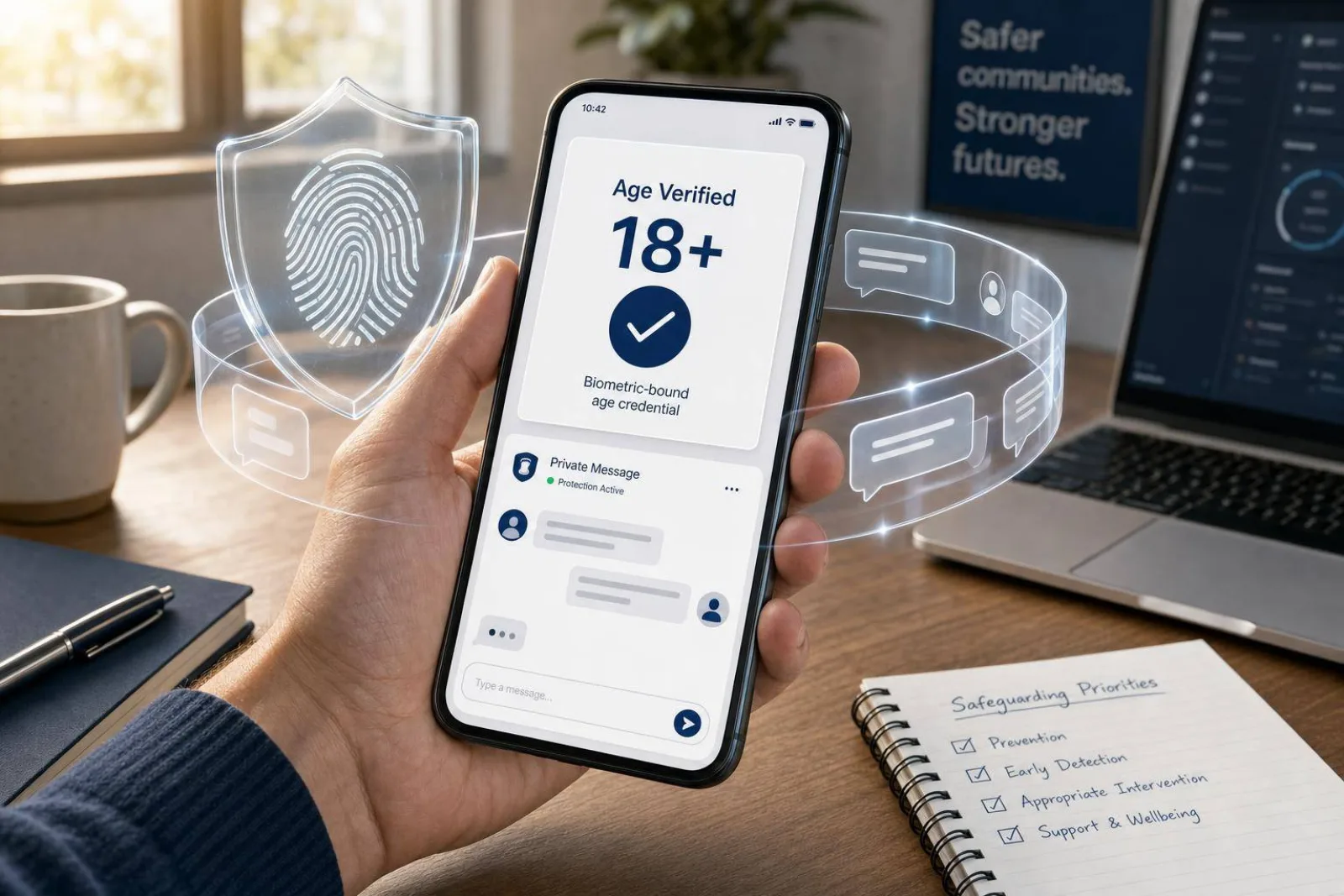
Study Summary: Biometric-Bound Age Credentials
I’d sum the study up like this: biometric-bound age credentials are a check at the door. They can tie an age claim to the person using the device, share only a simple age result like “over 13” or “over 18,” and cut the amount of personal data a platform receives. But they do not stop grooming, coercion, or abuse after access is granted.
If you only need the core points, here they are:
- What it does: links an age credential to a face scan or fingerprint on the user’s device
- What the platform sees: a threshold result, not a full birth date or ID
- What it helps with: lower data exposure and harder-to-fake sign-up checks
- What it does not solve: private-message abuse, live-chat harm, or all fraud paths
- What still matters: guardian consent records, data deletion, and behavior monitoring after entry
- What the study does not prove: firm results on replay attacks, liveness, or device-sharing defenses
A simple way to think about it: age proof answers “can this account enter?” Consent answers “did a parent or guardian approve?” Safety systems answer “what happens after the user gets in?”
Compared with ID uploads or self-reported birthdays, biometric-bound age proof gives a platform less personal data while offering a stronger sign-up check. The tradeoff is added setup friction, biometric error risk, device access limits, and the fact that a good onboarding check still leaves a large part of the safety job unfinished.
So my takeaway is plain: use biometric-bound age credentials as one layer, not the whole plan. For U.S. platforms, schools, and compliance teams, the study points to a stack that combines age checks, consent records, privacy controls, and post-access behavior review.
Introducing Incode On-Device Age Estimation
sbb-itb-47c24b3
How Biometric-Bound Age Credentials Work
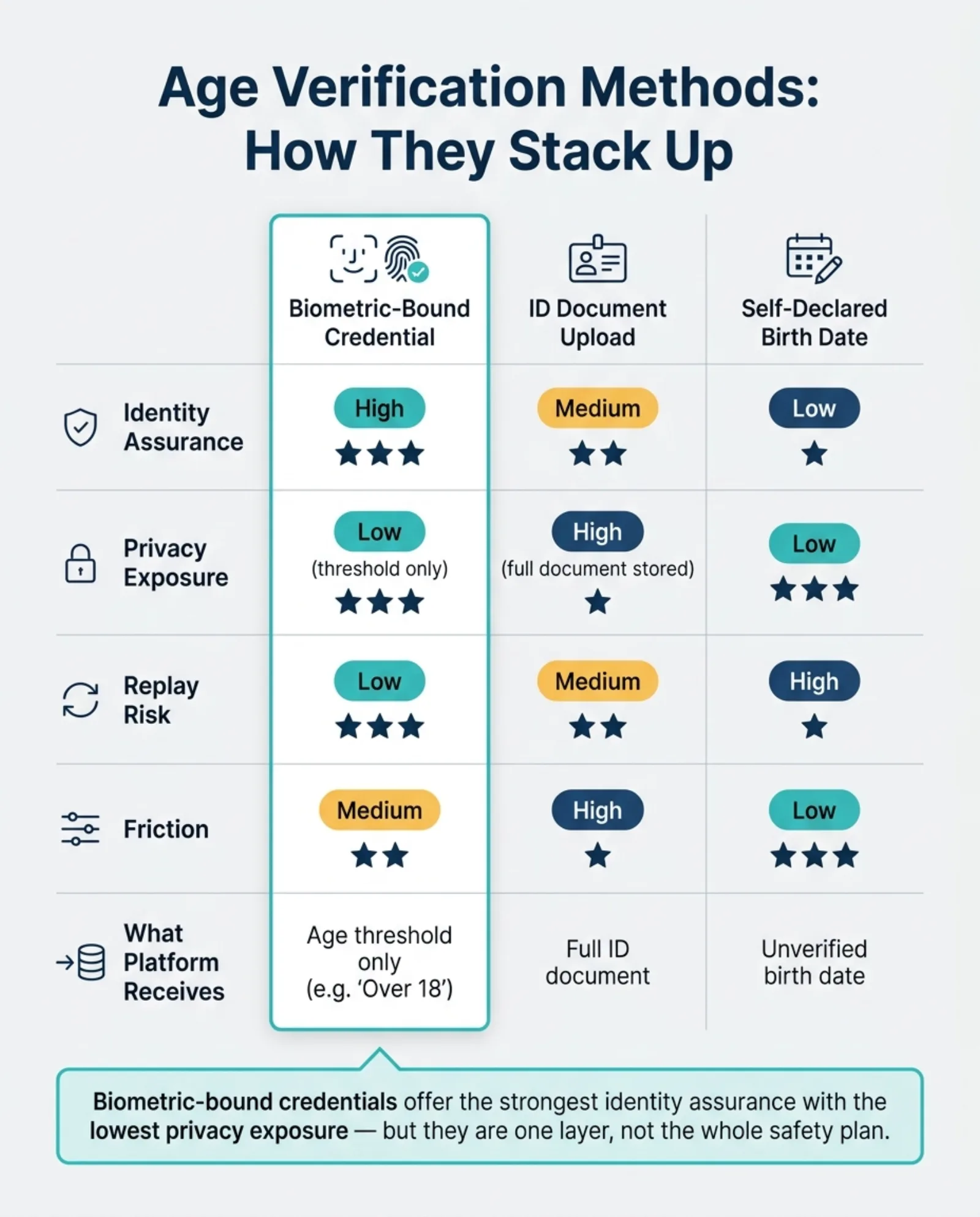
Biometric-Bound Age Credentials vs. ID Upload vs. Self-Declared Birthday
Within the age-assurance stack, biometric binding links a verified age claim to the person presenting it.
Credential Issuance, Wallet Storage, and Biometric Binding
A trusted issuer - such as a government identity authority or accredited verification provider - checks an applicant's identity documents and issues a signed digital credential showing that the holder meets a set age threshold. That credential is stored in a wallet on the user's device, where it is cryptographically locked to a biometric sample, usually a facial scan or fingerprint captured at issuance.
When the user presents the credential, the device checks the biometric locally before releasing the proof. That local check helps make sure the person holding the device is the same person who enrolled in the first place.
This is only one control layer. It supports broader platform protections, but it does not replace them. This approach is most effective when integrated into interoperable age verification systems that allow for consistent safety standards across different services.
Privacy-Preserving Proofs: Confirming Age Thresholds Without Disclosing a Full Birth Date
Instead of sending a full birth date or identity document, the credential system generates a zero-knowledge or selective-disclosure proof - a cryptographic statement that the holder is above a given age threshold, and nothing more. In plain English, the platform gets a yes-or-no answer like "over 13" or "over 18" without seeing the user's exact date of birth, name, or document number.
That matters for privacy. If a platform only gets the answer it needs, it has less personal data sitting on its systems. Privacy-preserving proofs should store no extra data and should purge queries automatically, which limits platform exposure if a data breach happens.
Comparison Table: Biometric-Bound Credentials vs. ID Upload vs. Self-Declared Birth Date
| Method | Identity Assurance | Privacy Exposure | Replay Risk | Friction |
|---|---|---|---|---|
| Biometric-bound credential | High | Low (threshold only) | Low | Medium |
| ID document upload | Medium | High (full document stored) | Medium | High |
| Self-declared birth date | Low | Low | High | Low |
The next issue is whether that proof can be reused, shared, or replayed.
Replay Risk, Device Binding, and Session Security
The next issue is simpler than it sounds: can a credential be copied, replayed, or passed around to another device?
Based on the source set, there isn’t support for firm claims about replay attacks, device binding, liveness checks, or head-to-head security results in age-verification flows. So if someone wants a clean answer here, the honest one is: the sources don’t give it.
Replay resistance, device binding, and liveness checks stay in the bucket of implementation choices outside this source set. In practice, that shifts attention to consent design as the next control point.
Session security then sits in its own lane. It matters, of course, but it is a separate control layer and not proof of age itself.
Consent Flow Design and Regulatory Fit for Minors
Once age is verified, addressing biometric age verification privacy concerns is the next step before getting guardian consent without asking for extra data the law doesn’t call for.
Linking Parent or Guardian Verification to Child Accounts
A simple way to handle this is to use an existing third-party account or phone verification to confirm guardian consent without collecting payment data [1]. That keeps the process easier for families and still leaves a record of consent.
It helps to think of this as two separate checks. Age proof answers eligibility. Consent records answer permission. Those are related, but they do different jobs.
Designing Low-Friction Consent Flows Without Dark Patterns
Good consent flows spell out each data-use purpose in plain language. That includes things like device information access, personalized content selection, and performance measurement, so users can see what they’re agreeing to [2].
Just as important: the platform needs a clear record of those choices. It can keep consent records through machine-readable consent signals shared with partners, which helps enforce user choices without sharing full user profiles [2]. Add automatic data deletion when retention periods expire, and the system is easier to review later.
Comparison Table: Self-Attestation, Parent-Bound Credential, and Biometric-Bound Age Proof
These approaches mainly differ in who gets verified and how much proof the platform keeps.
| Method | Who Is Verified | Data Collected | Auditability | Friction |
|---|---|---|---|---|
| Self-attestation | User (unverified) | Minimal | Low | Low |
| Parent-bound credential | Guardian (verified) | Moderate | Medium | Medium |
| Biometric-bound age proof | User (biometrically confirmed) | Threshold only | High | Medium |
The main tradeoff here is simple: less data versus stronger auditability. For minors, the aim is a low-friction consent path that is auditable, keeps data collection lean, and stays separate from the age credential.
Limits of Biometric-Bound Age Credentials and Where They Fit in a Broader Safety Stack
Biometric binding can make onboarding tougher to game, but it doesn't seal the whole safety gap.
Known Limitations: Exclusion Risk, Biometric Error, Circumvention, and Coverage Gaps
Biometric-bound credentials can cut fraud, but they're not foolproof. They can still break down because of false rejects, false accepts, limited device access, and credential sharing. And those weak spots hit hardest in private messaging and live chat, where abuse can ramp up after someone is already inside.
That's why post-access monitoring matters just as much as entry checks.
Why Age Assurance Must Be Paired With Ongoing Behavioral Protection
Once access is granted, biometric credentials don't stop grooming, coercion, or harassment in private messaging and live chat. They help confirm who gets in. They do not control what happens next.
Behavioral detection tools operate at that next layer. They flag grooming patterns, coercion, and escalation in private messages.
Key Takeaways for U.S. Platform, School, and Compliance Leaders
For U.S. platform, school, and compliance leaders, the takeaway is simple: age proof helps at onboarding, but ongoing behavioral protection is still required.
Think of it as a layered model:
- Verify entry
- Monitor behavior
FAQs
How is biometric data stored?
Biometric data is stored in secure systems built to protect sensitive information while still supporting continuity and context-aware analysis.
Some platforms also use tamper-evident data packages to preserve an audit trail and, when needed, a chain of custody for evidence, all under clear data protection guidelines.
Can kids bypass the age check?
Sometimes. Biometric-bound age credentials can make age checks more accurate because they tie verification to a person and, in many cases, a device. That can make it harder to fake an age check with a simple checkbox or a borrowed date of birth.
But they’re not foolproof.
Kids may still get around them by using an adult’s account or slipping past platform controls in other ways. And that’s the key issue: an age check can help, but it doesn’t stop every form of misuse on its own.
Tools like Guardii add another layer by spotting signs of exploitation, grooming, and abuse even when age checks fail or get bypassed.
What should platforms add after age verification?
After age checks, platforms should add continuous, context-aware monitoring to help protect users from predatory behavior that begins after onboarding.
That matters because risk doesn’t stop once someone gets through sign-up. In many cases, the problem starts later, inside chats, DMs, or private exchanges that shift over time.
This monitoring should spot behavior patterns in real time, such as:
- requests for secrecy
- platform migration
- information extraction
For youth-facing platforms, an opt-in protective layer can add another line of defense. Tamper-evident records can also support safety and oversight, especially when teams need a clear trail of what happened and when.