
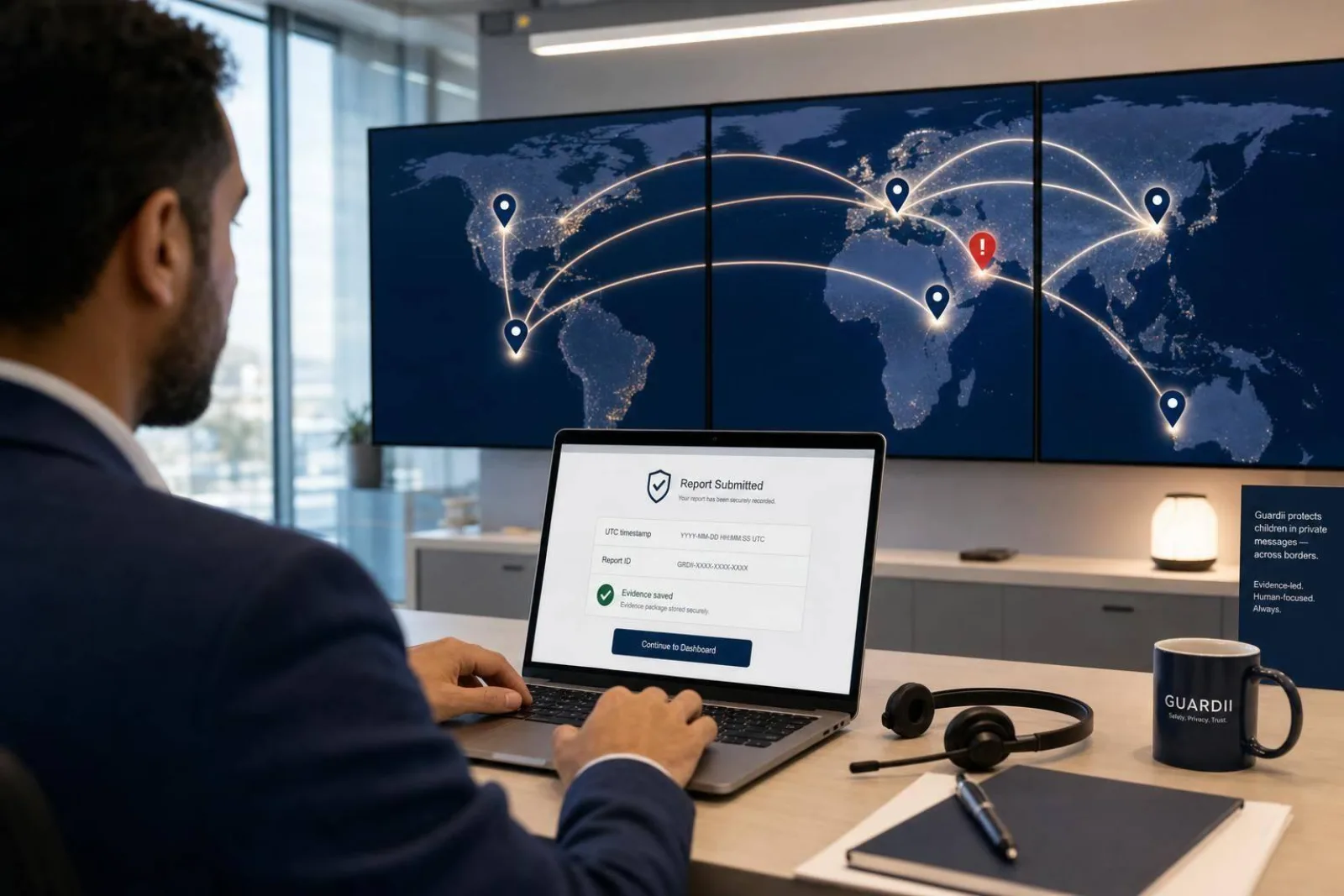
Reporting Child Exploitation Across Borders: Guide
If a child may be at risk, I report in parallel right away: 911 for immediate danger, the NCMEC CyberTipline, and the platform itself. That one move can cut delays, help keep account records in place, and give law enforcement a better shot at tracing a case that crosses countries.
Here’s the short version:
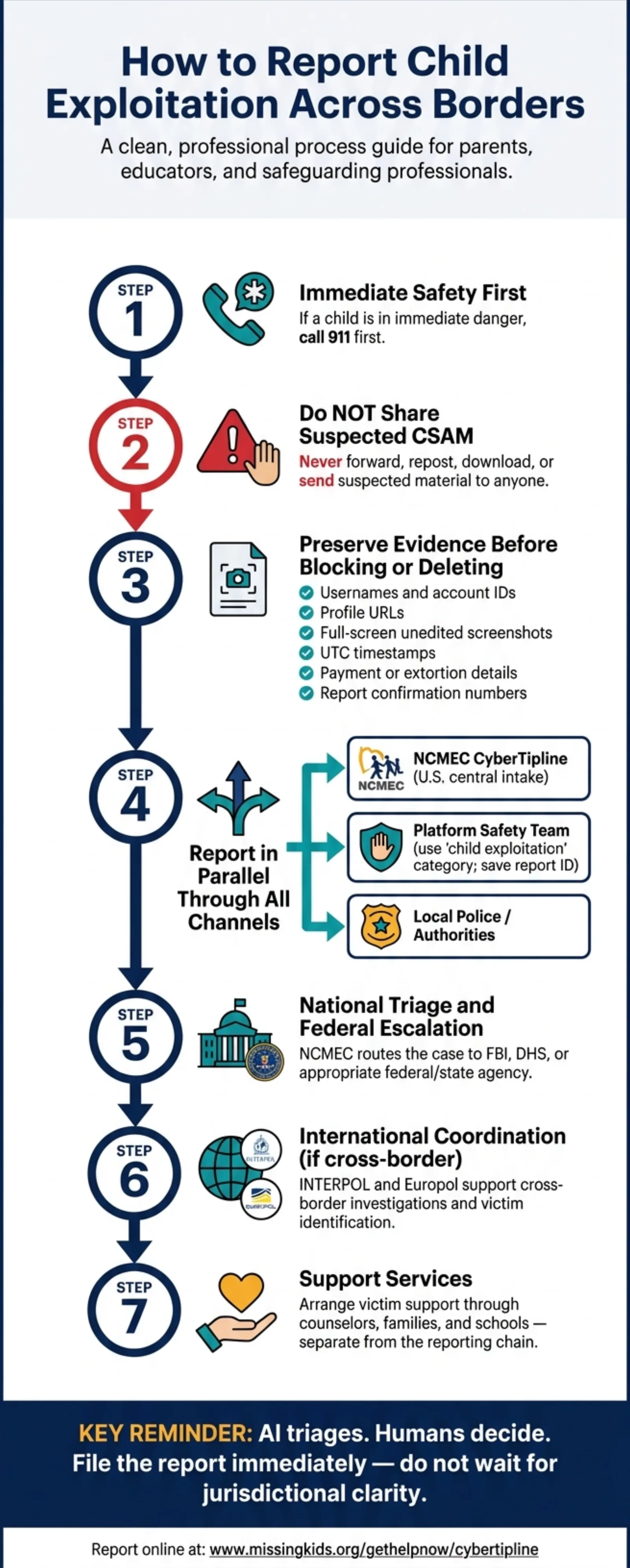
- Safety comes first. If there is immediate physical danger, call 911.
- I don’t share suspected CSAM. I never forward, repost, or send it to anyone.
- I save proof before blocking or deleting anything. That means usernames, profile links, full-screen screenshots, timestamps, and report IDs.
- I don’t wait for jurisdiction questions. Cross-border cases often involve a child in one place, an offender in another, and a platform based somewhere else.
- AI can help sort reports, not decide guilt. It can flag grooming, sextortion, and off-platform moves for human review. Recognizing warning signs of online predators is the first step in prevention.
A few facts matter here. Major platforms send many child-exploitation reports through NCMEC, and cross-border cases often involve multiple devices, accounts, time zones, and agencies. That is why evidence like UTC time, account IDs, and payment details can matter so much.
What I take from this guide is simple: protect the child, preserve the evidence, and report through every fast channel at the same time. After that, local police, federal units, platforms, and groups like INTERPOL or Europol can route the case where it needs to go.
How to Report Child Exploitation Across Borders: Step-by-Step Guide
How to Report
Understanding the behavioural data behind exploitation can help you identify what evidence is most critical to preserve for law enforcement.
sbb-itb-47c24b3
Who Should Report and Which Channels Handle the Case
Once the child is safe, the next move is simple: figure out who can report the case right now, and through which channel.
Victims, Families, Schools, and Safeguarding Leads
Parents and caregivers should report the case right away to the platform and to local authorities or a child protection hotline. In schools, designated safeguarding leads (DSLs) should send the case through internal safeguarding escalation channels [2].
That said, schools shouldn't be the only route [3]. Kids often switch between school-issued devices, home phones, and temporary networks. A case can touch more than one device, more than one account, and more than one location, fast.
Law Enforcement, Hotlines, and Platforms
Local police deal with immediate safety issues and local investigations. They can also move cases up to state or federal cyber units when needed. For online exploitation and CSAM, the NCMEC CyberTipline is the main U.S. intake point. NCMEC then refers cases to the FBI, DHS, and other agencies that fit the case [4].
If you're reporting inside an app or platform, pick the child exploitation or abuse category so the report lands with the right team [4]. Also, save the platform report ID. That small detail matters. Law enforcement may need it later to ask for data preservation or account records.
INTERPOL, Europol, and Other Cross-Border Agencies
After local and federal channels are involved, agencies such as INTERPOL and Europol can help when the offender, victim, or platform setup stretches across borders [2]. They help local investigators identify victims and share intelligence across countries after the first report has already been made.
Here’s how each channel fits into a cross-border case:
| Channel | Role | Use |
|---|---|---|
| Local Police | Immediate safety and local investigation | Can refer cases to state or federal cyber units |
| NCMEC CyberTipline | Central U.S. intake for online child exploitation reports | Triages and refers to federal or local agencies |
| Platform Safety Teams | Account review, removal, and preservation requests | Use in-app child exploitation categories; platforms also report CSAM to NCMEC |
| FBI / DHS | Federal investigation | Receive referrals from NCMEC |
| INTERPOL / Europol | Cross-border intelligence and victim identification | Support investigations across jurisdictions |
| Schools / DSLs | Student safeguarding | Use internal safeguarding escalation channels to route reports |
Once the right channels are notified, the next step is preserving the strongest evidence without changing it.
What Evidence Matters and How to Preserve It Safely
Once reports are filed, the next step is simple: keep the evidence as it is.
That matters even more in cross-border cases, where people in different places may need to review the same material and line it up with other reports.
High-Value Evidence for Cross-Border Cases
Start with the basics from the profile itself. Copy usernames, account IDs, and profile URLs directly from the profile page. Save full-screen screenshots that show the platform interface and the surrounding context, not just a small cropped image. Record timestamps in both local time and UTC. If money is involved, capture the amount, currency, and payment details. And save every report confirmation number.
Why does this matter? Because this kind of evidence gives investigators a way to compare reports across borders.[1][2]
Safe Handling, Chain of Custody, and What to Avoid
Preserve evidence exactly as found. Do not crop, annotate, or re-save screenshots. Edited images can be challenged as tampered evidence, and that can create problems later.
There’s another line you should not cross: do not forward or download suspected CSAM under any circumstances. Possessing or redistributing that material carries legal risk. Instead, report the URL or the in-app location through the platform’s official reporting tools.
It also helps to keep a short log with:
- who collected the evidence
- what device was used
- when it was saved
That chain-of-custody record matters in international prosecutions, where digital evidence fits cross-jurisdictional frameworks to stand up across different legal systems.
| Evidence Type | Investigative Value | Key Risk | Who Should Handle |
|---|---|---|---|
| Full-screen screenshots (unedited) | High - shows platform UI, context, and timestamps | Cropping or annotating destroys integrity | Victim, family, institution |
| Profile URLs and account IDs | High - direct digital identifier for the account owner or suspect | Typing errors can lead to the wrong profile | Anyone reporting |
| UTC timestamps | High - essential for cross-border coordination | Missing time zone context causes confusion | Anyone reporting |
| Payment or extortion details | High - establishes financial motive and money trail | Contains sensitive financial data | Anyone reporting |
| Suspected CSAM (links/location only) | High for law enforcement | Extreme - illegal to download, possess, or forward | Law enforcement only |
The same evidence can also feed risk scoring and pattern detection in private-message systems. This data is often used by AI to detect grooming behavior online and flag potential threats.
How AI Risk Scores Help Triage, Detect Patterns, and Support Reporting
What a Risk Score Means in Child Safety Work
Once evidence is preserved, AI can help sort which conversations need review first.
A risk score is a priority signal, not proof. It estimates the chance that a conversation includes grooming, sextortion, coercion, or signs of escalation. In practice, it helps reviewers focus on the cases that may need immediate attention.
In child safety work, a good score looks at behavior over time. Does the conversation start with compliments, then move to questions about the child’s age, offers of gifts or money, pressure to move off-platform, demands for secrecy, and then coercion? That sequence matters much more than any one word. A score that fires on a single flagged phrase is easy to dodge. A score that follows the shape of a conversation across many exchanges is much harder to dodge.
Plain-language explanations matter. A school safeguarding lead, a parent, or an investigator handling a cross-border case needs to see what behavior triggered the alert and what action it should prompt. Common safeguards include human review, audit logs, and false-positive monitoring across languages and slang.
| Use case | How to use the risk score | What not to do |
|---|---|---|
| Platform moderation | Route to trained trust and safety staff for review | Auto-ban without human confirmation |
| School safeguarding | Trigger a safeguarding lead review and preserve evidence | Treat the score as proof of abuse |
| Investigator workflow | Triage urgency, assemble evidence, coordinate across jurisdictions | Use the score alone as probable cause |
Behavioral Detection in Private Messages
online grooming and sextortion often begin in direct messages, not public feeds. That’s one big reason private messages are so hard to police with standard moderation tools.
Behavioral systems look for escalation patterns in direct messages, not just single keywords.
That matters because predators rarely rely on one obvious phrase. More often, they use a pattern: slow trust-building, quiet questions about age, offers of gifts or money, and a gradual move toward coercion. Those patterns can carry across translation, slang, code-switching, and transliterated text. Behavioral AI systems trained on grooming progression and sextortion escalation can follow those arcs across languages and dialects, which makes them more useful in cross-border cases.
Evidence packages and audit trails also help. They preserve what a reviewer found without exposing the full message feed any more than needed. The point is to report the pattern, not dump an entire transcript into every alert.
How AI-Assisted Systems Help in Cross-Border Cases
In cross-border cases, the same score can help send urgent alerts to the right team faster.
These cases create volume fast. Reports may arrive in different systems, in different languages, and with very different urgency levels. Manual triage at that scale is slow and uneven.
AI-assisted systems help with the intake work: scoring conversations, flagging escalation sequences, and assembling structured evidence packages before a human reviewer even opens the case. That gives investigators more time for the cases that need close attention, and it helps urgent cross-border referrals reach the right unit sooner. Behavioral systems are stronger for private-message triage, escalation detection, and structured evidence packaging.
AI triages; humans decide. Use the score to prioritize referrals, preservation requests, and jurisdiction routing.
Next Steps After Reporting: Coordination, Legal Frameworks, and Key Takeaways
From First Report to International Coordination
Filing a report is the start, not the end. Once that first report goes in, the case usually moves through several channels at once.
| Response Stage | Responsible Actor | Key Actions |
|---|---|---|
| Immediate Action | Victim / Parent / Guardian | Secure accounts without deleting anything |
| Local Escalation | Local Police / School Officials | File a police report; notify the school if the child is a student |
| National Triage | NCMEC / CyberTipline | Submit the report to the CyberTipline; NCMEC reviews and routes leads to the appropriate federal, state, or local agency |
| Platform Action | Trust & Safety Teams | Remove content and suspend accounts; route reports to NCMEC where appropriate |
| International Referral | INTERPOL / Europol | Share leads across national cyber units |
| Support Services | Families / Counselors / Schools | Provide victim support separately from the reporting chain |
What happens next depends on a few practical things: the country involved, the platform, and the evidence saved at intake. That’s why the first steps matter so much. If the evidence is there and the report gets to the right place fast, agencies can move sooner.
Legal and Policy Frameworks That Shape Cross-Border Reporting
In the U.S., two rules shape what happens after intake: who gets the report and how platforms respond.
NCMEC is the main clearinghouse for online child-exploitation reports from major platforms [4]. Once AI flags a pattern, people still make the next call. Human reviewers and agencies decide where the report goes, which unit leads, which jurisdiction files charges, and which international body handles cross-border coordination.
That point matters. AI can help sort and prioritize incoming reports, but it does not make the final call on action, charges, or jurisdiction.
Conclusion: The Short List to Remember
After a report is filed, speed and routing matter more than having perfect jurisdictional clarity. The short list is pretty simple:
- Act quickly if a child may be at risk.
- Report to the platform and to authorities at the same time.
- Preserve evidence before you block or delete anything.
- AI risk scoring helps triage and prioritize, but it doesn't replace a human decision. Use it to route cases faster, not to close them automatically.
- Do not wait to resolve jurisdiction; file the report immediately and let agencies route it.
The system works best when reports come in early. Every layer - hotlines, platforms, national agencies, and international bodies - relies on someone making that first report. Cross-border complexity shouldn't be the thing that stops it.
FAQs
What if I don’t know which country has jurisdiction?
If jurisdiction is unclear, focus on preserving strong evidence instead of trying to sort out legal authority on your own. The agencies that handle cross-border cases will work out the right jurisdiction from the details you provide.
Save the full conversation history. Tools like Guardii can help keep the thread intact and turn it into a structured evidence pack, including the context and behavior escalation patterns law enforcement may need for coordination.
Can I report anonymously?
It depends on the platform or agency, because reporting rules aren't the same across the board. Many major messaging platforms let you report harassment, scams, or child exploitation. But they don't all handle a reporter's identity the same way.
Law enforcement or child safety groups may let you file a report without giving your name. That said, sharing contact details can help if they need to confirm facts or ask follow-up questions. Check the reporting guidelines before you submit.
What happens after I file the reports?
After you file the reports, the platform or reporting route keeps the key communications on record as evidence. It then moves the case forward based on severity, evidentiary value, and the jurisdictions involved.
Guardii’s workflow can package that material into a tamper-evident, prosecution-ready bundle with an audit trail. From there, it can send the case to the designated authority, with a human decision-maker involved at the point of decision.